
Bitcoin's Diverging Dynamics: Short-Term Pain vs. Long-Term Resilience
The BitcoinBTC-- market in 2025 is increasingly defined by a stark divergence between short-term and long-term holder behavior, shaping liquidity, price resilience, and order book dynamics in ways that reflect both immediate pain and enduring structural strength. As the asset matures, these diverging trajectories offer critical insights for investors navigating a landscape where volatility and institutional adoption coexist.
Short-Term Pain: A Flight to Liquidity
Short-term holders have emerged as a destabilizing force in recent months, with 29,400 BTC moved to exchanges at a loss in November 2025 alone. This activity, driven by leveraged traders and speculative positions, has exacerbated downward pressure on Bitcoin's price, particularly as the asset tests critical support levels like $94,000 and $87,000. The sell-off in mid-2025-nearly a 30% drop from October peaks-exposed the fragility of liquidity during periods of extreme valuation, with order books thinning and price swings intensifying.
This behavior mirrors historical patterns observed during market corrections, where short-term holders often act as amplifiers of volatility. For instance, during the 2022 bear market, similar outflows from speculative accounts preceded prolonged bearish phases. The current wave of short-term selling suggests a market still grappling with the psychological aftermath of the 2024 bull run, where rapid profit-taking and margin calls create a self-fulfilling cycle of panic.
Long-Term Resilience: A Staggered Distribution Strategy
In contrast, long-term holders-particularly those with wallets aged seven years or older-have adopted a measured approach to profit-taking. Over the past month, 815,000 BTC has been distributed, marking the highest level since January 2024. Crucially, these transactions are characterized by regular, spaced-out sales, indicating a staggered distribution strategy rather than panic selling. This behavior aligns with historical bull cycles, where long-term holders systematically offload positions during overvaluation while maintaining a floor for price stability.
The resilience of long-term holders is further underscored by on-chain data: net profits for Bitcoin holders reached $3.0 billion on November 7, 2025, with minimal realized losses. This suggests a holder base that remains fundamentally bullish, even as short-term pain persists. Institutional investors, too, are reinforcing this trend. The Abu Dhabi Investment Council tripled its stake in BlackRock's iShares Bitcoin Trust during Q3 2025, signaling confidence in Bitcoin's role as a long-term digital gold allocation.
Market Structure Implications: Liquidity and Order Book Dynamics
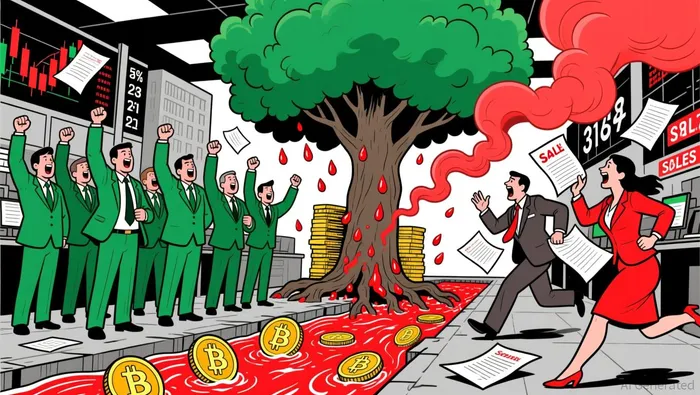 The interplay between these holder behaviors has profound implications for Bitcoin's market structure. Short-term volatility, driven by speculative outflows, creates liquidity imbalances that make the order book more susceptible to dramatic price swings. Conversely, long-term holders act as a stabilizing force, providing depth to the order book during periods of uncertainty. This duality is evident in the Bitcoin 1+ Year HODL Wave metric, which historically declines during bull markets (as holders take profits) and rebounds during bear markets (as they accumulate).
The broader market context also reveals Bitcoin's evolving role as a global liquidity barometer. During the post-COVID-19 period, its price stability-despite macroeconomic turbulence-demonstrated the confidence long-term holders instill in the asset's long-term viability. This dynamic is likely to persist as institutional adoption grows, with sovereign wealth funds and pension funds increasingly viewing Bitcoin as a strategic diversification tool.
Strategic Implications for Investors
For investors, the diverging dynamics between short-term and long-term holders highlight the importance of aligning strategies with Bitcoin's structural evolution. Short-term traders must contend with the risks of leveraged positions and liquidity crunches, while long-term investors are rewarded by the asset's inherent resilience. The current market environment-where whale activity is methodical and institutional allocations are expanding-suggests that Bitcoin's price floor is being reinforced by a base of patient capital.
However, the path forward remains contingent on key support levels. Analysts like Ki Young Ju and Alex Adler caution that a break below $87,000 could trigger further short-term selling, but emphasize that long-term holders are unlikely to panic. This duality-pain in the short term, resilience in the long term-defines Bitcoin's 2025 narrative, offering both challenges and opportunities for those who understand its underlying mechanics.






Comentarios
Aún no hay comentarios