
Bitcoin's Disbelief Phase: A Behavioral Finance Perspective on the Road to Recovery
Bitcoin's price history is a masterclass in behavioral finance, where psychological cycles of fear, greed, and disbelief repeatedly shape market outcomes. As of October 2025, the cryptocurrency is navigating a "disbelief phase," a critical juncture in its four-year cycle that historically precedes sharp recoveries. This phase, characterized by bearish sentiment and short-term pessimism, offers a unique lens to analyze how trader psychology and sentiment metrics interact with price dynamics to drive market reversals.
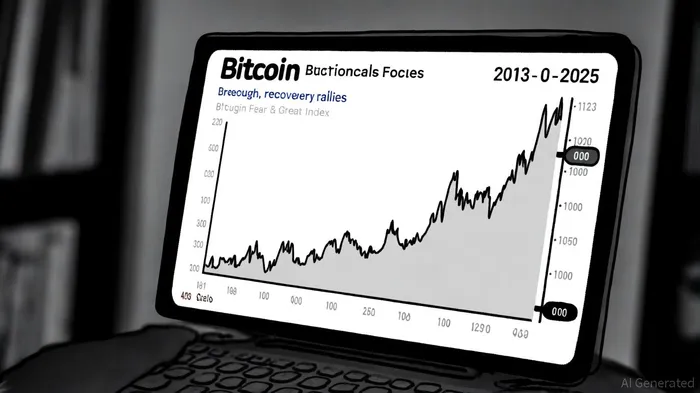
The Anatomy of Bitcoin's Price Cycles
Bitcoin's price cycles follow a predictable pattern of accumulation, growth, euphoria, and correction, with halving events acting as catalysts for scarcity-driven demand, according to HyroTrader's guide. The disbelief phase emerges during the late stages of a bear market, when traders short BitcoinBTC-- despite a rising price, creating conditions for a short squeeze, as noted in an FXEmpire forecast. For example, in April 2025, Bitcoin surged from $54,000 to over $100,000 amid heavy short positions between $113K and $127K, triggering a $1 billion liquidation event, according to a Cryptocurrency News report. This mirrors the 2021 short squeeze, where institutional buying and retail FOMO (fear of missing out) drove a 150% rally in under six months, as detailed in the OANDA timeline.
Historical data reveals that Bitcoin's price often bottoms when sentiment reaches extreme fear levels. The Bitcoin Fear & Greed Index, which measures market psychology on a 0–100 scale, frequently dips below 25 during disbelief phases. In May 2025, the index hit 15/100 following regulatory uncertainty, only to rebound sharply as institutional buyers entered the market, according to a BTCReads analysis. Such patterns suggest that periods of extreme pessimism-when traders dismiss Bitcoin's long-term value-often precede significant rebounds.
Behavioral Finance and Trader Psychology
Bitcoin's volatility is deeply rooted in cognitive biases and herd behavior. During disbelief phases, traders exhibit anchoring (fixating on past price levels) and loss aversion (prioritizing avoiding losses over gains), leading to panic selling, as shown in a ResearchGate study. Conversely, recovery rallies are fueled by confirmation bias, where bullish narratives gain traction as prices rise. For instance, the 2024 halving event saw retail traders overreact to short-term price spikes, only to face liquidations when sentiment reversed, according to a Medium analysis.
Academic studies reinforce these dynamics. A 2023 NCBI paper analyzing Bitcointalk forum sentiment found that negative sentiment during bear markets correlates with a 70–85% retracement of prior gains, while positive sentiment during recovery phases amplifies buying pressure. Similarly, machine learning models using sentiment data from social media and search trends have achieved 85% accuracy in predicting Bitcoin's price direction during disbelief-to-recovery transitions, as reported in a ResearchGate study.
Case Studies: Disbelief Phases and Recovery Rallies
- 2018–2019 Disbelief Phase: After Bitcoin's 80% drawdown in late 2018, the Fear & Greed Index hit 10/100 in early 2019. Long-term investors began accumulating at discounted prices, and by late 2019, Bitcoin had rebounded to $10,738, according to a DemandSage analysis.
- 2022–2024 Disbelief Phase: Following the 2022 crash to $16,547.50, prolonged negative funding rates signaled a potential upside move. By late 2024, Bitcoin surged to $96,461.34, driven by institutional adoption and spot ETF approvals, as discussed in a BitFinance post.
- 2025 Disbelief Phase: As of October 2025, Bitcoin is trading at $67,500, with altcoins in a "depression phase." Analysts like Michaël van de Poppe note that this psychological state historically precedes a 20–30% price rebound, according to a Blockchain.News piece.
The Road Ahead: Sentiment, Funding Rates, and Institutional Catalysts
Bitcoin's current disbelief phase is amplified by macroeconomic factors, including U.S. regulatory clarity and the potential for a U.S. Bitcoin reserve, as outlined in an Investopedia overview. Prolonged negative funding rates-where short sellers pay fees to longs-suggest that the market is nearing a turning point (an observation echoed by FXEmpire). Additionally, on-chain metrics like the Cost Basis Comparison (CBC) and Cumulative Value Days Destroyed (CVDD) indicate that the market is near a cycle bottom, a point also highlighted in HyroTrader's guide.
Institutional participation further strengthens the case for a recovery. The approval of spot Bitcoin ETFs in 2024 and 2025 has normalized Bitcoin as a portfolio asset, reducing the likelihood of extreme corrections, according to a Fidelity Insights article. As retail and institutional investors realign their strategies with Bitcoin's four-year cycle, the stage is set for a rally that could extend into 2026.
Conclusion
Bitcoin's disbelief phase is not a sign of terminal bearishness but a psychological checkpoint in its cyclical journey. By analyzing historical price patterns, sentiment metrics, and behavioral biases, investors can navigate this phase with a disciplined approach. The interplay between fear-driven selling and eventual optimism-driven by scarcity, institutional adoption, and sentiment shifts-suggests that Bitcoin's next leg higher is not a question of if, but when.






Comentarios
Aún no hay comentarios