
Bitcoin Dips, But Quickly Recovers as U.S. Captures Venezuela's Maduro
U.S. President Donald Trump announced on Saturday that the United States has carried out a large-scale strike on Venezuela and captured its leader, President Nicolás Maduro, along with his wife. The operation was conducted in conjunction with U.S. law enforcement and involved the U.S. Army’s Delta Force according to reports. Trump stated that Maduro and his wife had been removed from the country and would face criminal charges in New York according to a report.
The strike was the first known U.S. military operation on Venezuelan soil and marks a significant escalation in the Trump administration’s pressure campaign against Maduro’s government. The U.S. has been targeting alleged drug trafficking operations and has imposed sanctions on oil tankers linked to Venezuela’s oil exports according to analysts. 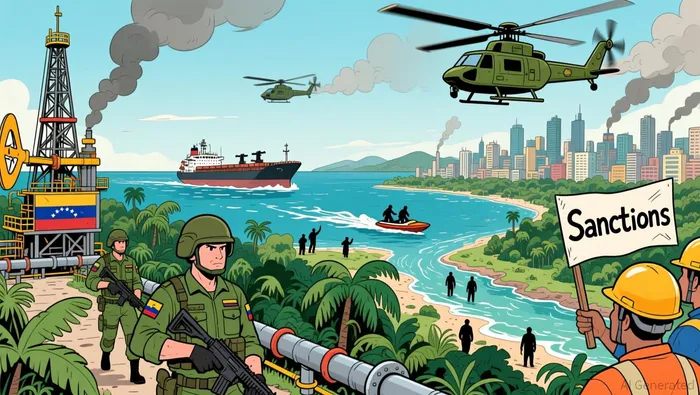 The capture of Maduro was confirmed by U.S. Attorney General Pam Bondi, who said the pair would face indictment in the Southern District of New York according to official statements.
Venezuela’s government rejected the military aggression and declared a state of national emergency according to official sources. President Maduro, who has been in power since 2013, has long been accused by the U.S. of orchestrating drug trafficking and has faced international condemnation for his government’s alleged election fraud according to U.S. intelligence reports. The U.S. has recognized opposition candidate Edmundo González as the rightful winner of the 2024 election according to official statements.
Why Did This Happen?
The U.S. has been engaging in a months-long campaign to disrupt drug trafficking and destabilize Maduro’s regime according to analysis. This includes a massive military buildup in the Caribbean, airstrikes on alleged drug-smuggling boats, and a blockade of sanctioned oil tankers according to intelligence reports. Maduro has been under indictment since 2020 for narcoterrorism and drug trafficking according to court documents.
The U.S. Department of Treasury has added multiple companies and vessels tied to Venezuela’s oil industry to its sanctions list according to official announcements. Trump has also publicly authorized the CIA to conduct covert operations in Venezuela.
How Did Markets React?
Crypto markets, including BitcoinBTC-- and EthereumETH--, showed minimal reaction to the news of the military action and Maduro’s capture. Traders appeared to be waiting for further clarity before making significant moves.
Oil markets were expected to be impacted, as the removal of Maduro could lead to a more stable environment for oil production. Wood Mackenzie, an energy research firm, estimated that improved infrastructure and governance could boost Venezuela’s oil output to 2 million barrels per day.
Gold prices, which typically rise during military conflicts, had already surged by 63% in the past year, limiting their potential as a safe-haven asset.
What Are Analysts Watching Next?
Analysts are monitoring the political and economic implications of Maduro’s capture. Vice President Delcy Rodríguez and key military officials may assume leadership in the interim.
The Trump administration has stated it anticipates no further action in Venezuela after Maduro’s capture. However, regional tensions remain high, with neighboring countries such as Colombia and Guyana mobilizing their forces.
The U.S. and Venezuela have been locked in a complex dispute over sanctions, drug trafficking, and oil exports. The capture of Maduro could mark a turning point in the ongoing conflict.
What Is the Next Step for the U.S.?
The U.S. plans to prosecute Maduro on drug trafficking and weapons charges in American courts. This marks a shift from covert operations to a more direct approach in addressing the crisis in Venezuela.
Lawmakers remain divided on the legality and justification for the military action. Some have criticized the administration for acting unilaterally without Congressional approval.
As the situation unfolds, the international community will be watching closely for further developments in Venezuela and the broader region.
What Does This Mean for Investors?
Investors are advised to monitor geopolitical tensions and potential shifts in regional stability. The capture of Maduro could lead to changes in Venezuela’s oil policy and economic direction.
Crypto markets are likely to remain stable unless there is a significant shift in the geopolitical landscape. The U.S. military’s continued presence in the region could impact global energy markets.
Analysts recommend that investors stay informed about the evolving situation and consider the long-term implications of the U.S.-Venezuela conflict.
What Is the Global Reaction?
Latin American countries have responded with concern and condemnation. Colombia’s President Gustavo Petro called for an emergency meeting of the UN Security Council.
Russia and China have not yet made official statements but are expected to weigh in as global powers with strategic interests in the region.
The Organization of American States (OAS) and the United Nations are expected to play a role in addressing the crisis and promoting dialogue.






Comentarios
Aún no hay comentarios