
Bitcoin's Deepening Bear Market: Technical and Fundamental Catalysts for Continued Downside
Technical Indicators Confirm the Bear Market
The technical case for a bear market has strengthened significantly. A key signal is the death cross, where Bitcoin's 50-day moving average fell below its 200-day moving average, a historically bearish divergence indicating weak short-term momentum according to technical analysis. Compounding this, BitcoinBTC-- closed below its 50-week moving average-a rare event during uptrends that signals long-term buyers are no longer defending prior support according to technical indicators. This level, often referred to as the "bull/bear line," must see a weekly close above $100,000 to stabilize the trend according to market analysis.
Further confirmation comes from the SuperTrend indicator, which recently flashed a "sell" signal on the weekly chart. Historically, this signal has coincided with the start of bear markets, such as those in 2014, 2018, and 2022. On-chain data also supports the bearish narrative: eight of ten tracked metrics, including increased panic-selling by short-term holders and reduced whale accumulation, point to deteriorating sentiment.
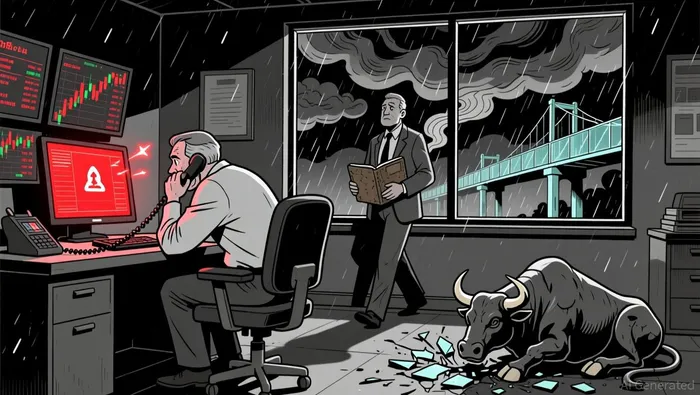 Derivatives markets add to the caution. Open interest has risen despite the price decline, suggesting fresh short positions are being added. Meanwhile, the 25-delta skew has turned negative, reflecting heightened fear and increased implied volatility as traders pay more for downside protection according to technical analysis.
Critical price levels to monitor include $90,000 and $82,000. A failure to hold $90,000 could accelerate the bearish momentum, with $85,000 emerging as a potential flush target if fear intensifies. A decisive close below $82,000-representing the average cost basis of long-term holders-would further confirm a bearish trend.
Fundamental Catalysts Driving the Downturn
The bear market is not purely technical; macroeconomic and institutional factors are amplifying the decline. According to market analysis, the Federal Reserve's hawkish monetary policy and global geopolitical tensions have created a risk-off environment, with Bitcoin lagging behind traditional assets like bonds, gold, and low-volatility stocks. U.S. spot Bitcoin ETFs have seen net outflows exceeding $3 billion in three weeks, signaling reduced institutional confidence.
Regulatory uncertainty has also constrained inflows. The lack of clear frameworks for crypto derivatives and spot ETFs has left investors in limbo, prolonging volatility. On-chain data, however, reveals a nuanced picture: long-term holders are accumulating Bitcoin, while exchange balances have declined, suggesting reduced selling pressure.
Analysts have outlined three 2026 price scenarios: a bear case testing $70,000, a base case rebounding to $95,000–$115,000, and a bull case reaching $150,000. The outcome will hinge on regulatory clarity, macroeconomic stabilization, and institutional adoption.
Risk Management and Strategic Positioning
In a confirmed bear market, risk management becomes paramount. Automated yield strategies-leveraging data-driven positioning-have emerged as a key tool for managing exposure. These strategies enable rebalancing, hedging, and disciplined capital deployment without constant manual intervention. For instance, institutional-grade analytics, such as Value-at-Risk (VaR) and volatility targeting, help maintain consistent risk exposure.
Diversification is another cornerstone. Combining core holdings of Bitcoin and EthereumETH-- with altcoins and stablecoins mitigates downside risk while preserving growth potential. Hedging mechanisms, such as futures and options, are also critical. Futures allow investors to lock in prices, while options provide downside protection against further declines.
Institutional investors, however, remain cautiously optimistic. Whale accumulation has increased, with addresses holding 1,000+ BTC rising-a sign that major players view the downturn as a buying opportunity. Long-term holders emphasize patience and disciplined accumulation, recognizing that bear markets often precede robust bull cycles.
Conclusion
Bitcoin's bear market in 2025 is a product of both technical breakdowns and macroeconomic pressures. While the path forward remains uncertain, strategic positioning and disciplined risk management can mitigate downside risks. Investors must stay agile, leveraging tools like automated strategies, diversification, and hedging to navigate the volatility. As the market tests key levels, the focus should remain on long-term fundamentals and the potential for a cyclical rebound.






Comentarios
Aún no hay comentarios