
Bitcoin's December 2025 Correction: A Buying Opportunity Amid Structural Market Maturity?
The December 2025 BitcoinBTC-- correction has sparked intense debate among investors, regulators, and analysts. While the market's volatility and leverage-driven selloffs have raised alarms, a deeper analysis reveals a landscape of structural maturation and potential entry opportunities. For both institutional and retail investors, the post-correction environment demands a nuanced understanding of risk-adjusted returns, leverage-cleansing dynamics, and historical precedents.
Structural Market Maturity: A Foundation for Resilience
Bitcoin's journey toward financial market legitimacy has accelerated in 2025. According to a report by XBTO, the asset's Sharpe ratio now stands at 2.42, placing it among the top 100 global assets by risk-adjusted returns. 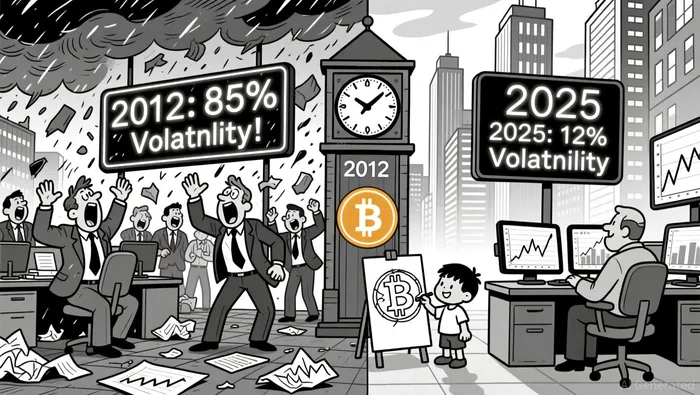 This metric underscores a significant reduction in volatility-down from 200% in 2012 to 50% in 2025 according to the same report. Such improvements reflect not only improved market infrastructure but also a shift in institutional participation, where sophisticated risk management tools like hedges and dynamic rebalancing have become standard.
However, December 2025 has tested this newfound maturity. On December 1, Bitcoin slipped below $90,000, erasing $1 billion in leveraged positions within hours. This event highlights the lingering fragility of leveraged retail and speculative capital, yet it also signals a critical self-cleansing process. As noted by K33 Research, the market's ability to hold the $87,000 support level without a catastrophic selloff-unlike previous corrections in July 2024 and January 2025-demonstrates prior deleveraging and reduced systemic risk.
Leverage-Cleansing and Cyclical Bottom Signals
The December correction has functioned as a stress test for Bitcoin's structural health. On-chain metrics paint a compelling picture of capitulation and accumulation. The Puell Multiple and Bitcoin mining stress have entered a "buy zone," historically preceding major bull markets. Meanwhile, whale accumulation hit a 13-year high, with large holders acquiring 269,822 BTC over 30 days. These indicators align with classic capitulation phases, where long-term holder dominance rises to 75% of the circulating supply and exchange balances hit multi-year lows.
Institutional flows further validate this narrative. Despite retail investors' "extreme fear" as measured by the Fear & Greed Index, US-listed Bitcoin ETFs have seen substantial inflows. This divergence between retail sentiment and institutional action suggests that the current price reflects overcorrection rather than fundamental weakness. As K33 Research argues, the market has overreacted to speculative threats like quantum computing and Tether instability, ignoring near-term signals of strength.
Strategic Entry Points: Balancing Risk and Reward
For investors seeking entry points post-correction, the focus must shift to risk-adjusted metrics. The Sharpe, Sortino, and Calmar ratios are critical for evaluating returns in the context of volatility and drawdowns. Bitcoin's current valuation, as measured by the BTC Yardstick, sits at -1.6 standard deviations below its long-term mean-a level historically associated with cycle bottoms in 2011, 2017, 2020, and 2022 according to historical data. The MVRV Z-Score has also entered an undervaluation zone, mirroring conditions before the 2023–2024 rally.
Institutional investors, in particular, are leveraging these metrics to time entries. Dynamic rebalancing and risk limits have allowed them to mitigate forced selling during leverage-driven selloffs. For example, the December 2025 drop below $86,000-triggering $500–550 million in liquidations-was cushioned by prior deleveraging in November, which erased $25 billion in cumulative liquidations. This structural purge, while painful, has strengthened Bitcoin's long-term fundamentals by reducing speculative overhang and increasing institutional ownership.
Retail investors, meanwhile, face a different calculus. The "extreme fear" phase often precedes retail buying opportunities, but caution is warranted. Historical precedents suggest that post-correction recoveries can take months, requiring patience and capital discipline. For those with risk tolerance, dollar-cost averaging into Bitcoin ETFs or on-chain accumulation at current levels could prove advantageous.
Conclusion: A Market at a Crossroads
Bitcoin's December 2025 correction is not merely a setback but a catalyst for structural evolution. While leverage-driven volatility and regulatory uncertainties persist, the market's improved risk-adjusted returns, institutional sophistication, and on-chain signals of accumulation point to a maturing asset class. For investors, the challenge lies in distinguishing between short-term pain and long-term opportunity.
As Peter Brandt's analysis suggests, the path ahead remains uncertain. Yet, the historical parallels to past cycle bottoms and the current alignment of fundamental and technical indicators make a compelling case for strategic entry. In a post-leverage-cleansing environment, Bitcoin may be poised to reward those who recognize its evolving role in the global financial ecosystem.







Comentarios
Aún no hay comentarios