
Bitcoin's Cyclicality and Market Rebound Potential: A Historical and Macroeconomic Analysis
Bitcoin's journey from a niche digital experiment to a $122,780 asset in July 2025, as shown in the 99Bitcoins price history, is a testament to its unique cyclicality and resilience. Over the past 15 years, BitcoinBTC-- has demonstrated a pattern of explosive growth followed by sharp corrections, driven by a mix of speculative fervor, technological milestones, and macroeconomic forces. This article dissects Bitcoin's historical price cycles, identifies recurring macroeconomic catalysts, and evaluates its potential for future rebounds in an evolving financial landscape.
The Genesis of Cyclicality: From Speculation to Institutional Adoption
Bitcoin's first major price surge in 2011-spiking over 8,000% before collapsing-was fueled by speculative trading and early adopter enthusiasm, according to the OANDA timeline. However, the 2008 financial crisis and subsequent distrust in centralized banking systems laid the groundwork for Bitcoin's appeal as a decentralized alternative, according to the OANDA timeline. By 2013, Bitcoin briefly crossed $1,000, but the collapse of Mt. Gox in 2014 triggered a prolonged bear market, underscoring the vulnerability of early infrastructure, as noted in the OANDA timeline.
The 2020 pandemic marked a turning point. Global economic uncertainty, coupled with unprecedented monetary stimulus, reignited institutional interest in Bitcoin as a hedge against inflation and currency devaluation, as discussed in Gate's 10-year review. This period saw Bitcoin transition from a speculative asset to a legitimate portfolio diversifier, setting the stage for its 2024-2025 meteoric rise.
Macroeconomic Catalysts: Inflation, Policy, and Geopolitical Shifts
Bitcoin's price cycles are increasingly intertwined with macroeconomic trends. The 2024 all-time high of $73,737.94, noted in the 99Bitcoins price history, coincided with the approval of U.S. spot Bitcoin ETFs, a regulatory milestone that legitimized Bitcoin as a tradable financial instrument. This event occurred amid a backdrop of stubborn inflation and aggressive Federal Reserve rate hikes, which amplified demand for assets uncorrelated with traditional markets, according to the 99Bitcoins price history.
The 2025 surge to $122,780 was further catalyzed by geopolitical and monetary policy shifts. The U.S. government's establishment of a Strategic Bitcoin Reserve in early 2025, reported in the 99Bitcoins price history, signaled a paradigm shift in how nations view digital assets. Simultaneously, Donald Trump's re-election in November 2024 spurred optimism around deregulation and pro-crypto policies, driving speculative buying, as observed in the 99Bitcoins price history. These developments highlight Bitcoin's growing role as a barometer for macroeconomic sentiment.
Asymmetric Recovery and the U.S. Dollar Inverse
Bitcoin's asymmetric recovery patterns-where it often surpasses previous highs after corrections-suggest maturing market dynamics. For instance, the 2024 ETF-driven rally erased the 2022-2023 bear market's damage within months, according to the 99Bitcoins price history. This resilience is partly attributed to Bitcoin's inverse relationship with the U.S. dollar. As central banks grapple with inflation and currency debasement, Bitcoin's fixed supply of 21 million coins positions it as a counterbalance to fiat volatility, as detailed in the OANDA timeline.
Future Outlook: Navigating the Next Cycle
While Bitcoin's historical cycles offer valuable insights, future rebounds will depend on evolving macroeconomic conditions. Central bank policies, geopolitical stability, and regulatory clarity will remain critical. For example, if inflationary pressures persist or new monetary tools emerge (e.g., digital dollar experiments), Bitcoin's role as a hedge could expand. Conversely, a return to low-inflation environments might temper demand.
Investors should also monitor technological advancements, such as Layer 2 scaling solutions and cross-chain interoperability, which could enhance Bitcoin's utility beyond a store of value. However, these innovations are secondary to macroeconomic fundamentals in shaping price trajectories.
Conclusion: A Malleable Asset in a Shifting World
Bitcoin's cyclicality reflects its dual identity as both a speculative asset and a macroeconomic hedge. From its 2009 inception to its 2025 peak, Bitcoin has evolved alongside global economic shifts, adapting to new catalysts while retaining its core appeal. For investors, understanding these cycles-and the macroeconomic forces that drive them-is essential to navigating Bitcoin's volatile yet potentially rewarding landscape. 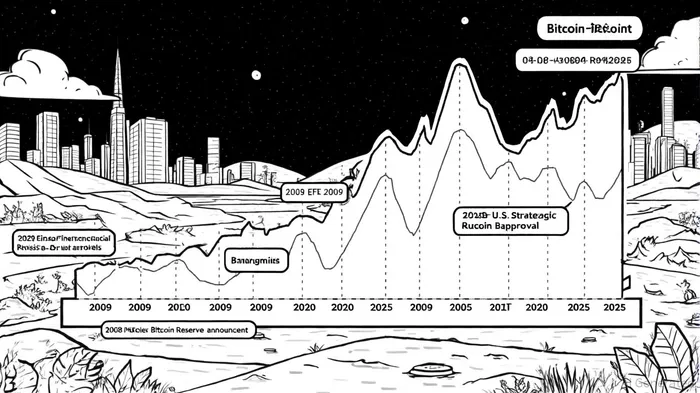






Comentarios
Aún no hay comentarios