
Bitcoin's Cyclical Momentum and Institutional Adoption: A Strategic Entry Point in the "Third Inning"
Bitcoin's cyclical momentum has long been a subject of fascination for investors, with its four-year bull-bear rhythm shaping market behavior. However, the current phase-often dubbed the "third inning" of Bitcoin's cycle-marks a pivotal departure from historical patterns. This period is defined by institutional adoption, regulatory clarity, and a structural shift in Bitcoin's role from speculative asset to integrated financial instrument. For long-term investors, this juncture presents a strategic entry point, underpinned by data-driven trends and macroeconomic tailwinds.
The "Third Inning" and Institutional Stabilization
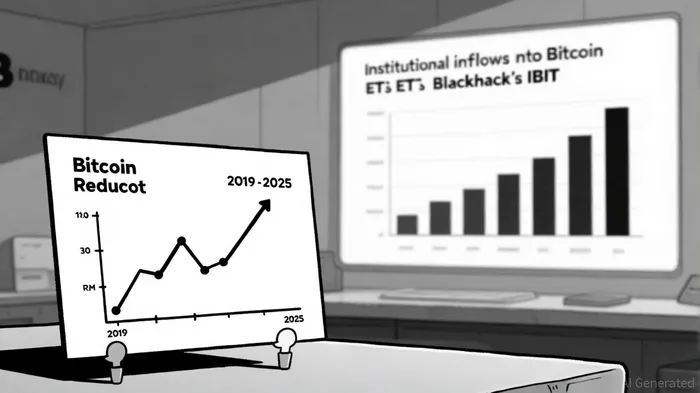
Bitcoin's cyclical narrative has traditionally followed a predictable arc: a bull run driven by retail enthusiasm, a bearish correction, and a rebirth cycle with halving events. The "third inning" concept, however, introduces a new dimension. According to a Cointelegraph report, institutional adoption since 2020 has fundamentally altered Bitcoin's volatility profile, reducing its 30-day rolling volatility to 35% in 2024–2025 from peaks of 158% in the 2019–2022 cycle. This stabilization is not accidental but a direct result of institutional capital inflows, which prioritize long-term horizons over short-term speculation.
The approval of U.S. spot BitcoinBTC-- ETFs in January 2024 marked a watershed moment. These products, including BlackRock's IBIT, have historically acted as a stabilizing force during market corrections, absorbing downward pressure through institutional buying, the Cointelegraph report notes. For example, during the 2024 market dip, ETF inflows offset retail outflows, preventing a deeper selloff. This dynamic suggests that Bitcoin's price is increasingly governed by institutional demand rather than retail sentiment-a critical shift for long-term investors seeking predictability.
Institutional Adoption: From Niche to Mainstream
Institutional adoption is no longer a speculative narrative but a structural reality. Data from an arXiv paper reveals that Bitcoin's correlation with major equity indices like the Nasdaq 100 and S&P 500 has risen sharply, signaling its integration into traditional financial portfolios. This trend is amplified by endorsements from major investment entities. Ric Edelman, a leading investment adviser managing $146 trillion in assets, has argued that crypto allocations are now essential for diversified portfolios, stating that "failing to own crypto is more speculative than owning it," a point highlighted in the Cointelegraph coverage. Even a modest 1% allocation to Bitcoin across his firm's assets could inject $1.46 trillion into the market-a tailwind that could extend the current bull cycle.
Regulatory clarity has further accelerated this adoption. The Trump administration's 2025 executive order, as noted in a Substack analysis, has provided a framework for institutional participation, reducing legal uncertainties that previously hindered large-scale investments. This regulatory tailwind is critical: it not only legitimizes Bitcoin as a viable asset class but also ensures its inclusion in pension funds, insurance products, and brokerages, broadening its investor base.
Strategic Entry Point for Long-Term Investors
For long-term investors, the "third inning" offers a unique confluence of factors. First, Bitcoin's reduced volatility makes it a more reliable store of value and medium of exchange. Second, institutional demand creates a floor for price appreciation, as seen during the 2024 correction. Third, regulatory tailwinds suggest that Bitcoin's integration into traditional finance is irreversible, ensuring sustained institutional inflows.
Consider the math: if Bitcoin's institutional adoption continues at its current pace, even a 5% annual increase in institutional ownership could drive price appreciation independent of retail demand. This is a stark contrast to previous cycles, where Bitcoin's value was heavily influenced by speculative retail trading. For investors with a 10-year horizon, the current phase offers a lower-risk entry point compared to the volatile early innings of the cycle.
Conclusion
Bitcoin's "third inning" is not merely a phase in its four-year cycle but a structural inflection point. Institutional adoption has transformed its volatility, correlation profile, and regulatory standing, positioning it as a cornerstone of modern portfolios. For long-term investors, this is a strategic window to capitalize on a maturing asset class-one that is no longer defined by retail speculation but by institutional confidence and macroeconomic integration.





Comentarios
Aún no hay comentarios