
Bitcoin's Cycle Exhaustion and Market Implications: Macrotrends and Investment Timing in the 2025 Bear Phase
Bitcoin's 2025 market dynamics are unfolding against a backdrop of conflicting signals: on-chain metrics suggest a resilient bull phase, while historical seasonality and macroeconomic risks hint at cyclical exhaustion. This analysis synthesizes data from on-chain analytics, institutional forecasts, and macroeconomic trends to evaluate Bitcoin's positioning in the current cycle and its implications for investors.
On-Chain Metrics: A Bullish Foundation
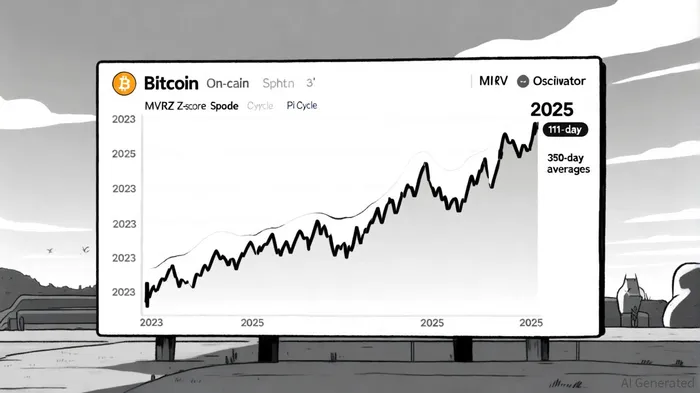
Bitcoin's on-chain indicators paint a picture of a market in accumulation mode. The MVRV Z-Score, which measures the ratio of market value to realized value, currently hovers near levels observed in 2017—a period that preceded a parabolic rally [1]. At 1.43 during the recent pullback to $75,000, the score aligns with historical local bottoms, suggesting the current correction is part of a healthy bull cycle rather than a bear market [5].
The Pi Cycle Oscillator, another critical tool, reveals bullish momentum as the 111-day and 350-day moving averages diverge—a pattern historically linked to price peaks [3]. Meanwhile, Value Days Destroyed (VDD) Multiple data underscores long-term holder accumulation, with reduced short-term profit-taking activity and growing confidence in Bitcoin's long-term value [5]. These metrics collectively indicate that the market is transitioning from speculative fervor to a more composed, institutional-driven growth phase [5].
Macroeconomic Tailwinds and Risks
Bitcoin's performance remains tightly correlated with macroeconomic conditions. The U.S. Federal Reserve's dovish policy, including anticipated rate cuts in late 2025, has historically supported Bitcoin's inverse relationship with the Dollar Index (DXY) [1]. A weakening U.S. dollar, coupled with a global M2 money supply expansion, creates a favorable environment for Bitcoin's store-of-value narrative [3].
However, risks persist. The S&P 500's volatility and potential global economic slowdowns could cap Bitcoin's upward momentum, as the asset has shown a strong correlation with equities [1]. Additionally, while BitcoinBTC-- ETF outflows in August 2025 signaled caution from short-term institutional investors [2], whale accumulation—evidenced by 19,130 addresses holding over 100 BTC—suggests strategic buying by long-term holders [2].
Seasonality and Structural Shifts
September 2025 has defied historical trends, with Bitcoin posting an 8% gain—the second-best September performance since 2012 [4]. This contrasts with the “September effect,” where the asset has historically declined by an average of 3.77% due to institutional rebalancing and tax-loss harvesting [2]. Analysts argue that 2025 could mark a break from this pattern, drawing parallels to 2017, when a September recovery set the stage for a year-end rally [2].
Structural shifts, such as the Trump administration's executive order positioning digital assets as a national priority and the maturation of digital asset treasuries (DATs), further challenge historical cycles [6]. These developments, combined with regulatory clarity (e.g., the U.S. GENIUS Act), are reshaping Bitcoin's volatility profile and reducing the likelihood of extreme corrections [5].
Investment Timing and Risk Management
For investors, the interplay of these factors suggests a nuanced approach. While on-chain metrics and macroeconomic tailwinds support a bullish case for Bitcoin reaching $180,000–$250,000 by year-end [1], the risk of a 70% drawdown in the next bear market cannot be ignored [2]. The current cycle's reduced volatility—30% drawdowns versus historical 80% corrections—hints at a maturing market, but liquidity tightening and leverage risks remain [2].
Technical analysis highlights key levels: Bitcoin's consolidation around $110,000, with support at $107,200 and resistance at $112,500, offers a strategic entry point for long-term investors [1]. However, a break below $107,200 could trigger short-term corrections, necessitating disciplined risk management.
Conclusion
Bitcoin's 2025 cycle appears to be diverging from historical norms, driven by institutional adoption, regulatory clarity, and macroeconomic tailwinds. While on-chain metrics and technical indicators suggest a resilient bull phase, investors must remain vigilant against macroeconomic headwinds and structural risks. The coming months will test whether this cycle can break free from the four-year boom-and-bust pattern—or if cyclical exhaustion will force a deeper correction. For now, the data leans toward a continuation of the bull narrative, but timing and risk mitigation remain paramount.






Comentarios
Aún no hay comentarios