
Bitcoin Self-Custody in Nigeria: Stealth Money's Role in Catalyzing Financial Sovereignty and Investment Growth
The global cryptocurrency landscape is witnessing a seismic shift in emerging markets, where financial instability and regulatory evolution are converging to create fertile ground for innovation. Nigeria, a nation long plagued by inflation, currency devaluation, and capital controls, has emerged as a bellwether for BitcoinBTC-- adoption. At the forefront of this transformation is Stealth Money, a platform that has redefined self-custody in Africa by offering hardware wallet solutions tailored to Nigeria's unique economic challenges. This analysis explores how Stealth Money's strategic positioning-coupled with Nigeria's regulatory recalibration and macroeconomic dynamics-positions the country as a critical nexus for institutional and retail investor confidence in self-sovereign finance.
Nigeria's Crypto Ecosystem: A Confluence of Necessity and Innovation
Nigeria's adoption of cryptocurrency has been driven by structural economic pressures. With inflation peaking at over 20% in 2024 and the naira losing more than 50% of its value against the dollar in a single year, citizens turned to Bitcoin and stablecoins as a hedge. According to Chainalysis, Nigeria ranked second globally in crypto adoption in 2024, and by 2025, it secured the 12th spot in global adoption metrics. This shift was further accelerated by the Nigerian government's 2025 regulatory reforms, including the Nigerian Investment and Securities Act (ISA 2025), which classified cryptocurrencies as securities and granted the SEC oversight of VASPs. These changes not only legitimized crypto but also opened the door for institutional participation, including crypto-fiat payment rails and digital asset-backed lending.
Stealth Money: Bridging the Gap Between Sovereignty and Accessibility
Stealth Money's 2023 launch of Bitcoin self-custody services in Nigeria marked a pivotal moment in the continent's financial history. By offering hardware wallets that enable users to store Bitcoin without intermediaries, the platform addressed a critical pain point: the lack of trust in centralized custodians. This is particularly relevant in Nigeria, where peer-to-peer (P2P) trading dominated the crypto landscape until 2025. Stealth Money's solution streamlines onboarding, allowing users to bypass the complexities of traditional crypto exchanges while retaining full control of their private keys.
The platform's timing aligns with Nigeria's transition from informal P2P networks to structured financial infrastructure. For instance, 56.1% of Nigerian crypto users primarily receive digital assets, underscoring the role of crypto as a tool for cross-border remittances and foreign exchange access. 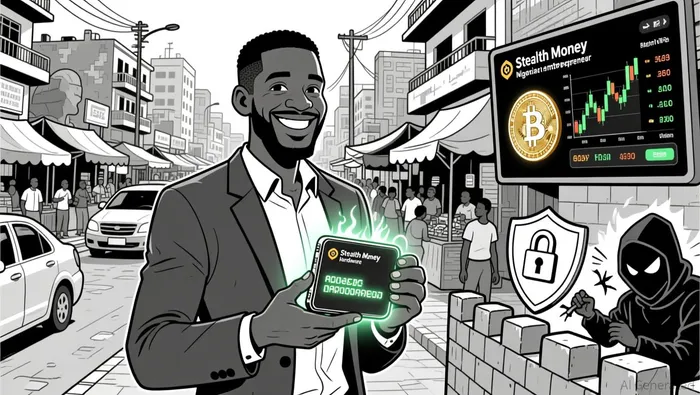 Stealth Money's hardware wallets, combined with the rise of USD-backed stablecoins like USDTUSDT-- and USDCUSDC--, provide a secure, low-cost alternative to traditional banking-a lifeline for a population where over 47% of those aged 18–64 have used cryptocurrency.
Institutional and Retail Investor Confidence: A New Paradigm
Investor confidence in Nigeria's crypto ecosystem has been bolstered by regulatory clarity and macroeconomic stability. The removal of the Central Bank of Nigeria's (CBN) 2021 ban on crypto transactions, coupled with the Accelerated Regulatory Incubation Programme (ARIP), has created a provisional licensing framework for crypto-native startups. Quidax, Nigeria's first crypto exchange to receive a provisional license under ARIP, exemplifies this shift. Meanwhile, traditional institutions like Zenith Bank have embraced open banking partnerships, signaling a broader acceptance of digital assets.
However, cybersecurity risks remain a double-edged sword. While Nigeria's removal from the FATF grey list in October 2025 has restored global trust in its financial system, cyberattacks surged by 1,047% in 2024, with losses reaching N53.4 billion. Stealth Money's emphasis on hardware wallets-devices immune to online hacking-directly counters these vulnerabilities, offering a security layer that appeals to both retail and institutional investors.
Why Now? The Optimal Moment for Investment
The convergence of regulatory, economic, and technological factors makes 2025 the optimal year to invest in platforms like Stealth Money. First, Nigeria's macroeconomic environment continues to drive demand for Bitcoin as a store of value. A 2025 currency devaluation triggered a $25 billion spike in on-chain activity, with Nigeria contributing significantly to this surge. Second, the government's push for a cashless economy-evidenced by partnerships like Visa and Moniepoint's 800 million monthly transactions-creates a fertile ecosystem for crypto adoption. Third, the removal of the CBN's crypto ban and the formalization of digital assets as securities reduce regulatory uncertainty, attracting foreign capital.
For investors, Stealth Money represents more than a fintech play; it is a catalyst for financial sovereignty in a market where 60% of adults remain unbanked. By empowering users to control their Bitcoin holdings, the platform aligns with global trends toward decentralized finance while addressing Nigeria's unique challenges.
Conclusion: A Sovereign Future, Built on Trust
Nigeria's journey from crypto prohibition to regulatory innovation underscores the transformative potential of self-custody solutions. Stealth Money's hardware wallet model not only mitigates the risks of centralized custodians but also democratizes access to Bitcoin in a market where trust in traditional institutions is eroding. As Nigeria's embedded finance market grows at a 12.2% CAGR and the government prioritizes digital transformation, platforms that prioritize security and sovereignty will dominate. For investors, the message is clear: the future of finance in Africa is self-sovereign, and Stealth Money is leading the charge.






Comentarios
Aún no hay comentarios