
Bitcoin's Crossroads: Navigating Macroeconomic Pressures and Investor Sentiment in Q4 2025
Bitcoin's market dynamics in Q4 2025 present a paradox: robust on-chain metrics coexist with macroeconomic fragility, creating a landscape where bullish accumulation and bearish caution collide. While institutional adoption and ETF inflows have stabilized volatility, the cryptocurrency's correlation with traditional assets and shifting investor sentiment underscore the need for defensive positioning in crypto portfolios.
On-Chain Metrics: Accumulation vs. Structural Risks
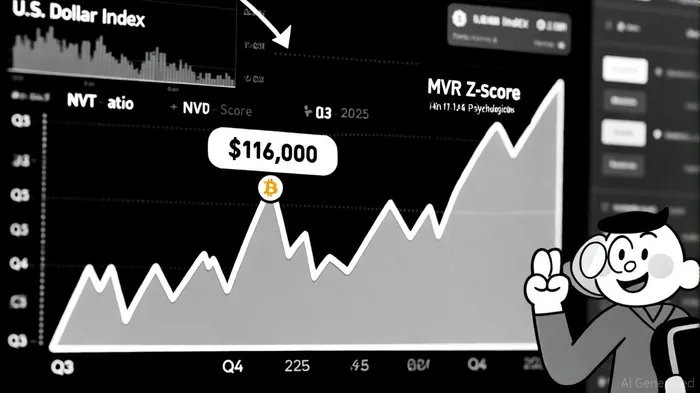
Recent on-chain data reveals a maturing BitcoinBTC-- ecosystem. Daily active addresses surpassed 2 million in Q3 2025, with long-term holders controlling 65% of the supply-a sign of conviction in Bitcoin's store-of-value proposition, according to a CoinAlert analysis. The Network Value to Transactions (NVT) ratio has declined by 32% to 29.2, aligning valuations with transactional utility rather than speculative fervor, as noted in a Forbes analysis. Meanwhile, Value Days Destroyed (VDD) and the MVRV Z-Score suggest a correction consistent with historical bull cycles, with undervaluation persisting until the Z-Score breaches 3, per a BitcoinInfoNews report.
However, structural risks loom. Exchange outflows since mid-2025 have reduced immediate selling pressure, but whale activity-such as the 147,000 BTC sold in a single month-introduces downward volatility, as CoinAlert noted. The $116,000 Trader's Realized Price acts as a critical inflection point: a break above it could reignite the bull phase, while a drop below may signal bearish momentum, according to a CoinDesk indicator. Historical backtesting of this threshold from 2022 to 2025 reveals that Bitcoin has yet to close above $116,000, meaning the strategy would not have triggered any trades during this period, according to the historical backtest.
Funding Rates and Correlation Shifts: A Mirror to Market Psychology
Bitcoin's perpetual futures funding rates remain flat in Q4 2025, reflecting a tug-of-war between bullish and bearish positioning, per a blockchain.news report. This neutrality suggests traders are awaiting catalysts-such as the Fed's dovish pivot or geopolitical shocks-to tip the balance. Crucially, Bitcoin's correlation with the S&P 500 has spiked to 0.88, behaving increasingly like a risk asset amid macroeconomic uncertainty, as CoinAlert reported. Conversely, its inverse correlation with the U.S. Dollar (-0.8) has strengthened as the dollar weakened 10% year-to-date, as noted by CoinDesk.
These dynamics highlight Bitcoin's dual role: a hedge against fiat devaluation and a barometer of risk appetite. For instance, during Q4's volatility, Bitcoin's price movements mirrored equity markets, diverging from its traditional safe-haven narrative, as Forbes observed. This shift complicates hedging strategies, as crypto investors must now account for Bitcoin's entanglement with equities and commodities.
Macroeconomic Crosscurrents: Tailwinds and Headwinds
The Federal Reserve's anticipated rate cuts and regulatory clarity-such as the GENIUS Act for stablecoins-remain tailwinds for Bitcoin, as CoinDesk suggested. Institutional adoption, including BlackRock's ETF expansions and corporate treasury allocations, has further stabilized the market, according to BitcoinInfoNews. Yet, these factors are offset by macroeconomic headwinds. The U.S. dollar's strength, geopolitical tensions, and uneven global growth trajectories could rapidly erode risk appetite, forcing Bitcoin into a defensive posture.
Moreover, Bitcoin's evolving relationship with commodities like gold and oil reveals its role as a diversifier rather than a pure hedge, as Forbes pointed out. While it can mitigate dollar exposure, its high volatility and speculative nature make it less reliable than traditional safe-haven assets during systemic crises.
Strategic Positioning: Defensive Hedging in a Volatile Regime
Given these mixed signals, investors should adopt a dual strategy:
1. Hedge Against Dollar Exposure: Allocate a portion of crypto portfolios to Bitcoin as a counterbalance to U.S. dollar weakness, leveraging its inverse correlation.
2. Diversify Across Asset Classes: Pair Bitcoin with gold or treasury bonds to mitigate risk during equity-driven downturns, given Bitcoin's growing equity-like behavior.
3. Monitor On-Chain Thresholds: Closely track the $116,000 level and NVT ratio. A sustained drop below these metrics could trigger bearish positioning, while a breakout validates the bull case.
Institutional investors, in particular, should prioritize liquidity management. With ETF inflows stabilizing Bitcoin's price, sudden outflows-such as those seen in October 2025-could amplify volatility, as CoinAlert noted. Retail investors, meanwhile, should avoid over-leveraging, as flat funding rates suggest a market primed for explosive moves in either direction.
Conclusion
Bitcoin's Q4 2025 narrative is one of transition. While on-chain metrics and institutional adoption point to a maturing market, macroeconomic pressures and shifting correlations demand caution. For investors, the path forward lies in balancing optimism with pragmatism-leveraging Bitcoin's utility as a hedge while hedging against its own volatility. As the Fed's policy trajectory and global growth outlook crystallize, the cryptocurrency's role in diversified portfolios will hinge on its ability to navigate this delicate equilibrium.






Comentarios
Aún no hay comentarios