
Bitcoin at the Crossroads: Geopolitical Tensions and Fed Policy Fuel Asymmetric Opportunities in 2025
Bitcoin at the Crossroads: Geopolitical Tensions and Fed Policy Fuel Asymmetric Opportunities in 2025
The global financial landscape in 2025 is defined by two seismic forces: the strategic adoption of BitcoinBTC-- by rogue states to circumvent sanctions and the U.S. Federal Reserve's aggressive rate-cutting cycle. These dynamics are not operating in isolation—they are colliding to create asymmetric opportunities in crypto markets, where volatility, regulatory shifts, and macroeconomic tailwinds converge. For investors, understanding this interplay is critical to navigating a market where Bitcoin's role as both a geopolitical tool and a monetary asset is reshaping risk-return profiles.
Rogue States and Bitcoin: A New Era of Financial Sovereignty
Rogue states have weaponized Bitcoin to undermine Western financial dominance and evade sanctions. Russia, for instance, has institutionalized crypto as a lifeline post-Ukraine invasion. By legalizing Bitcoin mining and international crypto payments, Moscow has leveraged its Garantex exchange to process transactions for sanctioned entities, effectively bypassing SWIFT and dollar-based systems [1]. Similarly, Iran and North Korea have weaponized decentralized finance (DeFi) and stablecoins to fund nuclear programs and ransomware operations. A report by Eurasiareview highlights how North Korea's cybercrime networks generated over $2 billion in 2024 through crypto theft, with proceeds funneled into its military-industrial complex [1].
These actions are not just about survival—they're about redefining economic sovereignty. By adopting Bitcoin and gold-backed stablecoins, rogue states are building parallel financial systems that challenge the U.S. dollar's hegemony. For example, Russia's collaboration with Iran on a gold-backed stablecoin signals a deliberate effort to de-dollarize trade and create a crypto-driven alternative to traditional banking [1].
Fed Rate Cuts: Liquidity Injection and Market Dynamics
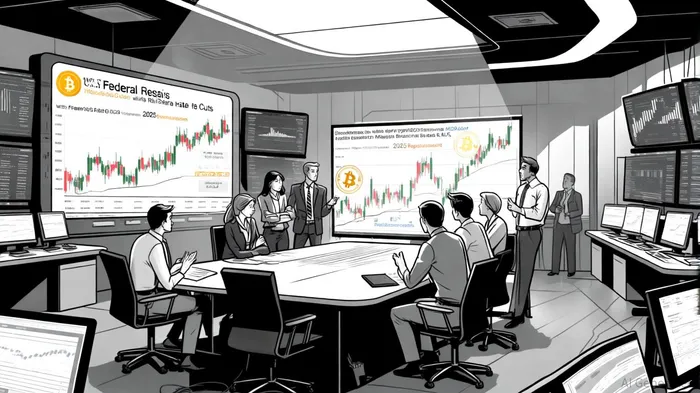
The U.S. Federal Reserve's 2025 rate cuts have amplified Bitcoin's appeal as a hedge against fiat devaluation. On September 17, 2025, the Fed slashed rates by 25 basis points, marking the first cut in over two years. This move injected liquidity into markets, weakened the U.S. dollar, and triggered a short-term Bitcoin rally to $118,000 [2]. According to Forbes, the rate cut reduced the opportunity cost of holding non-yielding assets like Bitcoin, driving capital flows into crypto as investors sought higher returns [2].
However, the market's reaction was nuanced. While the rate cut was largely priced in, Bitcoin's post-announcement consolidation near $116,000 reflected caution. Analysts at Bitget noted that the Fed's dovish guidance—hinting at further cuts in October and December—created a “buy the rumor, sell the news” dynamic, with volatility persisting as traders parsed macroeconomic signals [2].
Regulatory Responses and Market Stability
Regulators are scrambling to contain the fallout from rogue state crypto activities and Fed-driven liquidity surges. The U.S. passed the GENIUS Act in July 2025, mandating 1:1 reserve backing for stablecoins and independent audits to curb money laundering [3]. Meanwhile, the EU's Markets in Crypto-Assets (MiCA) regulation, effective late 2024, imposed stringent licensing requirements on exchanges, though enforcement remains inconsistent across member states [3].
These frameworks aim to stabilize markets but come at a cost. Smaller exchanges and DeFi protocols face compliance hurdles, with total value locked (TVL) in DeFi declining by 12% in Q1 2025 due to regulatory uncertainty [3]. Yet, institutional adoption of Bitcoin ETFs has surged, with inflows exceeding $2 billion in September 2025 alone, signaling growing acceptance of crypto as a legitimate asset class [2].
Asymmetric Opportunities: Where Geopolitics and Monetary Policy Converge
The intersection of Fed easing and rogue state actions creates unique asymmetries. For instance, Bitcoin's volatility—amplified by geopolitical tensions—has made it a high-beta asset. A Binance Research report found that Bitcoin dropped 11% during a Middle East crisis in 2025, far outpacing the Nasdaq-100's 1.3% decline [4]. Yet, this volatility also offers arbitrage opportunities. Traders who shorted Bitcoin during geopolitical spikes and bought back during Fed-driven rallies captured significant spreads.
Moreover, the U.S. Strategic Bitcoin Reserve—established in 2025—has added a new layer of stability. By holding confiscated crypto as a long-term store of value, the U.S. government has indirectly supported Bitcoin's legitimacy, even as rogue states exploit it for illicit purposes [5]. This duality—Bitcoin as both a geopolitical weapon and a monetary hedge—creates a paradox: the more it's weaponized, the more it's institutionalized.
Investment Outlook: Navigating the New Normal
For 2025 and beyond, investors must balance three forces:
1. Geopolitical Risk: Rogue state adoption of Bitcoin will continue to drive short-term volatility.
2. Monetary Policy: Fed rate cuts will likely sustain Bitcoin's long-term bull case by weakening the dollar.
3. Regulatory Clarity: Stricter rules will curb illicit activity but may stifle innovation in DeFi and altcoins.
The asymmetric opportunities lie in positioning for these dynamics. For example, Bitcoin ETFs and gold-backed stablecoins (e.g., those tied to Russia-Iran partnerships) could outperform as geopolitical tensions persist. Conversely, altcoins like SolanaSOL-- (SOL) and EthereumETH-- (ETH) may benefit from Fed-driven liquidity, provided regulatory hurdles are cleared [4].






Comentarios
Aún no hay comentarios