
Bitcoin's Critical Support and Resistance Levels: A Strategic Entry Point for Institutional Investors
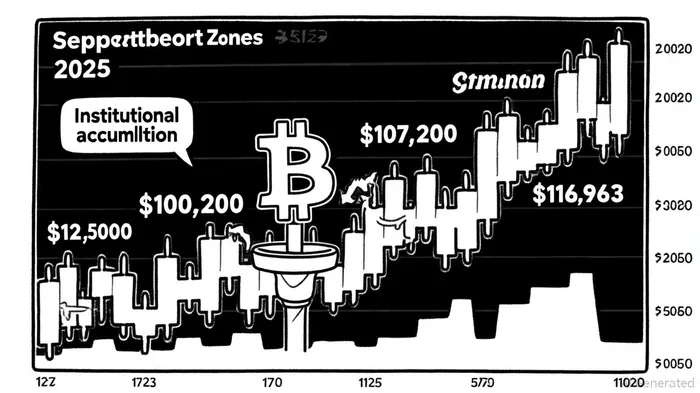
Bitcoin's price dynamics in September 2025 have crystallized around a narrow corridor of critical support and resistance levels, offering institutional investors a strategic framework to navigate volatility while capitalizing on macroeconomic tailwinds. As the asset consolidates near $110,000, technical analysis and sentiment indicators reveal a nuanced interplay between bearish corrections and bullish institutional accumulation, underscoring the importance of precise entry points.
Technical Analysis: Key Levels and Institutional Implications
Bitcoin's immediate support zone at $107,200 represents a psychological and technical linchpin. A breakdown below this level could trigger a cascade to deeper support at $104,000–$100,000, where the 200-day EMA and 50% Fibonacci retracement converge [1]. Conversely, a sustained breakout above $112,500—a resistance level reinforced by prior failed rallies—could invalidate bearish scenarios and propel prices toward $116,963, a threshold historically associated with institutional buying [2].
Institutional traders are closely monitoring these levels, as they align with historical patterns of whale activity. For instance, large investors accumulated 133,300 BTC at the $58,900 support zone in mid-2024, signaling conviction in Bitcoin's long-term trajectory despite short-term volatility [3]. Similarly, the current $100,000 level has been tested multiple times since 2023, with institutional inflows into spot ETFs—such as BlackRock's IBITIBIT--, which attracted $18 billion in AUM by Q1 2025—acting as a stabilizing force [4].
Market Sentiment: Divergence Between Retail and Institutional Actors
While Bitcoin's fear and greed index hovers at a neutral 49 as of September 17, 2025, institutional sentiment remains robust. Public companies have increased BitcoinBTC-- holdings by 200% year-to-date, reaching $20 billion in value, as entities like MicroStrategy and ARKARK-- Invest continue bulk purchases [3]. This contrasts sharply with retail behavior, where smaller traders have offloaded positions amid geopolitical uncertainties, creating a “strong hands” effect that reduces downside risk [5].
The CoinbaseCOIN-- Premium Index further highlights this divergence, showing negative values that suggest institutional reluctance to accumulate Bitcoin at current levels [1]. However, bearish indicators are tempered by macroeconomic catalysts, including anticipated Federal Reserve rate cuts and growing regulatory clarity. For example, the FDIC's new policy on crypto-related activities has bolstered institutional confidence, with 83% of surveyed investors planning to increase digital asset allocations by year-end [6].
Strategic Entry Points and Risk Mitigation
Institutional investors are employing multi-layered strategies to exploit Bitcoin's volatility. One approach involves dollar-cost averaging into the $107,200–$112,500 range, leveraging the stabilizing influence of ETF liquidity while hedging against potential corrections. Another tactic focuses on the $75,000–$73,000 support zone, a level that served as a prior high during the March 2024 rally and could attract bargain hunters if Bitcoin dips further [2].
For those adopting a bullish stance, the 200-day EMA at $104,000 offers a dynamic support line that, if held, could validate a rebound toward $120,000. Analysts project that a successful retest of $112,500 resistance—combined with ETF inflows and rate cuts—might push Bitcoin toward $200,000 by late 2025 [4]. Conversely, bearish scenarios warn of a potential head-and-shoulders pattern targeting $78,000, though such outcomes hinge on geopolitical shocks or regulatory setbacks [1].
Conclusion: Balancing Caution and Opportunity
Bitcoin's critical support and resistance levels in September 2025 reflect a market at a crossroads. While technical indicators suggest a high probability of consolidation, institutional behavior—marked by strategic accumulation and ETF-driven liquidity—points to a resilient asset class. For institutional investors, the key lies in aligning technical entry points with macroeconomic catalysts, ensuring that short-term volatility is leveraged rather than feared. As the Fed's policy trajectory and geopolitical risks evolve, Bitcoin's role as a hedge against traditional market uncertainties may yet redefine institutional portfolios.





Comentarios
Aún no hay comentarios