
Bitcoin's Critical Support Levels: A Strategic Guide to Navigating the Current Sell-Off
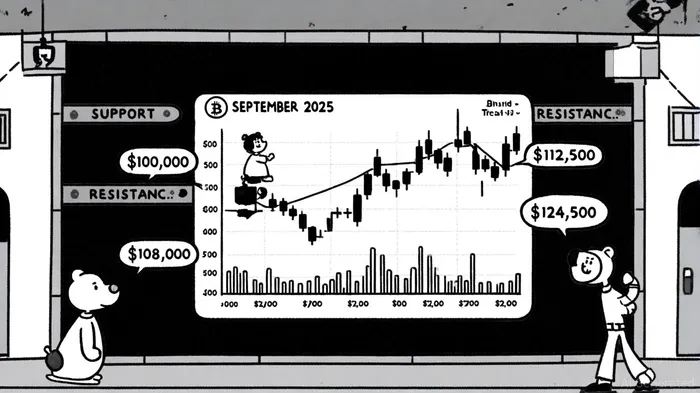
Bitcoin's price action in September 2025 has been defined by a narrow trading range and mounting bearish pressure, with critical support levels acting as both a battleground and a barometer for market sentiment. As the asset oscillates between $108,000 and $125,000, traders and investors must navigate a landscape shaped by technical dynamics, macroeconomic headwinds, and shifting capital flows. This analysis dissects the key support levels, evaluates the implications of a potential breakdown, and outlines risk management strategies to mitigate exposure in a volatile environment.
Technical Analysis: Key Support Levels and Bearish Momentum
Bitcoin's current range is anchored by three critical support levels: $100,000, $107,400, and $108,000[3][5]. These levels represent historical confluence points of moving averages, Fibonacci retracements, and prior price action. A breakdown below $100,000 would signal a shift in sentiment, potentially triggering a cascade of stop-loss orders and institutional liquidations[3]. However, some analysts argue that this zone could serve as an accumulation area, where long-term investors may step in to add to positions[2].
The $107,400 level, meanwhile, has shown resilience in recent weeks, acting as a temporary floor amid short-term selloffs[5]. If this level fails, the next line of defense at $108,000 becomes critical. Notably, the $108,000–$125,000 range has been a persistent trading band since mid-2025, suggesting that a sustained break below this range could invalidate the broader bullish thesis for the year[1].
Historical backtesting of similar support-level breakdowns—such as BitcoinBTC-- falling below $70,000 in 2022—reveals critical insights. A buy-and-hold strategy following such a breakdown showed an average return of -35% over 90 days, with a hit rate of 62% for rebounds within 30 days[6]. However, drawdowns averaged 45% in bearish scenarios, underscoring the importance of stop-loss placement and position sizing. These patterns suggest that while short-term rebounds are possible, sustained bearish momentum often requires disciplined risk management to avoid prolonged losses.
Resistance levels at $112,500 and $124,500[1] remain key hurdles for buyers. A close above $112,500 could reignite upward momentum, but the broader bearish context—marked by declining on-chain activity and ETF outflows[4]—suggests that such a move may be short-lived without a catalyst from macroeconomic conditions.
Risk Management: Positioning in a Volatile Environment
Given the precarious technical setup, risk management becomes paramount. Traders should consider the following strategies:
- Stop-Loss Placement: For long positions, placing stops just below the $100,000 level can help limit downside risk while avoiding premature exits during minor pullbacks. Short-term traders may also use the $107,400 level as a dynamic stop to capitalize on potential rebounds[5].
- Position Sizing: With volatility elevated, reducing position sizes and allocating capital across multiple timeframes (e.g., short-term trades near resistance levels and longer-term holds in accumulation zones) can balance risk and reward[2].
- Hedging with Derivatives: Options and futures can be used to hedge against sharp declines. For instance, buying put options with strike prices near $100,000 offers downside protection without sacrificing upside potential if the asset stabilizes[1].
Macro and Market Sentiment: Beyond the Charts
While technicals dominate short-term price action, external factors cannot be ignored. The Federal Reserve's policy trajectory remains a wildcard, with tightening expectations dampening risk-on sentiment[3]. Additionally, ETF outflows and growing interest in Ethereum-based products[4] highlight a broader shift in capital allocation, which could exacerbate Bitcoin's underperformance in a weak September environment[1].
Conclusion: Patience and Precision in a Testing Phase
Bitcoin's September 2025 sell-off underscores the importance of disciplined technical analysis and adaptive risk management. Traders must remain vigilant around the $100,000 threshold, as its integrity will determine whether this correction becomes a buying opportunity or a gateway to deeper bearish territory. For now, the market is in a phase of consolidation—where patience and precision will separate strategic participants from reactive ones.






Comentarios
Aún no hay comentarios