
Bitcoin's Critical Short-Term Support and Ethereum's Resilience: Strategic Entry Points for Crypto Investors?
The cryptocurrency market in late December 2025 remains a theater of volatility, with BitcoinBTC-- and EthereumETH-- navigating complex technical landscapes. For investors seeking to rebalance risk in this environment, understanding key support levels, momentum indicators, and structural price patterns is critical. This analysis synthesizes recent technical data to identify potential entry points and risk management strategies.
Bitcoin's Bearish Wave (Z) and Critical Support
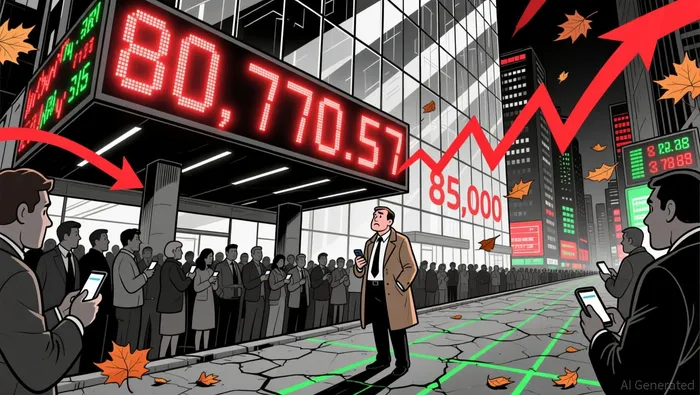
Bitcoin (BTC) is currently in what analysts describe as wave (Z) of a larger corrective pattern, with a projected target of $80,770.57. This level represents a confluence of Fibonacci retracement levels and historical support from 2024's bear market. Short-term traders and positioners should monitor this zone closely, as a breakdown below $85,000-currently acting as dynamic support- could accelerate the decline.
The broader bearish bias is reinforced by BTC's position below key exponential moving averages (EMAs), a classic sign of weakening momentum. However, the absence of a clear overbought/oversold signal in the RSI (which remains neutral) suggests the market is not yet in a panic phase. This creates a paradox: while the trend is decisively bearish, the lack of extreme indicators implies there may still be room for a short-term bounce before the next leg down.
Ethereum's Resilience Amid Range-Bound Consolidation
Ethereum (ETH) presents a more nuanced picture. Trading at $3,016 as of December 29, 2025, the asset is consolidating within a $2,900–$3,100 range, with immediate resistance at $3,050 and $3,100. A breakout above $3,100 could reignite bullish momentum toward $3,200, but this would require a reversal of the current bearish channel dynamics.
On the downside, the $2,900–$2,920 zone has emerged as a critical support cluster. The Boss, a pseudonymous analyst, highlights $2,917.65 as a pivotal level, below which a deeper correction toward $2,613.72 becomes more likely. Yet Ethereum's resilience is evident in its technical indicators: a golden cross on the 4-hour chart (EMA(7) crossing above EMA(30,120)) and a 120% surge in validator staking activity suggest that long-term holders are accumulating during dips.
The RSI at 45.25 and a flat MACD underscore the market's indecision. While Ethereum remains below its 34- and 89-period EMAs, the intertwined moving averages hint at a potential trend reversal if buyers can push the price above $2,985.
Risk Rebalance Opportunities in a Volatile Market
For investors, the current environment offers two strategic paths:1. Short-Term Bearish Plays on Bitcoin: Given BTC's alignment with wave (Z) and its position below key EMAs, short positions could be justified near $85,000, with a stop-loss above $88,000 to mitigate false breakouts.2. Ethereum's Range-Bound Setup: ETH's consolidation presents a high-probability trade for both long and short positions. A long bias could be triggered on a breakout above $3,100, while a breakdown below $2,917.65 would validate the bearish case.
Volume trends add nuance. While exchange reserves indicate selling pressure, the accumulation of 3.62 million ETH by long-term holders in December suggests a potential floor for the asset. This duality-short-term bearishness versus long-term resilience-highlights the importance of position sizing and stop-loss placement in volatile markets.
Conclusion: Navigating the Crossroads
The December 2025 market snapshot reveals a crypto landscape at a crossroads. Bitcoin's critical support at $80,770.57 and Ethereum's contested $2,900–$3,100 range are not just technical levels but psychological battlegrounds. For investors, the key lies in balancing risk exposure: shorting BTC's bearish wave while hedging Ethereum's range-bound potential. As always, volatility demands discipline-entry points must be validated by price action, and exits must respect dynamic support/resistance shifts.






Comentarios
Aún no hay comentarios