
Bitcoin's Critical Price Range: A Liquidity-Based Breakout Opportunity
Technical Liquidity Analysis: A Tipping Point
The Liquidity Inventory Ratio, currently at 8.3 months, signals that available liquidity can only sustain current demand for under nine months, as noted by that Blockonomi analysis. This imbalance is exacerbated by exchange balances shrinking to 2.83 million BTC, a level that magnifies the impact of large orders, according to a Coinotag report. Meanwhile, long-term holders have aggressively accumulated 373,000 BTC in a single month, locking up supply and reducing market float, the Blockonomi piece notes. Such structural shifts suggest that Bitcoin's price is no longer driven by broad retail participation but by strategic positioning from whales and institutions.
Data from Glassnode and Avenir Group reveals a paradox: while on-chain liquidity has hit an all-time high of $944 billion, this growth is driven by institutional flows and stablecoin inflows rather than retail activity, according to a Glassnode and Avenir report. ETFs, in particular, have become a dominant force, with unhedged flows indicating long-term exposure rather than short-term arbitrage, the report explains. This divergence between on-chain liquidity and exchange-based liquidity underscores a maturing market where Bitcoin's volatility increasingly mirrors equities and gold.
On-Chain Positioning: Whales and the Hidden Order Book
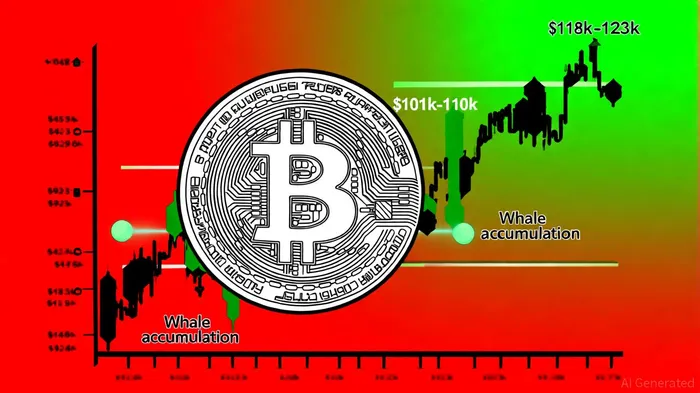
Whale activity-entities controlling at least 1,000 BTC-has become a defining feature of Bitcoin's price dynamics. With over 1,670 such entities, a level not seen since 2021, these actors often split large orders across addresses or use OTC desks to avoid disrupting public order books, as Coinotag reported. This stealth accumulation has created a "hidden order book," where visible liquidity on exchanges is a fraction of the total available supply.
The MVRV Z-Score, a key on-chain metric, currently stands at 1.43, a level historically associated with local bottoms in bull cycles, according to Bitcoin Magazine. This suggests that long-term holders are accumulating BitcoinBTC-- after a profit-taking phase, as evidenced by the Value Days Destroyed (VDD) metric entering the "green zone" of accumulation. Additionally, the Bitcoin Cycle Capital Flows chart shows increased activity from the 1–2 year cohort, signaling anticipation of higher prices during the next bull phase.
Critical Price Ranges and Breakout Potential
Q3 2025 on-chain data identifies two critical price ranges for Bitcoin:
1. Support Zone: $101k–$110k, a historically significant level where the MVRV Z-Score and NUPL metrics indicate a high probability of bullish reversal, according to a 99Bitcoins report.
2. Resistance Zone: $118k–$123k, a cluster of liquidity that could trigger a breakout if institutional demand and macroeconomic conditions align, the 99Bitcoins report argues.
Technical indicators further reinforce this outlook. Bitcoin's price currently trades near the –1 standard deviation on the linear regression chart, a level that has historically preceded strong rallies, as noted by the Blockonomi analysis. Analysts project potential targets up to $175k in the next expansion phase, driven by sustained accumulation and growing institutional demand, according to that same Blockonomi piece.
Future Outlook: Q4 2025 and Beyond
For Q4 2025, Bitcoin is expected to consolidate between $110k–$130k, with a higher probability of a breakout toward $130k if macroeconomic conditions improve, the 99Bitcoins report suggests. However, a drop to $95k–$100k remains a risk if key support levels fail, particularly in the context of a deteriorating equity market, as Bitcoin Magazine observed. The fourth quarter has historically been favorable for Bitcoin, as professional investors rebalance portfolios toward higher-risk assets like crypto ahead of year-end.
Conclusion
Bitcoin's liquidity-based breakout opportunity hinges on its ability to navigate the current tight liquidity environment while leveraging institutional demand and on-chain accumulation. Investors should closely monitor the $101k–$110k support zone and the $118k–$123k resistance cluster, as these levels will likely determine the next phase of the bull cycle. With ETF flows, whale activity, and macroeconomic trends converging, the coming months could redefine Bitcoin's role as a macro asset in global financial markets.






Comentarios
Aún no hay comentarios