
Bitcoin's Critical Price Levels and Rebound Potential: A Technical and Sentiment-Driven Analysis
Bitcoin's price action in September 2025 has become a focal point for traders and investors, as the asset navigates a complex interplay of technical support/resistance levels and a deeply bearish market sentiment. With the cryptocurrency trading within a projected range of $108,000 to $125,000[1], the coming weeks will test whether BitcoinBTC-- can break free from its consolidation phase or succumb to renewed downward pressure. This analysis synthesizes technical indicators, on-chain metrics, and sentiment data to assess the likelihood of a rebound—and the risks that remain.
Technical Analysis: A Tenuous Balance
Bitcoin's immediate trajectory hinges on its ability to hold key support and resistance levels. As of September 2025, the critical support zone lies between $107,200 and $104,000, with the 200-day moving average reinforcing the lower end of this range[3]. Conversely, resistance is clustered around $112,500–$115,000, levels that, if breached, could propel Bitcoin toward $120,000 or even $200,000 by year-end, according to bullish analysts[1]. However, a breakdown below $111,000—a level already tested multiple times this month—could trigger a cascade toward $107,200 and, in worst-case scenarios, the psychological $100,000 floor[2].
Historical patterns add nuance to this technical landscape. September has averaged a -3.77% decline for Bitcoin since 2013[4], a trend exacerbated by bearish momentum indicators like the Relative Strength Index (RSI) and weak institutional investment flows[6]. Yet on-chain data reveals a mixed picture: while $280 million in leveraged long positions were liquidated during a recent correction[1], open interest in Bitcoin derivatives has hit a record $54.6 billion, signaling sustained investor interest[6]. The 50-day and 100-day exponential moving average (EMA) golden cross—a bullish technical signal—further suggests that institutional buyers are accumulating Bitcoin, with 3.65 million BTCBTC-- held by large “shark” wallets[5].
Market Sentiment: Fear as a Contrarian Signal
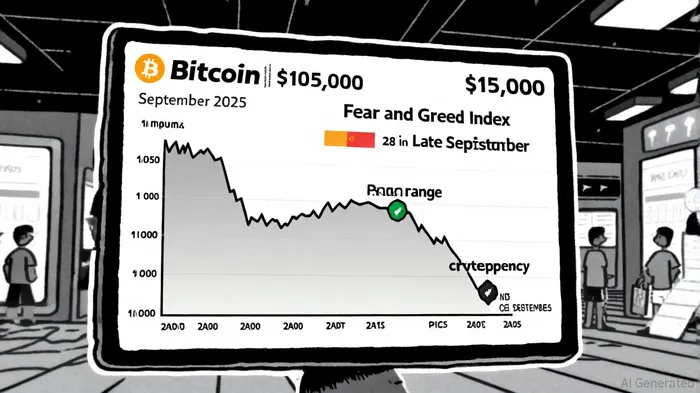
The Bitcoin Fear and Greed Index has plummeted to 28 as of September 26, 2025, marking one of the lowest readings since mid-April[5]. This extreme fear, driven by macroeconomic uncertainties (e.g., Federal Reserve policy ambiguity) and regulatory debates, reflects a risk-averse environment where retail investors are prone to panic selling[4]. Meanwhile, institutional investors remain cautiously optimistic, prioritizing Bitcoin ETFs over speculative altcoins[1].
Historically, such fear has acted as a contrarian indicator. For example, similar readings in mid-2024 preceded a 15% rebound in Bitcoin prices within a month[1]. However, the current environment carries unique risks. A further drop in the Fear and Greed Index below 40 could signal a deeper sell-off, pushing Bitcoin toward $100,000[4]. Retail investors, meanwhile, are caught in a cycle of emotional decision-making, oscillating between FOMO-driven buying and panic-driven selling[1].
On-Chain Metrics: Validation and Caution
On-chain data provides critical validation for both technical and sentiment-driven narratives. Bitcoin's exchange reserves have dwindled to 2.5 million BTC—the lowest since 2022—indicating reduced supply available for short-term dumping[5]. This scarcity, coupled with robust spot demand (evidenced by the Coinbase Premium Index's positive readings[1]), suggests that institutional accumulation is offsetting retail outflows.
Yet risks persist. The $107,200 support level is notNOT-- just a technical threshold but a liquidity trap, with over $3 billion in long positions exposed at this level[1]. A prolonged breakdown could trigger a structural bearish shift, extending Bitcoin's decline toward $93,000[2]. Conversely, a rebound above $113,000—reinforced by the on-chain realized price model—could reignite bullish momentum[5].
Outlook: A Pivotal 72 Hours
The next 48–72 hours will be decisive. If Bitcoin stabilizes above $113,000 and the Fear and Greed Index begins to normalize, a rebound toward $117,500 or higher becomes plausible. However, a sustained close below $111,500—particularly if the 50-day EMA is breached—could confirm a bearish trend, with $100,000 as the final defense.
Macro factors, including the Federal Reserve's policy stance and the PCE inflation print, will also play a role. A dovish pivot could weaken the U.S. dollar and provide tailwinds for Bitcoin[1], while a hawkish surprise might exacerbate risk-off sentiment.
Conclusion
Bitcoin's September 2025 narrative is one of tension between technical resilience and bearish sentiment. While the Fear and Greed Index and historical seasonal patterns suggest caution, on-chain metrics and institutional buying hint at a potential rebound. Investors must weigh these factors carefully, recognizing that volatility remains the norm—and opportunity often emerges in the shadows of fear.






Comentarios
Aún no hay comentarios