
Bitcoin's Critical Price Inflection Point: Short-Squeeze or Downward Spiral?
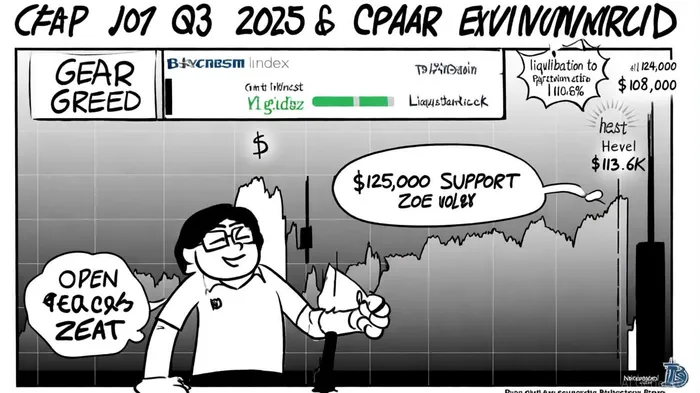
Bitcoin's price action in Q3 2025 has created a pivotal inflection pointIPCX--, with market participants divided between bullish short-squeeze narratives and bearish correction scenarios. To assess whether this is a structural turning point or a temporary volatility spike, we must dissect leveraged position dynamics and macroeconomic sentiment through a granular lens.
Leveraged Position Dynamics: A Ticking Time Bomb or Structural Floor?
The $16 billion in short exposure concentrated above $115,000 on exchanges like Binance and Bybit[2] suggests a high-stakes game of cat-and-mouse. A liquidation heatmap reveals a dense cluster of short positions at this level, meaning a sustained break above $115,000 could trigger a cascading short squeeze[2]. This is compounded by institutional accumulation: MicroStrategy's $10 billion BTC purchase and Metaplanet's $837 million acquisition[4] signal a shift from speculative retail dominance to long-term capital inflows.
However, technical indicators paint a nuanced picture. The MACD divergence and declining open interest (down 10.6% in August 2025)[1] suggest weakening momentum, while the MVRV Z-Score of 1.43 in July 2025[1] indicates a local bull market bottom. These metrics imply that while short-term volatility is likely, the structural floor is reinforced by institutional demand.
Market Sentiment: Fear, Greed, and the Institutional Overhang
The BitcoinBTC-- Fear & Greed Index hovering between 39–41 in September 2025[4] reflects a market in cautious equilibrium. Retail investors, spooked by the 12% pullback from $124,000 to $108,000[4], are underweighting leveraged positions, while institutions are capitalizing on dips. U.S. spot Bitcoin ETFs, managing $219 billion in assets by early September 2025[3], have created a “buy the dip” dynamic that counters bearish narratives.
Yet macroeconomic headwinds persist. The Federal Reserve's tightening cycle and liquidity withdrawal[4] remain critical risks, as does the $113.6K on-chain resistance level—the average purchase price for short-term investors[4]. If this level fails to hold, the 25-week cycle pattern projected by Osemka[1] could delay recovery until mid-September, prolonging bearish sentiment.
Short-Squeeze or Downward Spiral? A Two-Phase Outlook
The data supports a two-phase scenario. In the short term, Bitcoin's $115,000 support zone[1] and $16 billion in short exposure[2] create a high-probability short-squeeze scenario if institutional buying accelerates. This would align with historical patterns where whale accumulation and reduced volatility signal a market transition rather than reversal[1].
However, the broader picture remains fragile. Declining open interest and MACD divergence[4] suggest speculative overexposure is unwinding, while the Fed's policy uncertainty could trigger a deeper correction. The key variable is whether U.S. monetary policy pivots dovish before Powell's Jackson Hole speech—a catalyst that could unlock $160,000+ levels by Q4 2025[1].
Conclusion: Navigating the Inflection Point
Bitcoin's current inflection point is neither a guaranteed short squeeze nor an inevitable downward spiral. Instead, it represents a tug-of-war between institutional capital and macroeconomic headwinds. Retail investors should monitor the $113.6K resistance level[4] and liquidation heatmaps[2], while long-term holders can capitalize on ETF-driven structural floors[3]. For now, the market is in a recalibration phase—where patience and position sizing will determine success.






Comentarios
Aún no hay comentarios