
Bitcoin's Critical Price Inflection Point Ahead of the September 24 Halving Event: Strategic Entry Opportunities for Investors
Bitcoin's price action ahead of the September 24, 2025 halving event is poised to become a defining moment for both institutional and retail investors. Historical patterns, macroeconomic tailwinds, and structural shifts in market dynamics suggest a critical inflection point is forming—a moment where strategic entry or exit decisions could determine long-term returns.
Historical Context: Halving Cycles and Price Surges
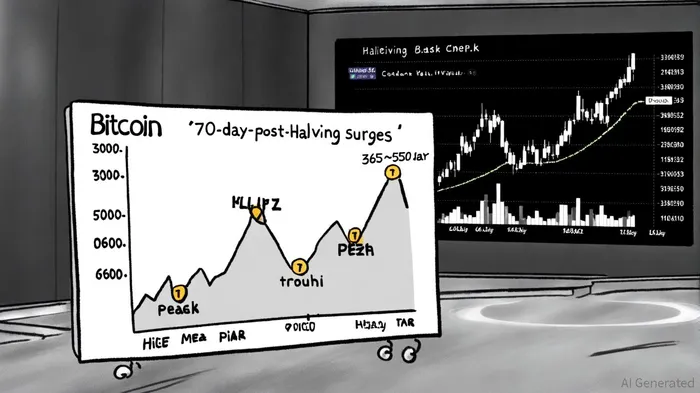
Bitcoin's halving events have consistently triggered cyclical price surges, driven by reduced supply issuance and increased scarcity. After the 2012 halving, BitcoinBTC-- surged 7,750% from $12.35 to $964 within a year [1]. The 2016 halving catalyzed a 277% rise to $2,500, while the 2020 event saw a 713% jump to $69,000 [2]. These trends align with a recurring pattern: a rapid 70-day post-halving rally followed by consolidation, with peak prices typically emerging 365–550 days after the event [3].
The 2024 halving, which reduced miner rewards to 3.125 BTC per block, occurred as Bitcoin traded at $64,968 [4]. By September 2025, the price had stabilized at $113,948—a 75% increase over 15 months [5]. This trajectory mirrors historical cycles, suggesting the September 2025 window could mark the next peak.
Current Market Dynamics: Institutional Adoption and Macro Tailwinds
The 2025 market is uniquely positioned for sustained growth due to institutional adoption and macroeconomic factors. U.S. spot Bitcoin ETF approvals in January 2024 injected billions into the market, with institutions projected to control 14% of Bitcoin's supply by September 2025 [6]. This institutional presence acts as a stabilizing force, mitigating volatility seen in earlier cycles.
Macroeconomic tailwinds further bolster the case for Bitcoin. The Federal Reserve's anticipated rate cuts in late 2025 and rising global liquidity—driven by central bank stimulus—position Bitcoin as a hedge against inflation and currency devaluation [7]. Additionally, the M2 money supply has expanded by 12% year-to-date, historically correlating with Bitcoin's price performance [8].
However, risks persist. The expiration of Trump's 90-day tariff freeze in Q3 2025 could reintroduce trade tensions, historically linked to Bitcoin corrections [9]. Meanwhile, Q3 has historically been a weaker quarter for Bitcoin, averaging only 6% gains since 2013 [10].
The September 2025 Inflection Point: A Strategic Crossroads
With Bitcoin trading at $114,000 as of September 2025, the market is at a critical juncture. Historical data suggests a peak is likely within 3–5 months, but volatility remains a factor. Standard Chartered's bullish outlook—projecting $135,000 by Q3 end and $200,000 by year-end—hinges on sustained ETF inflows and corporate treasury buying [11]. Conversely, consolidation phases are common post-rallies, with corrections of 10–20% historically observed [12].
For institutional investors, this inflection point offers an opportunity to lock in long-term holdings. With 14% of Bitcoin's supply already under institutional control, their deep pockets and long-term horizons make them less susceptible to short-term volatility [13]. Strategic entry points could include dips during Q3 consolidation, leveraging dollar-cost averaging to mitigate risk.
Retail investors, meanwhile, should adopt a cautious approach. Historical patterns suggest a peak by November 2025, followed by a 3–6 month consolidation phase [14]. Setting price alerts at $135,000 and $150,000 could help time exits, while smaller position sizing during Q3 volatility ensures flexibility.
Conclusion: Positioning for the Next Bull Run
Bitcoin's September 2025 inflection point is notNOT-- just a technical milestone—it's a confluence of historical cycles, institutional momentum, and macroeconomic forces. For investors, the key lies in balancing optimism with pragmatism: leveraging institutional-grade tools for risk management while staying attuned to market timing signals.
As the halving approaches, the focus should shift from short-term noise to long-term value. Whether through strategic ETF allocations, treasury diversification, or retail position sizing, the next chapter of Bitcoin's journey promises outsized rewards for those who act decisively.






Comentarios
Aún no hay comentarios