
Bitcoin's Critical 'Max Pain' Zone and Institutional Selling Pressure
The "Max Pain" Range: A Convergence of Institutional Exposure
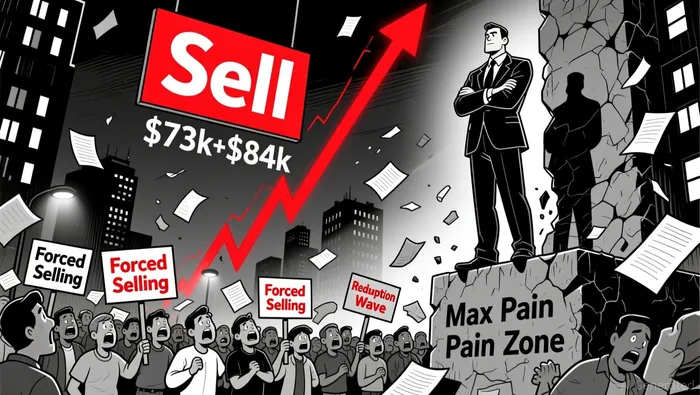
The "max pain" concept refers to price levels where institutional investors face the greatest unrealized losses, often prompting defensive selling. Bitcoin's proximity to this range is underscored by the fact that BlackRock's IBIT, the largest Bitcoin ETF, has seen record outflows, including a $523 million single-day redemption in November 2025. Similarly, MicroStrategy's stock has traded at a discount to its Bitcoin holdings, amplifying concerns about corporate-level liquidity pressures. Analysts like André Dragosch of Bitwise Europe warn that a break below $82,000-a high-volume node on on-chain tools-could accelerate redemptions and trigger a "fire-sale" scenario.
Institutional Selling Pressure: Beyond ETFs
While ETF outflows dominate headlines, broader institutional selling metrics reveal a fragile market. JPMorgan analysts attribute November's crypto correction to retail investors pulling $4 billion from Bitcoin and EthereumETH-- ETFs, a stark contrast to the $96 billion inflows into equity ETFs during the same period. This divergence highlights crypto's vulnerability to risk-off sentiment, even as equities attract capital. Meanwhile, corporate Bitcoin sales-though less quantified-add to the bearish narrative. For instance, MicroStrategy's strategic rebalancing of its Bitcoin portfolio amid declining prices suggests a reevaluation of long-term holding strategies.
Key Support Levels and Technical Dynamics
On-chain data identifies two critical support clusters within the $73k–$84k range. The $82,000 to $79,000 band is a high-volume node reinforced by round-number psychology, while the $85,000 level acts as a psychological threshold for bulls to reclaim according to technical analysis. A sustained break below $82,000 could test the $73,000 cost basis of MicroStrategy's holdings, potentially triggering a cascade of forced sales. Conversely, a rebound above $85,000 would alleviate short-term liquidation risks and signal renewed buying interest. Overhead resistance remains concentrated at $90,000–$94,000, where heavy open interest in short-dated call options suggests a battleground for near-term momentum according to on-chain data.
Macroeconomic Catalysts: Fed Uncertainty and Global Trends
The Federal Reserve's December FOMC meeting looms as a critical macroeconomic variable. With rate-cut expectations at 41.8%-a sharp decline from earlier optimism-liquidity constraints could persist, mirroring the conditions that fueled Bitcoin's November 2024 sell-off. Compounding this, delayed labor data due to a U.S. government shutdown has left policymakers with limited visibility into inflation trends, heightening uncertainty. Globally, Bitcoin's appeal as a hedge against fiat debasement remains intact, with its Q3 2025 rally to $114,600 reflecting its role as "digital gold" amid rising U.S. inflation (3% year-over-year). However, geopolitical tensions-such as Middle East conflicts and U.S.-China trade disputes-have introduced volatility, complicating institutional positioning.
The Path Forward: Balancing Bearish and Bullish Signals
Despite the near-term bearishness, several factors suggest a potential floor for Bitcoin's price. Stablecoin reserves on exchanges have surged to $72 billion, a historical precursor to major rallies. Additionally, Bitcoin remains above its 200-week EMA, a technical indicator of long-term bullish momentum. For investors, the key will be monitoring whether institutional holders-particularly those near their cost bases-defend the $73k–$84k range or exacerbate selling pressure. A successful rebound above $85,000 could reignite institutional demand, while a breakdown below $73,000 would likely force a reevaluation of Bitcoin's macroeconomic narrative.
In conclusion, Bitcoin's "max pain" zone represents both a risk and an opportunity. While institutional selling and macroeconomic headwinds weigh on the short-term outlook, historical patterns and technical indicators suggest a potential inflection point. Investors must remain vigilant to both price action and evolving macroeconomic signals as the market navigates this critical juncture.





Comentarios
Aún no hay comentarios