
Bitcoin's Critical On-Chain Cost Basis: A Make-or-Break Threshold for 2026
Bitcoin's on-chain cost basis metrics have long served as a barometer for market structure, investor behavior, and macroeconomic sentiment. As 2026 unfolds, these metrics are crystallizing into a pivotal battleground that could determine whether BitcoinBTC-- consolidates its dominance or faces a prolonged bear phase. The interplay between structural support levels, institutional adoption, and short-term holder dynamics is shaping a narrative where every $10,000 move carries existential weight.
The 2023–2025 Foundation: Confluence of Metrics and Structural Support
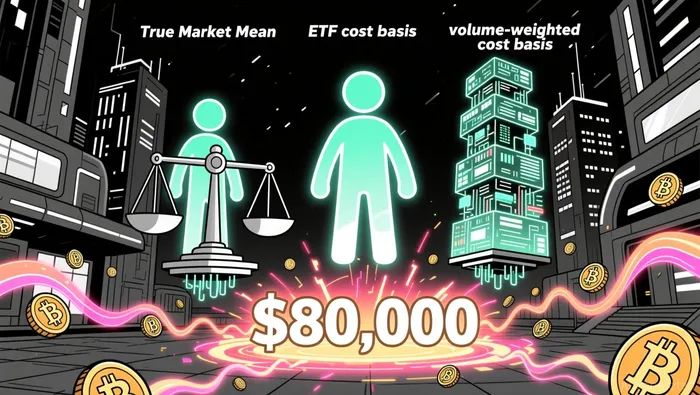
From 2023 to 2025, Bitcoin's on-chain cost basis metrics revealed a complex but coherent picture. The $80,000 price level emerged as a critical confluence of three key metrics: the True Market Mean (~$81,000), the U.S. ETF cost basis (~$83,844), and the 2024 yearly volume-weighted cost basis (~$83,000) according to CoinDesk analysis. These levels acted as gravitational anchors, with Bitcoin's ability to hold above them signaling strong investor conviction. The Relative Unrealized Loss metric, at 3.1% by late 2025, further underscored market resilience compared to the 2022–2023 bear cycle.
However, the structural equilibrium began to fray in late 2025 when Bitcoin broke below the Short-Term Holder (STH) cost basis (~$112.5K), a threshold that historically signals fading demand. This breakdown coincided with declining ETF inflows and elevated sell pressure, marking a transition into a moderate bear phase. The CME Bitcoin futures basis, meanwhile, reflected institutional strategies leveraging contango structures to profit from spot-futures arbitrage, highlighting the growing sophistication of market participants.
2026 Trends: Stalemate and Structural Thresholds
As of early 2026, Bitcoin trades around $93,000, with the $80,000 level retaining its role as a foundational support zone. The True Market Mean and U.S. ETF cost basis remain critical benchmarks, but the market is now locked in a stalemate between sellers taking profits and long-term holders (LTHs) accumulating. The STH Realized Price, currently near $87.5K, is a key short-term threshold: reclaiming this level could reduce selling pressure from short-term investors and signal a potential rebound.
Institutional activity has also shifted dramatically. Centralized exchange outflows have surged as institutional capital migrates to long-term holdings, a trend amplified by regulatory clarity in the U.S. For example, Strategy Inc. increased its Bitcoin holdings to 672,497 BTC by late 2025, while BitMine Immersion Technologies expanded EthereumETH-- staking infrastructure according to MEXC reporting. These moves reflect a maturing market where Bitcoin is increasingly treated as a yield-generating asset rather than a speculative play.
Institutional Adoption and Macroeconomic Catalysts
The integration of Bitcoin into traditional finance has been a defining theme of 2026. Grayscale's projection of a new all-time high by mid-2026 hinges on macroeconomic catalysts such as U.S. monetary policy shifts and ETF inflow dynamics. A steepening yield curve and a weaker dollar have further bolstered demand for alternative stores of value. However, weakening ETF inflows and smart-money selling remain red flags. If Bitcoin fails to reclaim its STH Realized Price, the risk of a bear market scenario intensifies, with bears projecting a decline to the Realized Price near $56,000.
Risks and Projections: A Delicate Balance
While institutional adoption and regulatory progress provide a tailwind, structural risks persist. The Spent Output Profit Ratio (SOPR) hovering near neutral suggests sales are occurring close to original purchase prices, indicating a lack of conviction among short-term holders. Additionally, the migration of BTC from centralized exchanges to long-term holdings, while a sign of market maturity, could reduce liquidity during periods of stress.
Experts project Bitcoin will trade between $80,000 and $140,000 for most of 2026, with a new all-time high contingent on macroeconomic triggers. However, a breakdown below $80,000 could reignite bearish sentiment, particularly if ETF inflows stall or macroeconomic conditions deteriorate.
Conclusion: A Make-or-Break Year
Bitcoin's 2026 trajectory hinges on its ability to defend critical on-chain cost basis thresholds. The $80,000 level remains a structural floor, while the STH Realized Price (~$87.5K) and True Market Mean serve as near-term benchmarks. Institutional adoption and regulatory clarity offer a long-term tailwind, but short-term volatility and ETF dynamics could disrupt the equilibrium. For investors, the key takeaway is clear: 2026 is a year of structural validation, where Bitcoin's on-chain metrics will either cement its role as a global store of value or expose vulnerabilities in its market structure.






Comentarios
Aún no hay comentarios