
Bitcoin's Critical $93,389 Threshold and Structural Institutional Adoption in 2025
Bitcoin's price trajectory in 2025 has become a focal point for investors and analysts, with the $93,389 threshold emerging as a symbolic and technical linchpin. This level, while not a hard technical resistance, represents a psychological and macroeconomic inflection point. Galaxy Research and Michael Novogratz, CEO of Galaxy DigitalGLXY--, offer divergent but complementary perspectives on Bitcoin's price action and institutional adoption trends, underscoring a market at a crossroads between short-term volatility and long-term structural transformation.
The $93,389 Threshold: A Macroeconomic and Psychological Battleground
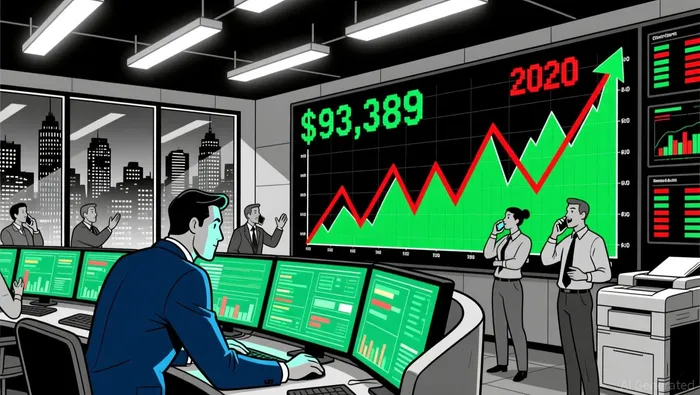
Bitcoin's failure to breach $100,000 in 2025-despite institutional adoption surging-has left the $93,389 level as a critical psychological benchmark. Galaxy Research notes that Bitcoin's real-term peak (adjusted for inflation) remains at $99,848 in 2020 dollars, meaning the $93,389 level is effectively a "floor" for a new all-time high in nominal terms according to market analysis. This threshold is not merely technical; it reflects broader macroeconomic realities. With the U.S. dollar's purchasing power eroded by 20% since 2020, Bitcoin's ability to outpace inflation becomes a key narrative for institutional buyers.
Novogratz, however, has tempered expectations, stating that BitcoinBTC-- "didn't do what it was supposed to do" in 2025, closing near $87,000 instead of his earlier $150,000 forecast. He attributes this to macroeconomic headwinds, including interest rate uncertainty and traditional market selling pressure. Yet, he emphasizes that institutional adoption has continued apace, with corporations like Strategy accumulating Bitcoin as a treasury asset. This dichotomy-between price underperformance and structural adoption-highlights a market where fundamentals and sentiment are decoupling.
Institutional Adoption: The New Structural Engine
The 2025 institutionalization of Bitcoin has been driven by regulatory clarity and innovative financial products. The repeal of SAB 121 and the creation of a Strategic Bitcoin Reserve in the U.S. have provided a legal framework for pension funds, state governments, and corporations to allocate capital to Bitcoin. Spot Bitcoin ETFs, particularly BlackRock's IBIT, have become cornerstones of institutional portfolios, with assets under management surging into the billions. These products have normalized Bitcoin as a tradable asset class, bridging the gap between traditional finance and crypto.
Corporate adoption has also accelerated. Firms are increasingly adopting the "MicroStrategy Playbook," converting cash reserves into Bitcoin to hedge against inflation and diversify balance sheets. This trend is not speculative but strategic, reflecting a shift in corporate treasury management. Galaxy Research projects that such adoption will continue even if Bitcoin experiences short-term dips, as institutional strategies like options overwriting and tokenized equity platforms gain traction.
Macroeconomic Narratives and Volatility Dynamics
Bitcoin's volatility in 2025 has been shaped by macroeconomic narratives. Novogratz notes that Bitcoin's sideways movement is a function of broader financial market pressures, including inflation and interest rate uncertainty. However, he argues that these factors are temporary. "Once Bitcoin moves back above $100,000, broader optimism will return," he stated, citing the potential for pro-crypto legislation like the CLARITY Act to act as a catalyst.
Galaxy Research, meanwhile, remains bullish on Bitcoin's long-term trajectory. While acknowledging 2025's challenges, the firm projects a new all-time high in 2026 and a price of $250,000 by 2027, driven by institutional adoption, DeFi maturation, and AI-driven payment systems. This optimism is rooted in structural trends: declining long-term volatility and the integration of Bitcoin into hybrid financial platforms that combine banking, tokenized equities, and prediction markets.
Strategic Implications for Investors
For investors navigating 2025's uncertainty, the interplay between price action and institutional flows offers actionable insights. First, the $93,389 threshold should be viewed as a psychological and macroeconomic battleground. A breakout above this level could reignite bullish sentiment, while a sustained breakdown might trigger short-term corrections. However, institutional adoption suggests that Bitcoin's floor is structurally higher than its 2025 price.
Second, investors should prioritize structural indicators over short-term volatility. The growth of spot ETFs, corporate Bitcoin holdings, and regulatory clarity are more reliable signals than price targets. Novogratz's caution about $250,000 price targets for 2025-requiring "a heck of a lot of crazy stuff"-highlights the need for patience. Instead, investors should focus on 2026-2027, when Galaxy Research anticipates Bitcoin's next phase of growth.
Finally, macroeconomic catalysts-such as the CLARITY Act or geopolitical shifts-could redefine Bitcoin's trajectory. These events are not predictable, but their potential to unlock institutional capital is undeniable. Investors should hedge against volatility while maintaining exposure to Bitcoin's long-term narrative.
Conclusion
Bitcoin's 2025 journey reflects a market in transition. The $93,389 threshold symbolizes both a challenge and an opportunity, with institutional adoption serving as the ultimate structural driver. While price targets remain contentious, the integration of Bitcoin into traditional finance is irreversible. For investors, the key lies in balancing short-term pragmatism with long-term vision, leveraging institutional trends to navigate a market poised for transformation.





Comentarios
Aún no hay comentarios