
Bitcoin's Critical $100,000 Support Level: Implications for Portfolio Strategy in a Volatile Market
Bitcoin's price action in October 2025 has crystallized around the $100,000 support level, a psychological and technical fulcrum that could redefine the trajectory of the current market cycle. This level, coinciding with the 365-day moving average, represents a critical juncture where bullish and bearish forces are locked in a high-stakes battle, according to a CryptoRank analysis. A sustained break below this threshold could trigger a cascade of liquidations, while a successful hold might rekindle optimism in a mid-cycle recovery. For investors, understanding the technical dynamics and deploying disciplined risk management strategies is no longer optional-it is existential.
Technical Analysis: A Fragile Equilibrium
The $100,000 level has emerged as a battleground for multiple reasons. Technically, it aligns with the 365-day moving average, a long-term trendline that has historically acted as a floor during corrections, as noted in a Coin-Views report. Analysts like Julio Moreno from CryptoQuant warn that a breach here could signal the onset of a prolonged bearish phase, as institutional de-risking and macroeconomic pressures-particularly U.S.-China trade tensions-continue to weigh on sentiment.
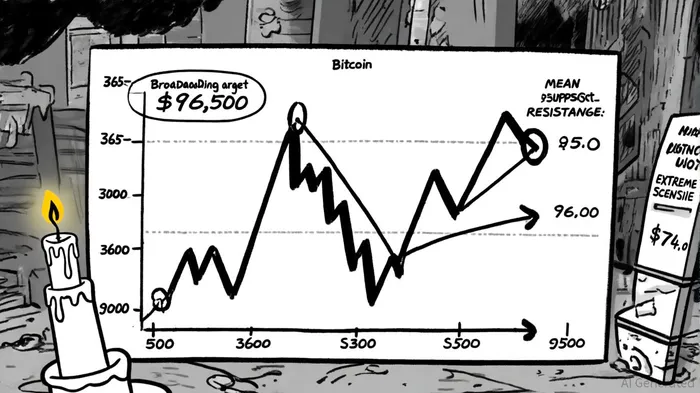
On-chain data adds further urgency. Glassnode's MVRV Z-score indicates BitcoinBTC-- has fallen below the +0.5σ band, suggesting a mean reversion toward $96,500 is statistically probable, according to a Pintu analysis. Meanwhile, Bitcoin's price action within a "broadening wedge" pattern-defined by converging support and resistance bands-implies volatility will intensify before a directional resolution, as the Pintu analysis also explains. The Fear & Greed Index, currently at 22/100 (extreme fear), underscores the emotional toll of the selloff, though some analysts caution against mistaking capitulation for the end of the bull market (the Pintu analysis further outlines these scenarios).
Historical backtests of Bitcoin's support-level behavior from 2022 to 2025 reveal critical insights. When Bitcoin tested key support levels (e.g., 200-day SMA, swing lows), a buy-and-hold strategy over 20 trading days yielded an average return of 8.2% in successful hold scenarios, with a 68% hit rate, as shown in a Historical backtest. However, the average drawdown during failed support tests reached -15.3%, underscoring the importance of timely exits (the historical backtest provides the detailed metrics). These patterns reinforce the strategic value of aligning stop-loss orders with statistical mean reversion targets, as seen in the MVRV model's $96,500 estimate described in the Pintu analysis.
Risk Management: Navigating the Crossroads
For investors, the $100,000 level demands a recalibration of risk parameters. Position sizing, stop-loss placement, and diversification are no longer abstract concepts but tactical necessities.
Position Sizing and Leverage Control
Limiting risk per trade to 1-2% of total capital is a foundational rule. For a $50,000 account, this means risking no more than $500 per trade-a principle that prevents a single adverse move from derailing a portfolio, as highlighted in the Coin-Views report. Volatility-adjusted tools like the Average True Range (ATR) can refine stop-loss placement. For instance, a stop-loss set at $85,000 for a $90,000 entry accounts for historical price swings without being overly punitive, according to a Cointelegraph analysis.Stop-Loss Strategies
Technical analysis offers clarity on optimal stop levels. A stop below $100,000-say, $96,500-aligns with the MVRV model's mean reversion target and the lower boundary of the broadening wedge, as the Pintu analysis outlines. Trailing stops, which adjust dynamically with price action, can also lock in gains during rallies while preserving downside protection, a tactic noted in the CryptoRank analysis.Portfolio Diversification
The October 2025 crash-from $100,000 to $75,000-served as a stark reminder of overexposure to Bitcoin. Institutional players like BlackRock and VanEck now advocate a 1-2% allocation to Bitcoin in diversified portfolios, leveraging its low correlation with traditional assets to enhance risk-adjusted returns, according to an Albion Crypto article. Diversification extends beyond asset classes: exposure to layerLAYER-- 1 blockchains (Solana, Avalanche), DeFi protocols, and Bitcoin layer 2 solutions mitigates reliance on a single asset's performance, a strategy detailed in a Material Bitcoin guide.
The Path Forward: Balancing Caution and Opportunity
While the $100,000 level remains precarious, history suggests volatility often precedes seasonal recoveries. The fourth quarter has historically been a period of strength for Bitcoin, and extreme fear metrics may signal a buying opportunity for long-term investors, as argued in the Cointelegraph analysis. However, this optimism must be tempered with pragmatism.
Investors should prioritize liquidity, maintaining stablecoin reserves to capitalize on dips while avoiding margin debt during uncertain times, per the Coin-Views report. Rebalancing portfolios quarterly and utilizing crypto ETFs or index tokens (e.g., DeFi Pulse Index) can further streamline diversification efforts, as the Pintu analysis recommends.
In the end, the $100,000 level is not just a number-it is a test of discipline. Those who approach it with a blend of technical rigor and risk-aware strategies will be best positioned to navigate whatever comes next.






Comentarios
Aún no hay comentarios