
Bitcoin's COT Positioning: Decoding Institutional Sentiment and Early Warning Signals for 2025
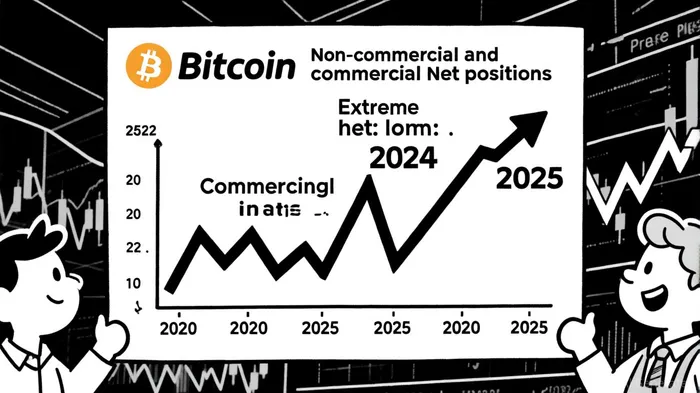
The BitcoinBTC-- futures market has become a critical battleground for institutional and speculative capital, with the Commitments of Traders (COT) reports from the CFTC offering a unique lens into positioning dynamics. As of September 2025, the latest COT data reveals a stark divergence between non-commercial (speculative) and commercial (institutional) positions, with the former holding a net long of 20 contracts and the latter a net short of -453 contracts[4]. This contrast underscores a pivotal moment in Bitcoin's market evolution, where speculative bullishness clashes with institutional caution, creating fertile ground for early warning signals.
Non-Commercial vs. Commercial Positioning: A Tale of Two Markets
Non-commercial traders, typically hedge funds and large speculators, have historically acted as contrarian indicators. Their current net long position of 20 contracts, though modest, aligns with a broader trend of accumulation observed in Q2 2025[2]. This contrasts sharply with commercial positions, which have shifted from a net long of +1,927 contracts in July 2025 to a net short of -453 by late September[4]. Such a reversal suggests hedgers are either reducing exposure to Bitcoin's volatility or shorting to offset risks in other markets.
The open interest in Bitcoin futures has surged to 28,844 contracts, a 3.32% weekly increase[4], indicating heightened liquidity and participation. However, the COT index—a measure of positioning neutrality—stands at 46.53%, signaling a relatively balanced market compared to historical extremes (e.g., 99.51% in July 2025)[1]. This balance, however, masks underlying tensions: speculative longs are building, while institutions are hedging, creating a potential catalyst for price volatility.
Historical Patterns and Correlation Shifts
Bitcoin's positioning dynamics have evolved significantly since 2020. During the 2024 market cycle, hodlers reduced positions during price declines (e.g., the April 2024 drop to $50,000) but accumulated aggressively as prices stabilized[2]. This cyclical behavior mirrors historical patterns post-halving, where supply constraints and speculative inflows drive price recoveries.
Notably, Bitcoin's correlation with equities has strengthened, reaching 0.48 with the S&P 500 in early 2025[3]. This shift reflects Bitcoin's integration into mainstream portfolios, where it is now viewed as a risk-on asset rather than a standalone speculative play. For institutional investors, this means Bitcoin's price movements are increasingly influenced by macroeconomic factors—such as U.S. dollar strength and central bank policies—that also affect equities[5].
Institutional Strategies: Cash-and-Carry and COT-Driven Entry Points
Institutional investors have adopted sophisticated strategies to navigate Bitcoin's volatility. One such approach is the cash-and-carry strategy, where long-spot ETF positions are paired with short CME futures to capture yields of up to 9.6%[1]. This strategy has driven record open interest in CME Bitcoin futures to $32.9 billion, reflecting institutional confidence in structured exposure[1].
The COT report itself is a critical tool for timing entries. For example, a surge in non-commercial longs (as seen in July 2025) often precedes bullish trends, while extreme commercial shorting (e.g., the -453 net position in September 2025) may signal oversold conditions[4]. Cross-referencing these signals with liquidity sweeps and order blocks can refine high-probability trade setups[6].
Early Warning Signals for 2025
Three key signals emerge from the COT data:
1. Extreme Non-Commercial Longs: When speculative positions exceed historical thresholds (e.g., the 99.51% COT index in July 2025), it often precedes a correction. Institutions should consider hedging or reducing exposure in such scenarios[1].
2. Commercial Shorting Reversals: A shift from net shorting to net longing among hedgers (e.g., the July-to-September 2025 transition) may indicate institutional confidence in Bitcoin's fundamentals[4].
3. Open Interest Divergence: Rising open interest alongside stable prices (as seen in Q3 2025) suggests accumulation by long-term holders, a precursor to upward momentum[2].
Conclusion: Positioning for the Next Leg
Bitcoin's COT data reveals a market at a crossroads. Speculative bullishness is building, while institutional caution persists. For institutional investors, the key lies in leveraging COT-driven signals to time entries during commercial shorting reversals or speculative overbought conditions. With regulatory clarity and ETF inflows providing tailwinds, 2025 could see Bitcoin's price test $200,000—a target supported by both on-chain metrics and positioning trends[5].






Comentarios
Aún no hay comentarios