
Bitcoin as a Corporate Treasury Reserve Asset: The Saylor Strategy and Its Implications for Institutional Adoption
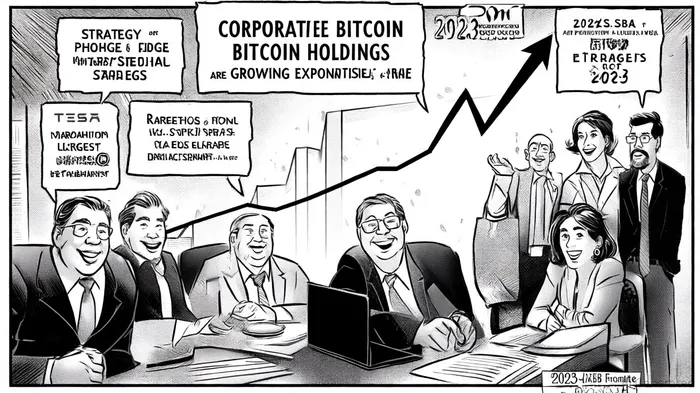
The corporate adoption of BitcoinBTC-- as a treasury reserve asset has evolved from a niche experiment to a strategic imperative for institutional investors. At the forefront of this movement is StrategyMSTR-- (formerly MicroStrategy), whose Bitcoin-centric model under Michael Saylor has redefined corporate capital allocation. By mid-2025, Strategy had accumulated 628,791 BTC, valued at $46.07 billion, transforming it into the largest corporate holder of Bitcoin [1]. This aggressive accumulation, funded through equity and debt instruments, has not only reshaped the company’s balance sheet but also catalyzed a broader trend of institutional Bitcoin adoption.
The Saylor Strategy: A Flywheel of Accumulation and Leverage
Michael Saylor’s approach to Bitcoin treasury management is rooted in a self-reinforcing capital structure. By issuing equity and convertible debt, Strategy has raised over $10 billion since 2023, with proceeds directly allocated to Bitcoin purchases [1]. This strategy leverages Bitcoin’s capped supply as a hedge against fiat devaluation while exploiting the asset’s volatility to amplify returns. For instance, Strategy’s Q2 2025 financial results revealed a BTC Yield of 25% and a $13.2 billion unrealized gain, driven by Bitcoin’s price appreciation from $65,000 to $85,000 during the period [1].
The company’s dual-class share structure, with Saylor controlling a majority of voting power, ensures strategic continuity. This governance model allows for sustained Bitcoin accumulation despite market fluctuations, as evidenced by Strategy’s $9.25 billion in convertible debt outstanding, which remains tied to Bitcoin’s performance ahead of the 2028 halving cycle [5]. Critics argue that equity dilution could erode shareholder value, yet Strategy’s stock has traded at a near 3x premium to its net asset value, suggesting market confidence in the model [3].
Broader Implications for Institutional Adoption
Strategy’s success has inspired a new class of Digital AssetDAAQ-- Treasury Companies (DATCOs), including Metaplanet and SharpLink GamingSBET--, which collectively hold $93 billion in Bitcoin [1]. Regulatory tailwinds, such as the 2023 FASB accounting update and the 2024 SEC approval of U.S. spot Bitcoin ETFs, have normalized Bitcoin’s inclusion in corporate balance sheets [1]. As of July 2025, 135 public companies had adopted Bitcoin as a reserve asset, with the U.S. accounting for 60% of these entities [2].
The strategic rationale for Bitcoin treasury holdings is threefold:
1. Inflation Hedging: Bitcoin’s fixed supply of 21 million units positions it as a counterbalance to central banks’ quantitative easing policies.
2. Yield Generation: Unlike cash or bonds, Bitcoin offers the potential for capital appreciation, particularly in low-interest-rate environments.
3. Brand Positioning: Companies like BlockXYZ-- Inc. and TeslaTSLA-- have leveraged Bitcoin holdings to signal innovation and attract a new investor base [5].
However, the risks remain significant. Bitcoin’s volatility can lead to earnings instability, as seen with GameStopGME-- and Sequans CommunicationsSQNS--, which experienced short-lived share price spikes after announcing Bitcoin treasury plans [4]. Cross-border regulatory complexities further complicate adoption, particularly for firms operating in jurisdictions with restrictive crypto laws [4].
The Future of Bitcoin as Corporate Capital
Looking ahead, the 2028 halving cycle is expected to amplify Bitcoin’s scarcity premium, potentially driving institutional demand. Strategy’s financing strategy, which ties debt maturity to Bitcoin’s price trajectory, reflects this anticipation [5]. Meanwhile, the emergence of DATCOs suggests a shift from speculative accumulation to systematic integration of Bitcoin into corporate treasury management.
For investors, the Saylor Strategy underscores the importance of aligning capital structure with macroeconomic trends. While Bitcoin’s role as a corporate reserve asset is still evolving, its adoption by public companies signals a maturing market. As regulatory frameworks solidify and institutional infrastructure expands, Bitcoin may transition from a speculative asset to a cornerstone of diversified corporate treasuries.
Source:
[1] Strategy Announces Second Quarter 2025 Financial Results [https://www.strategy.com/press/strategy-announces-second-quarter-2025-financial-results_07-31-2025]
[2] The Rise of Digital Asset Treasury Companies (DATCOs) [https://www.galaxy.com/insights/research/digital-asset-treasury-companies]
[3] Saylor's Flywheel: How Strategy Became Bitcoin's Corporate Whale [https://university.mitosis.org/saylors-flywheel-how-strategy-became-bitcoins-corporate-whale/]
[4] The Risks and Rewards of Bitcoin Treasury Strategies in ... [https://www.bitget.com/news/detail/12560604940986]
[5] Why MicroStrategy Is Financially Safe - For Now [https://blofin.com/academy/blofin-courses/why-microstrategy-is-financially-safe-for-now]





Comentarios
Aún no hay comentarios