
Bitcoin's Corporate Ascendancy: Strategic Investment in a Maturing Digital Asset Market
The maturation of BitcoinBTC-- as a strategic asset has reached a pivotal inflection point, driven by the aggressive accumulation strategies of corporate entities. As of October 2025, public and private companies collectively hold over 1.3 million BTC-6.2% of the total Bitcoin supply-marking a 21x increase since January 2020, according to a Business Initiative report. This surge reflects a broader institutional shift, where Bitcoin is no longer viewed as a speculative fad but as a core component of diversified corporate treasuries. For investors, understanding this trend is critical to navigating a digital asset market increasingly shaped by institutional demand.
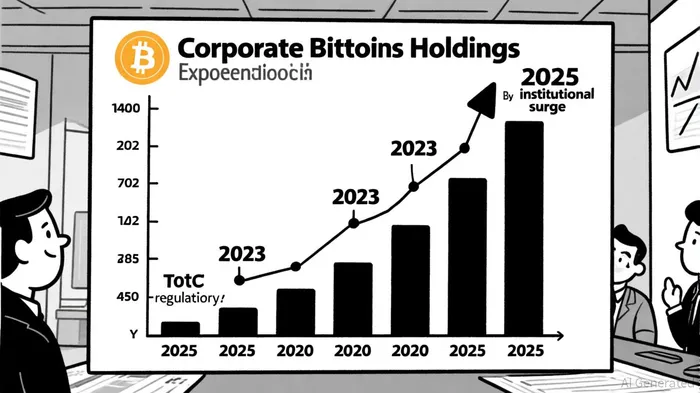
The Institutional Shift: From Niche to Norm
The rapid adoption of Bitcoin by corporations is underpinned by three key factors: regulatory clarity, inflation hedging, and asset diversification. In the U.S., the passage of the GENIUS and CLARITY Acts in 2025 provided much-needed legal frameworks for stablecoin oversight and crypto asset classification, reducing jurisdictional conflicts between regulators, according to a CryptoRank report. Concurrently, the opening of 401(k) investment channels to Bitcoin further legitimized its role as a mainstream financial instrument, according to a ChainCatcher report.
Data from that Business Initiative report reveals that 75% of corporate Bitcoin adopters are small businesses with fewer than 50 employees, allocating a median of 10% of net income to BTC. This democratization of adoption-spanning sectors like finance, technology, and real estate-has created a self-reinforcing cycle: as more companies treat Bitcoin as a strategic reserve asset, its price gains upward momentum, incentivizing further accumulation.
Key Players and Market Dynamics
MicroStrategy, rebranded as Strategy, remains the poster child of this trend. As of October 2025, the company holds 628,791 BTC, valued at $74.5 billion, dwarfing the holdings of competitors like MARA Holdings (50,000 BTC) and XXI (43,514 BTC), according to the Business Initiative report. Strategy's aggressive $7.7 billion Q1 2025 purchase, reported by ChainCatcher, underscores its role as a price anchor, with its stock performance historically mirroring Bitcoin's price swings, as shown in Cointelegraph's Bitcoin rich list.
The global landscape is equally dynamic. Japan's Metaplanet, now Asia's largest publicly traded Bitcoin holder, controls 7,800 BTC, according to The Coinomist list, while U.S. firms like Twenty One (31,500 BTC) and Brazil's Méliuz (320 BTC) illustrate the cross-border appeal of Bitcoin treasuries. Notably, the U.S. government itself has entered the fray, holding 207,189 BTC as part of its strategic reserve, the Cointelegraph list shows.
Market Implications: Institutional Dominance and Price Resilience
The institutionalization of Bitcoin has profound implications for its price dynamics. According to a Bitcoin Magazine analysis, corporate entities and ETFs acquired 944,330 BTC by October 2025-surpassing the total 2024 inflow. This demand has created a floor for Bitcoin's price, with institutional buyers acting as a counterbalance to retail volatility. For instance, despite a slowdown in corporate purchases during Q3 2025 due to macroeconomic headwinds, Bitcoin's price remained resilient, supported by ETF inflows and long-term treasury strategies, ChainCatcher noted.
Moreover, the correlation between corporate Bitcoin holdings and stock performance is becoming increasingly evident. Firms like Metaplanet and Twenty One have seen their equity valuations closely track Bitcoin's price trajectory, as noted on the Cointelegraph list, signaling a new era where crypto exposure directly influences corporate equity markets.
Challenges and Future Outlook
While the trend is robust, challenges persist. Macroeconomic pressures, such as rising interest rates and shifting investor sentiment, caused public companies to reduce Bitcoin purchases in late 2025, the Bitcoin Magazine analysis observed. MicroStrategy's monthly acquisitions, for example, plummeted from 134,000 BTC in November 2024 to 3,700 BTC by August 2025, the same analysis reported. However, these pauses are likely temporary. With over 1.3 million BTC already held by corporations and projections suggesting Bitcoin could reach $120,000 by Q2 2025, the CryptoRank report projects, the long-term trajectory remains bullish.
For investors, the key takeaway is clear: Bitcoin's maturing market is now driven by institutional players whose strategic accumulation provides both price stability and growth potential. As regulatory frameworks solidify and more companies adopt Bitcoin as a treasury asset, the digital asset's role in global finance will only expand.
Conclusion
The corporate Bitcoin boom is not a fleeting trend but a structural shift in how institutions perceive and manage risk. For investors, aligning with this shift-whether through direct BTC exposure, equity stakes in Bitcoin-native firms, or ETFs-offers a pathway to capitalize on a market increasingly defined by institutional demand. As the lines between traditional finance and digital assets blurBLUR--, strategic positioning in Bitcoin's corporate ecosystem will be a defining factor in long-term portfolio success.





Comentarios
Aún no hay comentarios