
Bitcoin's Corporate Adoption Surge vs. Price Stagnation: Unraveling the Institutional-Valuation Disconnect
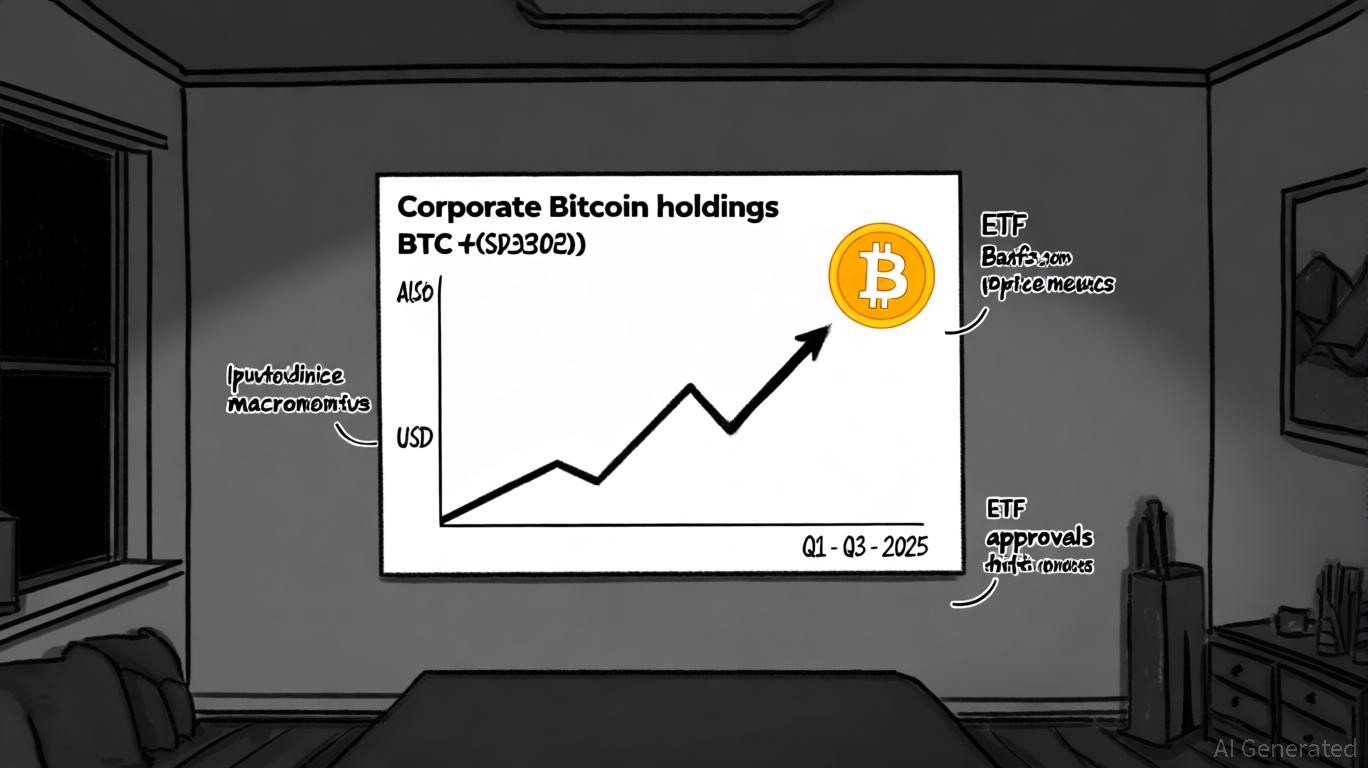
The BitcoinBTC-- market in 2025 presents a paradox: corporate adoption has reached unprecedented levels, yet the asset's price remains stubbornly range-bound. By Q3 2025, 338 entities-spanning 265 public and private companies-held over 1.3 million BTC, valued at $117 billion, with corporate entities collectively controlling 6.2% of Bitcoin's total supply, according to a FinancialContent report. This surge, driven by firms like Strategy (640,250 BTC) and Marathon Digital Holdings (53,250 BTC), reflects a strategic shift toward Bitcoin as a treasury asset. Yet, despite this institutional stampede, Bitcoin's price has oscillated between $75,000 and $120,000, failing to break out of a multi-month consolidation phase, according to a CoinDesk prediction.
The Mechanics of Institutional Adoption
The corporate Bitcoin boom is underpinned by three key factors: regulatory clarity, ETF-driven demand, and a redefinition of Bitcoin's role in corporate treasuries. By October 2025, U.S. spot Bitcoin ETFs-led by BlackRock's IBIT-had amassed $50 billion in assets under management, with global institutions acquiring 944,330 BTC since January 2025-7.4 times the annual mined supply, according to a PowerDrill analysis. This accumulation, however, is often executed over-the-counter (OTC) to avoid market impact, a tactic that dampens immediate price volatility, as reported in a Yahoo Finance analysis.
![]https://cdn.ainvest.com/aigc/hxcmp/images/compress-qwen_generated_1760721909785.jpg.png
Small and medium-sized businesses (SMBs) have also joined the trend, with 75% of corporate Bitcoin holders operating firms with fewer than 50 employees. These businesses allocate an average of 22% of their net income to Bitcoin, viewing it as a long-term reserve asset, according to a River report. The U.S. Strategic Bitcoin Reserve, established in March 2025, further legitimizes Bitcoin's role in institutional portfolios, as noted in a Business Initiative analysis.
The Price Conundrum: Why Isn't Bitcoin Reacting?
Despite record institutional demand, Bitcoin's price has shown little correlation with the surge in corporate holdings. Several factors explain this disconnect:
1.
OTC Accumulation and Market Impact: Large-scale OTC purchases by corporations and ETFs bypass spot markets, reducing direct pressure on price discovery. As noted by ChainCatcher, "Institutional buyers are prioritizing stealth over speed, accumulating Bitcoin in private deals that avoid public order books," according to ChainCatcher's report.
2.
ETF Inflows vs. Spot Volatility: While ETFs have injected $50 billion into Bitcoin's ecosystem, their impact on price is mediated by macroeconomic conditions. For instance, the Federal Reserve's tightening cycle and trade tensions have created a "two-speed market," where institutional demand coexists with macro-driven caution, as explained in a Greenhaus analysis.
3.
Market Psychology and Positioning: Retail investors, who historically drive Bitcoin's price cycles, have adopted a wait-and-see approach. The lack of a "retail-led" buying frenzy-unlike the 2020–2021 bull run-has limited upward momentum, according to 99Bitcoins' report.
4.
Supply-Demand Dynamics: With 3.8 million BTC held by institutions (as of September 2025), the remaining float has shrunk, reducing liquidity in spot markets. This scarcity, however, has not yet translated into a price breakout, suggesting that market participants are pricing in future adoption rather than current flows, according to a Bitcoin Magazine analysis.
The Road Ahead: A Structural Shift or a Temporary Stalemate?
Analysts remain divided on Bitcoin's near-term trajectory. Optimists cite on-chain metrics like the MVRV Z-Score and Pi Cycle Oscillator, which suggest a potential $190,000–$210,000 range by late 2025, according to a Bitcoin Magazine outlook. Pessimists, however, warn of a prolonged consolidation phase, with Bitcoin trading in a $119,500–$120,000 range until macroeconomic risks abate, warns a Coinpedia forecast.
The key question is whether corporate adoption will eventually translate into price appreciation. History offers mixed signals: while the 2020–2021 bull run was fueled by institutional inflows, the 2017 cycle saw similar adoption without sustained price gains. The difference in 2025 lies in the maturity of market infrastructure-ETFs, custody solutions, and regulatory frameworks-that may eventually bridge the gap between institutional demand and market valuation, argues a Pinnacle Digest analysis.
---





Comentarios
Aún no hay comentarios