
Bitcoin Core v30 Wallet Migration Bug and Its Implications for On-Chain Security and Backup Practices
The recent discovery of a critical wallet migration bug in BitcoinBTC-- Core v30.0 and v30.1 has reignited urgent discussions about the fragility of legacy wallet management and the necessity of institutional-grade backup solutions. This flaw, which risks permanent fund loss for users attempting to migrate older wallets, underscores a broader tension between software innovation and backward compatibility in the Bitcoin ecosystem. As the Bitcoin Core development team scrambles to release a fix in version 30.2, the incident serves as a stark reminder of the systemic risks inherent in relying on outdated infrastructure without robust safeguards.
Technical Vulnerabilities in Legacy Wallet Migration
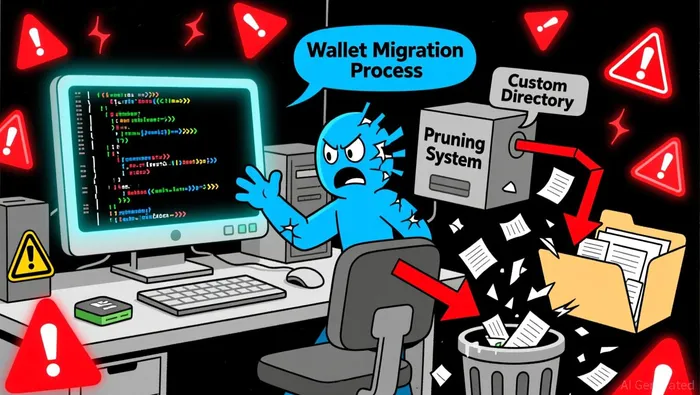
The v30 wallet migration bug primarily affects users of legacy wallets-specifically those stored in the default wallet.dat file-when pruning is enabled and the wallet is located in a custom or mounted directory according to technical analysis. Under these conditions, the migration process can erroneously delete all files in the wallet directory, rendering recovery impossible without a backup as reported by security experts. This issue is exacerbated for users who have not updated their wallets in years, as legacy formats lack the structural resilience of modern multi-signature (multi-sig) or hardware wallet solutions according to Bitcoin Core documentation.
Developers have acknowledged that the bug stems from a flaw in how the software handles wallet unloading during pruning, a process designed to reduce blockchain storage requirements as detailed in technical reports. While the affected binaries have been removed from official download pages, the incident highlights a critical vulnerability: even well-established software can introduce catastrophic risks when evolving to accommodate new features without fully accounting for backward compatibility according to industry analysis.
The Human Cost of Inadequate Backup Practices
The Bitcoin Core team's advisory to avoid migration attempts and back up entire data directories has been widely circulated has been met with both relief and frustration. For individual users, the incident underscores the perils of neglecting basic security hygiene. According to a report by Resonance Security, over 60% of crypto-related fund losses stem from poor key management, including the absence of backups and failure to store recovery phrases securely according to security research. The v30 bug amplifies these risks, as even technically savvy users can fall victim to edge-case errors when navigating complex migration processes as observed in case studies.
The QuadrigaCX scandal-where $130 million in assets became inaccessible after the CEO's death-serves as a cautionary tale according to security analysis. In that case, a lack of multi-sig protocols and contingency planning rendered the funds irretrievable. While the v30 bug is distinct in its technical cause, it shares a common root with such failures: an overreliance on single points of failure and insufficient redundancy.
Institutional-Grade Solutions: A Blueprint for Resilience
In contrast to individual users, institutional players have long adopted practices that mitigate such risks. Cold storage-keeping private keys offline-is a foundational strategy, with hardware wallets like Ledger providing protection against both cyber threats and physical damage as described in institutional reports. However, cold storage's limitations in transaction speed have led institutions to adopt hybrid custody models, combining cold storage's security with hot wallets for liquidity management according to custody solution analysis.
Multi-sig configurations further enhance resilience by requiring multiple approvals for transactions, thereby distributing risk across teams or custodians according to institutional security guidelines. A 2-of-3 multi-sig setup, for instance, ensures continuity even if one keyholder becomes unavailable. Unlike multi-party computation (MPC) solutions, multi-sig offers transparent on-chain validation, which is critical for regulatory compliance and auditability as explained in security documentation.
Institutional-grade solutions also emphasize contingency planning. Secure key management includes storing seed phrases in fireproof, waterproof devices and appointing custodial trustees with technical expertise to manage assets in emergencies according to best practices research. Ledger Vault's institutional offerings, for example, enable multi-authorization rules and rapid transaction execution without requiring all signers to be present as detailed in product documentation. Structured crypto trusts, meanwhile, provide a legal framework for asset transfer in the event of a keyholder's death, ensuring that inheritance rights are preserved according to comprehensive guides.
Implications for On-Chain Security and Future Development
The v30 bug is not merely a technical glitch but a symptom of deeper challenges in maintaining backward compatibility while advancing Bitcoin's infrastructure. As the network evolves, developers must balance innovation with the need to protect users of legacy systems. This includes rigorous testing of migration pathways and clearer communication about the risks of outdated formats.
For investors and operators, the incident reinforces the imperative of adopting institutional-grade practices. While individual users may dismiss such measures as excessive, the cost of inaction-measured in lost funds and eroded trust-is far greater. The Bitcoin ecosystem's resilience hinges on its ability to learn from these incidents and institutionalize best practices across all user tiers.
Conclusion
The Bitcoin Core v30 wallet migration bug is a wake-up call for the entire crypto community. It exposes the vulnerabilities of legacy systems and the human errors that amplify their risks. Yet, it also provides a roadmap for improvement through institutional-grade solutions that prioritize redundancy, transparency, and contingency planning. As Bitcoin continues to mature as a store of value and medium of exchange, the adoption of these practices will be critical to ensuring its long-term security and usability.






Comentarios
Aún no hay comentarios