
Bitcoin Core v30's OP_RETURN Expansion: A Paradigm Shift for Metaprotocols and Bitcoin's Value Proposition
Bitcoin Core v30, released in October 2025, has ignited a seismic debate within the cryptocurrency community by expanding the OP_RETURN data limit from 80 bytes to 100,000 bytes per output-effectively allowing nearly 4MB of arbitrary data per transaction, according to a Coinotag article. This change, framed as a policy update rather than a consensus rule, has positioned BitcoinBTC-- at a crossroads: a potential transition from a peer-to-peer electronic cash system to a generalized data layer capable of supporting metaprotocols and decentralized applications (DApps). While proponents argue this expansion unlocks new use cases and modernizes Bitcoin's utility, critics warn of risks to decentralization, network bloat, and a dilution of its core value proposition.
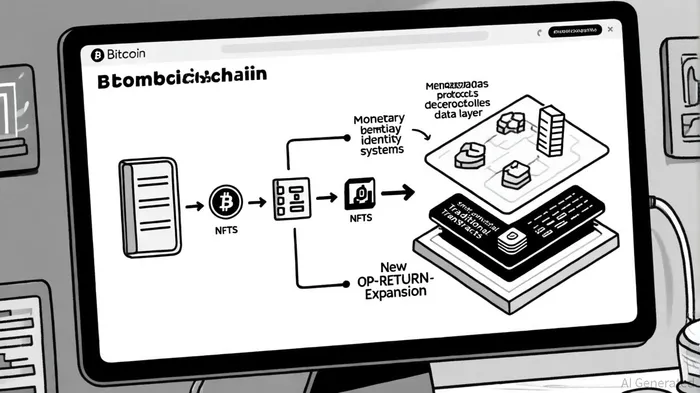
Enabling Metaprotocols: A New Frontier for Bitcoin
The expanded OP_RETURN capacity allows developers to embed complex data such as images, timestamps, and even video clips directly into the blockchain, as reported by BeInCrypto. This has catalyzed the development of metaprotocols-layer-1 protocols that leverage Bitcoin's immutability for non-financial applications. For instance, the Atomicals Virtual Machine (Atomicals VM) now enables the creation of unique digital assets and smart contracts on Bitcoin, bypassing the need for sidechains or Layer 2 solutions, as discussed on Bitcoin Stack Exchange. Similarly, decentralized identity systems and zero-knowledge proofs can now be anchored to Bitcoin's blockchain, offering users verifiable, censorship-resistant credentials, a point also highlighted in the Coinotag article.
A bitbo.io article suggests this shift could democratize access to decentralized finance (DeFi) and non-fungible tokens (NFTs) by leveraging Bitcoin's existing infrastructure, potentially attracting a broader user base. For investors, the emergence of metaprotocols represents a significant opportunity: projects like Ordinals and STAMPS, which previously relied on workarounds to embed data, may now integrate seamlessly into Bitcoin's ecosystem, driving demand for on-chain transactions and fee revenue, according to CoinDesk.
The Value Proposition Dilemma: Cash vs. Data Layer
Bitcoin's original design, as outlined in the whitepaper, prioritized simplicity and efficiency as a decentralized monetary system. The v30 update, however, challenges this ethos by enabling Bitcoin to function as a data storage mechanism. Critics, including developers like Luke Dashjr, argue that this risks blockchain bloat, increasing storage and bandwidth demands for nodes and potentially centralizing the network as smaller operators exit, as warned in a Medium post.
The ideological debate mirrors the 2017 block size wars, with maximalists advocating for Bitcoin's role as a "digital gold" and others pushing for innovation. A Protos article notes that the configurability of the -datacarriersize parameter-allowing node operators to set custom limits-has further fragmented the community, with some opting for alternative implementations like Bitcoin Knots to enforce stricter defaults. This fragmentation raises questions about governance and whether Bitcoin can maintain consensus amid diverging priorities.
Risks and Market Implications
While the technical feasibility of metaprotocols is clear, their economic viability remains uncertain. Transaction costs could surge as larger data payloads drive up fees, potentially pricing out smaller users, a concern raised in the Coinotag article. Additionally, legal risks for node operators-such as liability for hosting copyrighted or illegal content-introduce regulatory uncertainty, as discussed on the OneSafe blog. For investors, these risks necessitate a careful assessment of long-term adoption trends and fee dynamics.
Conclusion: Balancing Innovation and Core Principles
Bitcoin Core v30's OP_RETURN expansion is a double-edged sword. On one hand, it empowers developers to build innovative applications on Bitcoin's immutable ledger, potentially broadening its appeal beyond payments. On the other, it risks undermining the network's decentralization and efficiency. For investors, the key lies in monitoring on-chain metrics-such as transaction volume, fee rates, and node participation-to gauge whether the market embraces this new paradigm.
As the debate unfolds, one truth remains: Bitcoin's adaptability is both its greatest strength and its most contentious challenge. The v30 update is not merely a technical upgrade but a philosophical pivot that will shape Bitcoin's trajectory for years to come.






Comentarios
Aún no hay comentarios