
Bitcoin's Contradictory Trajectory: Contrarian Views vs. Institutional Momentum
The Institutional Bull Case: Policy, Security, and Strategic Reserves
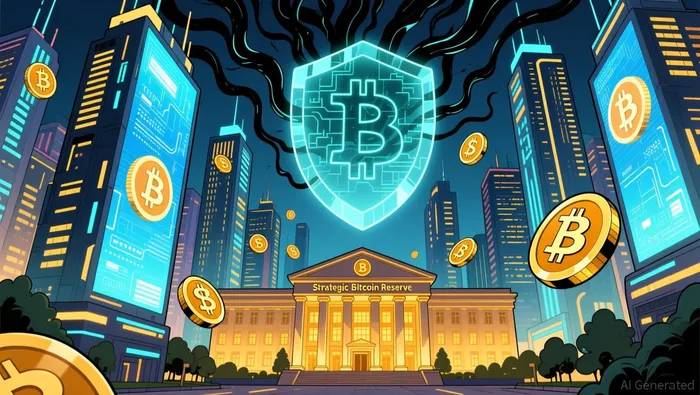
Institutional confidence in Bitcoin has reached a fever pitch, driven by legislative innovation and technological reassurance. The Bitcoin for America Act of 2025, endorsed by the Bitcoin Policy Institute, is a game-changer. By allowing Americans to pay federal taxes in Bitcoin without triggering capital gains liability, the act notNOT-- only legitimizes the asset as a store of value but also creates a Strategic Bitcoin Reserve for the U.S. government. This move signals a shift from viewing Bitcoin as a speculative tool to a strategic asset-a hedge against inflation and a long-term wealth generator for public coffers.
Technological robustness further fuels institutional optimism. Quarkslab's first public third-party audit of Bitcoin Core found no critical vulnerabilities, a finding that silences critics who question the network's security. For institutions, this audit is a green light: Bitcoin's infrastructure is mature, its codebase resilient. Combine this with CME Group's growing adoption of Bitcoin volatility indices, and you have a toolkit for managing risk in a market that's still prone to wild swings.
The Contrarian Bear Case: Volatility, Scalability, and Sustainability
Yet the bulls face a formidable counterargument. Bitcoin's volatility remains a double-edged sword. A 21.2% drop in November 2025 and a 23.2% loss over three months have exposed the fragility of passive Bitcoin strategies. MicroStrategy's 60% stock price plunge, driven by its heavy Bitcoin holdings, underscores the risks of treating Bitcoin as a "buy and hold" asset in a deleveraging environment. 's observation that Bitcoin's volatility mirrors broader market cycles is a reminder that no asset is immune to macroeconomic headwinds.
Scalability, too, remains a thorn in Bitcoin's side. While projects like Bitcoin Munari aim to address throughput limitations through phased development on SolanaSOL-- and EVM-compatible smart contracts, the core Bitcoin network still struggles with transaction bottlenecks. For institutions demanding high-speed settlements, these limitations are not just technical hurdles-they're existential questions about Bitcoin's utility in a globalized economy.
Then there's the elephant in the room: environmental impact. With the Trump administration's Energy Department pivoting toward fossil fuels and nuclear power, Bitcoin's energy consumption-still heavily reliant on non-renewable sources-has come under renewed scrutiny. Critics argue that without a clean energy transition, Bitcoin's carbon footprint could clash with global sustainability goals. This isn't just a PR issue; it's a regulatory risk that could trigger stricter oversight.
The Balancing Act: Contradictions as Catalysts
The key to navigating Bitcoin's contradictory trajectory lies in recognizing that these narratives are not mutually exclusive. Institutional adoption is accelerating precisely because Bitcoin is addressing its weaknesses. The Strategic Bitcoin Reserve and volatility indices are tools to mitigate risk, not ignore it. Similarly, projects like Bitcoin Munari are innovating within the Bitcoin ecosystem to solve scalability issues, proving that the network's limitations are not insurmountable.
However, investors must remain vigilant. The environmental critique and volatility risks are real and could resurface if macroeconomic conditions deteriorate. The lesson here is to treat Bitcoin not as a standalone investment but as part of a -one that balances its potential for growth with hedging strategies and regulatory contingencies.
Conclusion: A Market at a Crossroads
Bitcoin in 2025 is at a crossroads. Institutional momentum is undeniable, but it's not a free pass. The contrarian arguments-volatility, scalability, and sustainability-are valid and must be addressed. For investors, the challenge is to harness Bitcoin's strengths while mitigating its flaws. As the market evolves, the winners will be those who can navigate this duality with both optimism and pragmatism.







Comentarios
Aún no hay comentarios