
Bitcoin's Consolidation Phase and the Institutional Altcoin Shift: Strategic Allocation in a Maturing Crypto Market
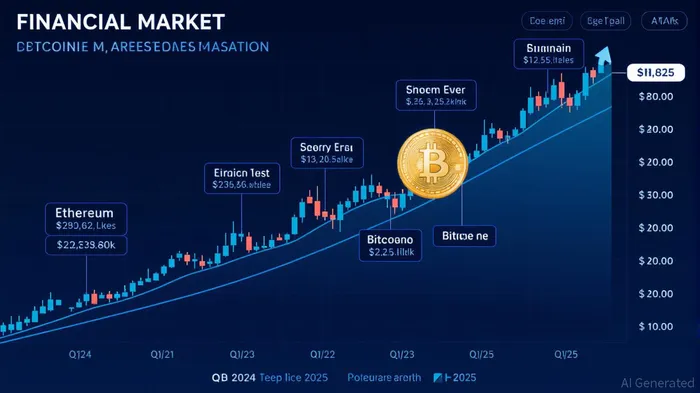
Bitcoin's recent sideways movement—a consolidation phase—has sparked a strategic reallocation of capital among institutional investors. As the crypto market matures, the narrative is shifting from Bitcoin-centric portfolios to diversified allocations across altcoins, driven by innovation, scalability, and niche use cases. This trend reflects a broader maturation of the asset class, where risk-return profiles are being reevaluated through a lens of technological differentiation and macroeconomic positioning.
The Case for Bitcoin's Consolidation
Bitcoin's price action in 2025 has been characterized by a deliberate consolidation phase, with the asset trading within a $60,000–$70,000 range. This pattern, observed in on-chain metrics and price-volume data, suggests a market in equilibrium as investors digest post-halving volatility and macroeconomic uncertainty. While BitcoinBTC-- remains the dominant store of value, its role as a speculative asset has plateaued, prompting institutions to seek higher-growth opportunities in the altcoin space.
Institutional Appetite for Altcoins: A Strategic Diversification
Institutional capital is increasingly allocating to altcoins to hedge against Bitcoin's stagnation and capture innovation-driven returns. EthereumETH-- (ETH), for instance, retains its dominance as a decentralized application platform, with a market capitalization exceeding $418.9 billion [2]. Its transition to a proof-of-stake model and the proliferation of decentralized finance (DeFi) protocols have solidified its appeal as a “blue-chip” altcoin.
Solana (SOL) has emerged as a high-speed alternative, leveraging a hybrid proof-of-stake and proof-of-history consensus mechanism to process thousands of transactions per second at minimal cost [2]. This scalability has attracted institutional investors seeking exposure to blockchain infrastructure, particularly in emerging markets where transaction efficiency is critical.
Meanwhile, Bitcoin Hyper (HYPER) is gaining traction as a Layer 2 solution, enabling faster Bitcoin transactions and integrating DeFi features like staking and lending [4]. This innovation addresses Bitcoin's inherent limitations, offering institutions a way to retain exposure to the Bitcoin ecosystem while accessing yield-generating opportunities.
Meme Coins and the Risk-Reward Paradox
The altcoin surge has also extended to meme coins, with Maxi DogeDOGE-- (MAXI) and DogecoinDOGE-- (DOGE) drawing attention for their speculative potential. Maxi Doge, for example, offers trader-focused tools and high staking rewards, while Dogecoin's bullish flag pattern suggests a possible breakout [5]. However, these assets come with elevated volatility and liquidity risks, making them suitable only for aggressive, short-term allocations.
Strategic Allocation in a Maturing Market
As the crypto market evolves, strategic asset allocation must balance Bitcoin's stability with altcoin innovation. Key considerations include:
1. Diversification by Use Case: Allocating to altcoins with distinct value propositions—such as CardanoADA-- (ADA) for smart contracts, AvalancheAVAX-- (AVAX) for fast transactions, and XRPXRP-- for cross-border payments [2]—reduces exposure to single-asset risk.
2. Risk Management: Altcoins require rigorous due diligence, given their susceptibility to regulatory shifts and liquidity gaps. Institutions are advised to cap altcoin allocations at 10–15% of crypto portfolios.
3. Macro Alignment: Altcoin adoption is being fueled by record ETF inflows and growing institutional infrastructure [4]. Investors should monitor macroeconomic signals, such as interest rate trends and global payment demand, to time entries.
Conclusion
Bitcoin's consolidation phase is not a sign of waning relevance but a catalyst for a more diversified crypto ecosystem. As institutional investors navigate this maturing market, the strategic allocation to altcoins offers a pathway to capitalize on innovation while mitigating overexposure to Bitcoin's cyclical patterns. However, success hinges on a disciplined approach that prioritizes technological fundamentals, risk management, and macroeconomic alignment.






Comentarios
Aún no hay comentarios