
Bitcoin's Compressed Volatility and the Fed's Rate Cut Implications
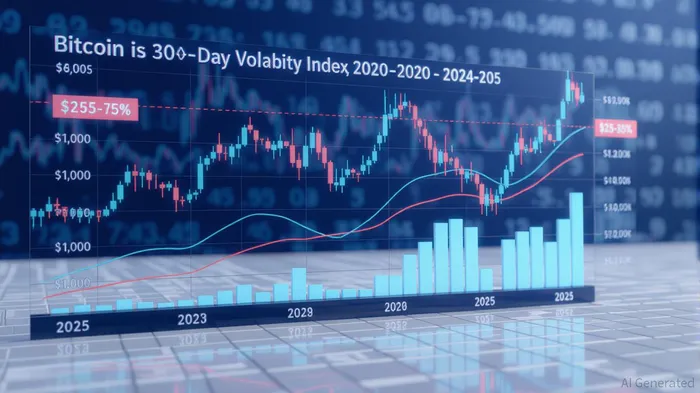
The New Normal: Bitcoin's Compressed Volatility in Q3 2025
Bitcoin's volatility profile in Q3 2025 has entered a phase of compression, driven by structural shifts in institutional adoption and macroeconomic stability. On-chain metrics like the MVRV Z-Score (currently at 2.7) and Value Days Destroyed (VDD) indicate a market in accumulation mode, with long-term holders (LTHs) absorbing dips below $75,000 . This contrasts with the hyper-volatile 2020–2022 period, where Bitcoin's 30-day volatility averaged 4.8% . The compression is attributed to two factors:
1. Institutional Anchoring: U.S. 401(k) access to BitcoinBTC-- and $118B in ETF inflows by Q3 2025 have stabilized price swings, as institutional buyers prioritize long-term value over speculative trading .
2. Regulatory Clarity: The approval of spot Bitcoin ETFs in early 2024 reduced arbitrage opportunities and fragmented liquidity, narrowing bid-ask spreads .
However, this calm is fragile. Historical precedents show that overbought conditions (MVRV Z-Score > 2.5) often precede corrections, even in bull cycles .
Fed Rate Cuts: A Double-Edged Sword for Liquidity Reallocation
The Federal Reserve's projected 0.25% rate cut in September 2025 is poised to reshape capital flows. Traders have priced in an 86% probability of this cut, driven by a 4.2% unemployment rate and moderating inflation . While rate cuts typically boost risk-on sentiment, their impact on Bitcoin is nuanced:
- Short-Term Liquidity Surge: Lower rates reduce the opportunity cost of holding non-yielding assets like Bitcoin, potentially fueling ETF inflows and spot price rallies .
- Long-Term Volatility Risks: The Fed's dovish pivot may trigger a “flight to quality” in equities, decoupling Bitcoin from its traditional equity correlation. However, geopolitical risks (e.g., trade wars) could reignite volatility .
A critical question remains: Will the Fed's rate cuts amplify Bitcoin's liquidity reallocation or expose structural weaknesses? The answer lies in how institutional players respond.
Volatility Re-Emergence: The Unseen Threat
Despite compressed volatility, Bitcoin's historical volatility patterns suggest re-emergence is inevitable. During the 2024–2025 cycle, the 30-day volatility index dropped to 3.28% post-ETF approval , but this masks underlying fragility. Key risks include:
1. Overvaluation: Bitcoin's $190,000 price target by Q3 2025 implies a 67% upside from current levels, raising concerns about speculative bubbles .
2. Macro Shocks: A global recession or equity market crash could trigger a 20%+ correction, as seen in March 2025 post-Trump inauguration .
3. Geopolitical Triggers: While institutional adoption has dampened war-related volatility (e.g., 4.5% drop during the 2025 Iran-Israel conflict), systemic risks persist .
Strategic Implications for Investors
Investors must balance the Fed's rate cut tailwinds with Bitcoin's inherent volatility. A diversified approach is recommended:
- Hodlers: Allocate to Bitcoin ETFs for liquidity and regulatory safety, but cap exposure at 10–15% of a diversified portfolio.
- Traders: Use volatility indices and options to hedge against potential corrections, especially as the MVRV Z-Score approaches 3.0 .
- Institutions: Monitor capital flow dynamics, as a shift from Bitcoin to altcoins could signal a new “altcoin season” .
Conclusion
Bitcoin's compressed volatility in Q3 2025 reflects a maturing market, but the Fed's rate cuts and macroeconomic uncertainties pose a volatile undercurrent. While institutional adoption and ETF inflows provide a floor, investors must remain vigilant against re-emerging volatility. The next 90 days will test whether Bitcoin's new equilibrium can withstand the forces of liquidity reallocation and macroeconomic turbulence.
Source:
[1] What Bitcoin Indicators Predict For Q3 2025? [https://bitcoinmagazine.com/markets/bitcoin-indicators-predict-q3-2025]
[2] Bitcoin Price Dynamics: A Comprehensive Analysis of Macroeconomic Correlations, Halving Cycles, and Institutional Adoption Patterns [https://papers.ssrn.com/sol3/Delivery.cfm/5395221.pdf?abstractid=5395221&mirid=1]
[3] Q3 2025 Bitcoin Valuation Report [https://www.chaincatcher.com/en/article/2199982]
[4] Bitcoin Price History Chart + Historical Events 2009-2025 [https://99bitcoins.com/cryptocurrency/bitcoin/historical-price/]
[5] Fed seen on track for three rate cuts this year, starting next week [https://www.reuters.com/business/fed-seen-track-three-rate-cuts-this-year-starting-next-week-2025-09-09/]
[6] White Paper: Bitcoin's Positive Correlation with Federal Reserve Rate Declines and Projected 30% Price Surge Per 1% Rate Cut [https://cognac.com/white-paper-bitcoins-positive-correlation-with-federal-reserve-rate-declines-and-projected-30-price-surge-per-1-rate-cut/]
[7] What will drive crypto in Q3 2025? [https://www.blockscholes.com/research/bybit-x-block-scholes-quarterly-report-what-will-drive-crypto-in-q3-2025]
[8] Bitcoin Price Slumps After Trump Inauguration Surge ... [https://b24.am/en/crypto/bitcoin-price-slumps-after-trump-inauguration-surge.html]
[9] How does war affect Bitcoin? A deep analysis of the five- [https://www.panewslab.com/en/articles/8k53xr62fi82]
[10] Altcoin season and the evolving role of Bitcoin [https://www.blockscholes.com/research/bybit-x-block-scholes-quarterly-report-altcoin-season-and-the-evolving-role-of-bitcoin]






Comentarios
Aún no hay comentarios