
Bitcoin's CME Gap Fill and ETF Rebalancing: A Technical and Structural Turning Point?
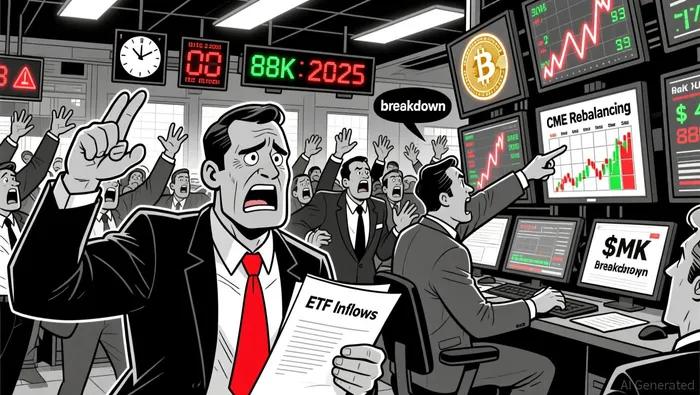
Bitcoin's price action in late 2025 and early 2026 has been shaped by a confluence of technical triggers and structural shifts, most notably the CMECME-- gap fill and ETF rebalancing dynamics. These factors, combined with broader macroeconomic and institutional trends, are raising critical questions about whether this period marks a turning point for the cryptocurrency's trajectory.
Short-Term Dynamics: CME Gap Fills and ETF Rebalancing
The CME gap fill-a technical phenomenon where price gaps on futures charts are revisited-has long been a focal point for BitcoinBTC-- traders. In late 2025, Bitcoin approached a key gap zone between $91,000 and $90,000, a level analysts deemed critical for sentiment and leverage management. noted that a fill of this gap could trigger a "narrative flip," destabilizing leveraged long positions and shifting market psychology toward caution. Meanwhile, a deeper retest of the $88,000 zone could signal a broader correction, prompting defensive positioning among traders.
Simultaneously, ETF rebalancing activity in December 2025 added another layer of complexity. revealed outflows of approximately 1,160 BTCBTC-- (~$105 million) during late November and early December, attributed to year-end portfolio adjustments rather than a bearish shift in sentiment. These outflows temporarily pressured Bitcoin's price but were followed by renewed inflows in early January as spot buyers absorbed dips, suggesting resilience in institutional demand.
The interplay between these short-term factors and macroeconomic conditions further complicates the outlook. Lower real interest rates and the anticipation of a Federal Reserve rate cut in late 2025 have bolstered risk-on sentiment, with Interactive Brokers analysts highlighting Bitcoin's alignment with broader market trends favoring inflation hedges.
Long-Term Structural Shifts: Institutional Adoption and Regulatory Clarity
While short-term volatility remains a concern, the long-term narrative is increasingly defined by institutional adoption and regulatory progress. By 2025, 86% of institutional investors had either allocated to digital assets or planned to do so, with 68% specifically targeting Bitcoin exchange-traded products (ETPs). This shift has been fueled by landmark regulatory developments, including the repeal of SAB 121 and the enactment of the GENIUS Act, which provided clarity on stablecoin and digital asset accounting.
Corporate treasuries have also embraced Bitcoin as a strategic asset. Firms like MicroStrategy, Semler Scientific, and Metaplanet have institutionalized Bitcoin holdings, converting cash reserves into the cryptocurrency to hedge against currency devaluation and generate yield. This trend has been amplified by innovations such as staking-enabled ETFs, which transform Bitcoin into a yield-generating asset while mitigating volatility risks.
Regulatory frameworks are further cementing Bitcoin's institutional legitimacy. The EU's Markets in Crypto-Assets (MiCA) regulation, fully implemented in 2025, has created a harmonized legal environment for digital assets, while the U.S. is poised to pass a crypto market structure bill in 2026, clarifying the roles of the SEC and CFTC. These developments are expected to reduce barriers for traditional financial institutions, enabling deeper integration of Bitcoin into pension funds, 401(k) plans, and asset management strategies.
A Convergence of Forces
The convergence of short-term technical dynamics and long-term structural trends suggests that Bitcoin's current phase is more than a transient correction-it is a structural inflection point. The CME gap fill and ETF rebalancing activity highlight the asset's sensitivity to institutional flows and leverage cycles, while regulatory clarity and corporate adoption underscore its transition from speculative novelty to a core portfolio asset.
For investors, the key takeaway is that Bitcoin's price trajectory will increasingly reflect institutional demand rather than retail-driven volatility. With global institutional assets exceeding $100 trillion, even a modest 2–3% allocation to Bitcoin could generate $3–4 trillion in demand, far outpacing supply constraints from halving events. This imbalance, combined with macroeconomic tailwinds and regulatory tailwinds, positions Bitcoin for sustained appreciation in 2026 and beyond.
Conclusion
Bitcoin's CME gap fill and ETF rebalancing in late 2025 are not isolated events but symptoms of a broader transformation. As institutional adoption accelerates and regulatory frameworks mature, the cryptocurrency is evolving into a foundational asset class. While short-term volatility remains inevitable, the long-term trajectory is increasingly shaped by structural forces that favor Bitcoin's integration into global finance. For investors, the challenge lies in navigating the immediate technical risks while recognizing the enduring institutional tailwinds that define this new era.





Comentarios
Aún no hay comentarios