
Bitcoin's CME Gap Dynamics and Implications for 2026 Volatility
The evolution of Bitcoin's price action in 2026 is inextricably tied to the structural mechanics of the CMECME-- BitcoinBTC-- futures market and the behavioral psychology of institutional participants. As the CME GroupCME-- solidified its dominance in crypto derivatives-surpassing Binance in open interest by October 2025-the interplay between regulated futures trading and 24/7 spot markets has created unique volatility drivers. These dynamics, amplified by institutional herd behavior and sentiment amplification, are reshaping how Bitcoin's price is interpreted and traded.
Institutional Structures and the CME Gap Mechanism
The CME Bitcoin futures market operates on a traditional trading schedule, closing over weekends and holidays, while spot markets trade continuously. This structural dislocation creates "CME gaps"-price discrepancies between the Friday close and Monday open. For example, the $375 gap observed in March 2025, where Bitcoin opened at $88,200 after closing at $87,825 the prior week, exemplifies how these gaps serve as technical signals for institutional traders. Historical data reveals that approximately 98% of CME gaps eventually fill, often within five trading days, creating predictable patterns that institutions exploit through leverage and basis trading.
The alignment of spot Bitcoin ETFs with CME futures has further institutionalized these dynamics. By tying ETFs and futures to the same reference rate, delta-neutral basis trades allow institutions to isolate profits from directional price movements. This alignment has also amplified liquidity, with the CME's 35% share of global regulated Bitcoin derivatives volume making it a critical barometer for market sentiment.
Behavioral Psychology and Herd Mentality
The psychological impact of CME gaps cannot be overstated. When gaps emerge, they act as focal points for collective decision-making. For instance, the $655 gap in January 2026-arising from spot trading during the CME's holiday closure-triggered heightened market attention and strategic positioning. Institutional traders, recognizing the historical likelihood of gap fills, often adopt synchronized strategies, creating a self-fulfilling prophecy. This herd behavior is exacerbated by the CME's role as a regulated benchmark, which lends credibility to its price signals and amplifies collective action.
This is a 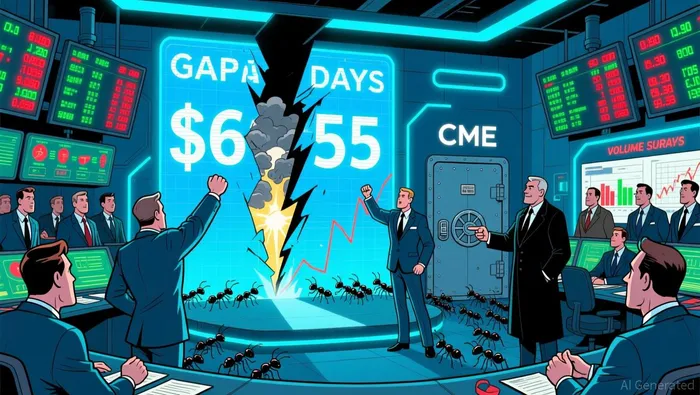 . Academic research underscores this phenomenon. Studies from 2023–2025 highlight how liquidity and investor sentiment drive herding behavior, particularly during periods of uncertainty. In the context of CME gaps, this manifests as institutions collectively interpreting gaps as signals of momentum or correction, accelerating price convergence. For example, the 2026 $655 gap was viewed as a "market signal" by analysts, with traders positioning for fills based on historical patterns.
Case Study: The 2026 $655 Gap and Volatility Amplification
The January 2026 CME gap provides a vivid case study of how institutional structures and behavioral psychology interact. The gap's size-69% above recent averages-suggested unusual market activity during the CME's closure, likely driven by macroeconomic factors or algorithmic trading. Institutions, unable to adjust futures positions during the holiday, reacted en masse once trading resumed, creating a feedback loop of amplified sentiment.
This event also highlights the role of regulatory frameworks. The CME's oversight under the U.S. Commodity Futures Trading Commission reinforces its authority as a price benchmark, making gaps more influential in shaping broader market psychology. Additionally, the alignment of ETFs and futures allowed institutions to hedge exposures more effectively, further entrenching their dominance in gap-driven strategies.
2026 Volatility Projections: A Convergence of Factors
For 2026, volatility projections hinge on the interplay of institutional structures and behavioral dynamics. The Federal Reserve's anticipated rate cuts-91.7% probability in September 2025 according to prediction markets-are expected to boost liquidity, making Bitcoin a high-beta asset sensitive to global monetary conditions. Combined with the structural dislocations of CME gaps, this creates fertile ground for sharp price swings.
Technical analyses suggest a potential price range of $120,000 to $170,000 for Bitcoin in 2026, supported by Fibonacci extensions and historical volatility patterns. However, caution is warranted. Analysts like Peter Brandt and Jurrien Timmer warn of potential corrections to $60,000–$65,000 by Q3 2026, reflecting the dual forces of institutional demand and sentiment-driven volatility.
Conclusion
Bitcoin's CME gap dynamics in 2026 underscore a maturing market where institutional structures and behavioral psychology converge to drive price action. The CME's regulated framework, coupled with ETF alignment, has created a feedback loop of herd behavior and sentiment amplification. As gaps become increasingly predictive of short-term volatility, investors must navigate both the technical mechanics of price convergence and the psychological undercurrents of institutional positioning. For 2026, the stage is set for a year of heightened volatility-a testament to the evolving interplay between structure and sentiment in crypto markets.





Comentarios
Aún no hay comentarios