
Bitcoin Cloud Mining as a Low-Barrier Passive Income Strategy in 2026
In 2026, the cryptocurrency landscape is undergoing a pivotal shift. Bitcoin's network hash rate, a critical metric for mining profitability, has faced headwinds, with hash prices declining from ~$55/PH/s in early 2025 to below $35/PH/s by November 2025, while network competition surged past 1.1 ZH/s. This intensifying competition, coupled with rising energy costs and hardware volatility, has pushed many miners to seek alternatives. Enter cloud mining-a strategy that allows investors to bypass the logistical and financial hurdles of traditional mining. For 2026, platforms like Fleet Mining are redefining accessibility, offering a $15–$100 new-user bonus that aligns with both market dynamics and institutional-grade adoption trends.
The Case for Cloud Mining in 2026
Bitcoin's network hash rate decline underscores a broader challenge: mining is becoming increasingly capital-intensive and less profitable for individual operators. As miners underclock machines to conserve energy amid economic pressures, the cost of entry for traditional mining has ballooned. Cloud mining, however, sidesteps these barriers by allowing users to rent hashing power without upfront hardware or electricity costs. This model is particularly appealing in 2026, as institutional investors allocate more capital to digital assets. According to Coinbase Institutional, 76% of global investors plan to expand their digital asset exposure in 2026, with nearly 60% targeting allocations exceeding 5% of their AUM.
Fleet Mining's $15–$100 new-user bonus exemplifies this democratization. By offering zero-cost entry, the platform enables users to start mining BitcoinBTC-- (BTC), EthereumETH-- (ETH), and even XRPXRP-- with minimal risk. For instance, a $100 contract over 2 days generates $3 in daily returns, compounding to $106 total. This flexibility-paired with automated processes like hash scheduling and income settlement-makes it ideal for both beginners and long-term investors according to platform documentation.
Strategic Value of Fleet Mining's Bonus
The strategic value of Fleet Mining's bonus lies in its alignment with two key trends: institutional-grade cloud mining adoption and Bitcoin's evolving network economics.
Institutional Adoption and Regulatory Clarity
Institutional investors are increasingly treating Bitcoin as a strategic asset, driven by regulatory frameworks like the EU's MiCA and the U.S. GENIUS Act according to industry analysis. These policies have created structured environments for institutional participation, with tokenized assets and regulated ETFs (e.g., spot BTC ETFs) opening new pathways. The U.S. BTC ETF market alone grew to $103 billion in AUM in 2025, with institutional participation rising to 24.5% according to SSGA reports. Fleet Mining's bonus taps into this momentum by offering a low-risk on-ramp for investors seeking exposure to Bitcoin's price action without the complexities of hardware or energy management.Bitcoin's Network Hash Rate and Cost Efficiency
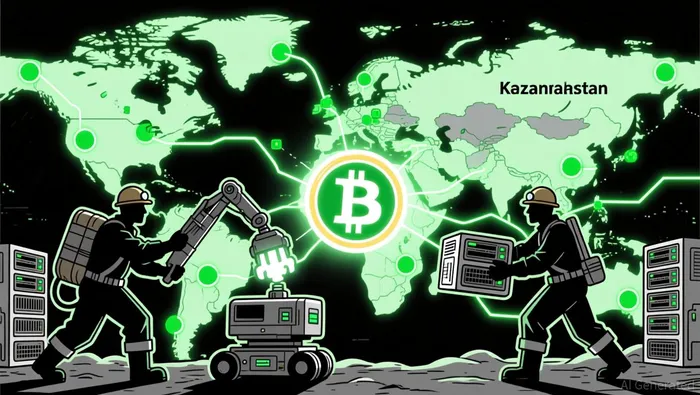
Bitcoin's 8% hashrate drop in early 2026 highlights the economic pressures on miners. As traditional operations pivot to AI and high-performance computing for alternative revenue streams, cloud mining emerges as a cost-effective alternative. Fleet Mining's energy-efficient infrastructure in regions like Kazakhstan and Iceland further reduces operational costs, passing savings to users. For example, a $15 contract over 1 day yields $0.60 in profit according to platform data, demonstrating how even small investments can generate returns in a high-competition environment.
Risk Mitigation and Market Positioning
Fleet Mining's bonus mitigates several risks inherent to traditional mining:
- Upfront Costs: No hardware or electricity payments are required, reducing capital outlay.
- Volatility Exposure: Users can withdraw earnings or reinvest to compound growth, balancing short-term price swings.
- Scalability: Contracts are flexible, according to platform documentation, allowing users to scale investments as their risk tolerance or market confidence evolves.
Moreover, the absence of an expiration date for the bonus as of 2025 data provides users with long-term flexibility, aligning with the platform's emphasis on passive income generation. This is particularly relevant in 2026, as macroeconomic uncertainty and regulatory delays may slow broader institutional adoption.
In 2026, the question is no longer if Bitcoin mining will evolve-it's how investors will adapt. For those prioritizing accessibility, cost efficiency, and institutional alignment, Fleet Mining's bonus offers a compelling answer.






Comentarios
Aún no hay comentarios