
Bitcoin's Christmas Market Window: A Strategic Entry Point Amid Mechanical Buy Pressure and Darwinian Industry Filtering
The Christmas market window has long been a period of intrigue for BitcoinBTC-- traders, marked by thin liquidity, seasonal tax-loss harvesting, and macroeconomic volatility. In 2025, however, the interplay between mechanical buy pressure, short liquidation clusters, and mNAV dynamics in digital asset treasuries (DATs) created a unique confluence of risks and opportunities. This analysis explores how investors can leverage these forces to time a bullish-neutral Bitcoin trade, navigating the Darwinian filtering of the DAT sector while capitalizing on structural imbalances in the market.
Mechanical Buy Pressure: From Catalyst to Drag
Historically, DATs have acted as a source of mechanical buy pressure for Bitcoin, with firms like StrategyMSTR-- (MSTR) and American BitcoinABTC-- (ABTC) using debt and equity issuance to accumulate crypto assets according to analysis. However, in late 2025, this dynamic reversed as Bitcoin's 30% decline from its October peak triggered a wave of forced selling. Over 180 public companies holding crypto on their balance sheets faced negative equity, compelling them to liquidate holdings to meet debt obligations or repurchase shares at a discount. This "forced seller" effect exacerbated Bitcoin's downward spiral, with five firms selling 1,883 bitcoins in a single month to raise capital.
The mNAV (market net asset value) ratio, a critical metric for DAT health, became a focal point. As mNAV ratios for firms like MSTRMSTR-- converged toward 1.0, it signaled a collapse in investor confidence, with DAT stocks trading at a discount to their underlying crypto holdings. This created a self-reinforcing cycle: falling Bitcoin prices eroded DAT balance sheets, forcing further sales, which in turn depressed Bitcoin's value.
Short Liquidation Clusters: Volatility as a Double-Edged Sword
Bitcoin's price action in late 2025 was punctuated by short liquidation clusters, particularly between $90,000 and $98,000 according to market analysis. These clusters, driven by leveraged positions and thin holiday liquidity, created sharp price swings. On one volatile day, 116 million in futures were liquidated within an hour, underscoring the fragility of leveraged positions. The December 18 sell-off, which saw $357 million in ETF outflows, pushed Bitcoin below $85,000, far from its October peak.
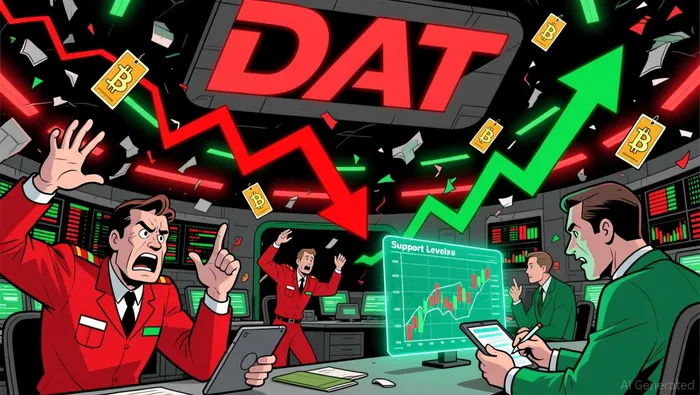
Despite the bearish momentum, these liquidation events also created buying opportunities. Accumulator wallets and institutional players like MicroStrategy continued to add to their Bitcoin holdings, hinting at a two-layer market dynamic: fear on the surface and accumulation underneath according to market observations. For traders, identifying these clusters through order flow analysis and on-chain metrics could signal key support levels where long-term buyers might step in.
Darwinian Filtering: Weeding Out the Weak
The collapse of DAT premiums has triggered a "Darwinian phase" in the sector, where only firms with diversified business models or operational cash flows are likely to survive according to market reports. Companies that followed the Michael Saylor playbook-leveraging debt to accumulate Bitcoin-now face existential risks as their mNAV ratios approach parity according to analysts. For example, Solana-focused DATs saw a 40% drop in net asset value since October 2025, compounding liquidity strains.
This filtering process, while painful in the short term, could ultimately strengthen the sector. Firms that stabilize their mNAV ratios through cash reserves such as Strategy's $1.44 billion fund or pivot to hybrid models may emerge as long-term winners. Investors who identify these resilient players could gain exposure to Bitcoin's upside while avoiding the weakest links in the DAT chain.
Strategic Entry Point: Timing the Bullish-Neutral Trade
The convergence of these factors presents a strategic entry point for a bullish-neutral Bitcoin trade. Key considerations include:
1. Post-Liquidation Rebound: After the December 2025 sell-off, Bitcoin's $90,000–$95,000 support zone became critical. A sustained rebound above this range could trigger a reaccumulation by DATs and institutional buyers, creating a floor for further declines according to market analysis.
2. DAT Forced Sales Exhaustion: As DATs liquidate their holdings to meet obligations, the rate of forced selling may slow, reducing downward pressure on Bitcoin. This could coincide with a stabilization in mNAV ratios, particularly if firms like MSTR avoid further asset sales according to sector reports.
3. Macro Catalysts: A reacceleration in December inflation data or a shift in Fed policy could reintroduce volatility, but a resolution of uncertainty-such as a confirmed inflation slowdown-might catalyze a risk-on rally according to economic analysis.
Traders should position ahead of key macroeconomic events (e.g., the Bank of Japan's December 19 rate decision according to market commentary) and monitor on-chain accumulation signals. A long Bitcoin position, hedged with short-term options or DATs with strong balance sheets, could capitalize on the post-Darwinian rebalancing while mitigating downside risk.
Conclusion
Bitcoin's 2025 Christmas market window was defined by a toxic mix of forced selling, short liquidation clusters, and mNAV compression. Yet, within this chaos lies an opportunity: the Darwinian filtering of the DAT sector may pave the way for a more sustainable market structure, while post-liquidation rebounds and strategic DAT stabilization efforts create a bullish-neutral setup. For investors with a medium-term horizon, timing the entry point around key support levels and structural catalysts could yield significant rewards in the coming months.





Comentarios
Aún no hay comentarios