
Bitcoin's On-Chain Metrics and Market Cycle Shifts: A Bullish Case for 2025
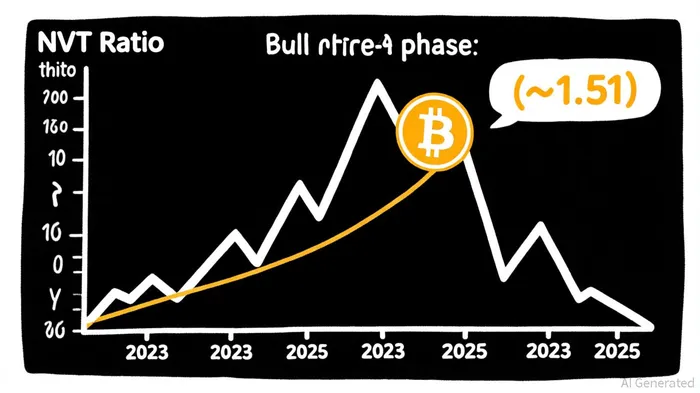
Bitcoin's on-chain metrics in 2025 paint a compelling picture of a market transitioning from speculative consolidation to fundamentals-driven growth. Key indicators such as the Network Value to Transactions (NVT) ratio, Supply-Proofed Value (SPV), and network flow dynamics suggest a tightening supply environment and robust demand, signaling a potential bull market phase change.
NVT Ratio: A Golden Cross of Fundamentals
The NVT ratio, a critical metric for evaluating Bitcoin's valuation relative to its transactional utility, has crossed into a “golden-cross” range of ~1.51. This level historically marks a balance between speculative fervor and intrinsic value, indicating that Bitcoin's price is increasingly supported by real-world usage rather than short-term trading activity [1]. For context, during the 2017 and 2021 bull cycles, the NVT ratio typically bottomed near 1.2 before surging to 3.0+ as speculative demand outpaced utility. The current 1.51 level suggests a healthier equilibrium, with transaction volumes reflecting genuine adoption rather than hype [3].
This shift is further reinforced by the post-halving supply dynamics. Following the April 2024 halving, Bitcoin's daily issuance plummeted to ~900 BTCBTC--, reducing the float of available coins. Approximately 74% of circulating BTC is now illiquid, with ~75% of coins dormant for over six months [1]. This hoarding behavior—driven by long-term holders (LTHs) and institutional investors—creates a supply squeeze that amplifies the impact of any demand surge.
SPV and Network Flow: Accumulation Over Speculation
Bitcoin's SPV (Spent Output Verification) ratio and network flow metrics in Q3 2025 reveal a market dominated by accumulation rather than speculative trading. The MVRV Z-Score, which measures market value relative to realized value, has rebounded from a low of 1.43—a level historically associated with local bottoms in 2017 and 2021 [2]. This rebound, coupled with the Value Days Destroyed (VDD) Multiple returning to a “green zone,” indicates that LTHs are aggressively accumulating BitcoinBTC-- after a correction from $100,000 to $75,000 [2].
Network flow data also highlights a shift in buyer demographics. Capital flows have transitioned from new retail entrants to experienced holders, a pattern that historically precedes major bull market rallies [2]. Institutional adoption, evidenced by large ETF holdings and corporate accumulation (e.g., MicroStrategy's 1.3 million BTC stash), further validates this trend [4]. However, transaction counts remain subdued, reflecting a maturing market where larger, fewer transactions dominate—a hallmark of institution-led growth [4].
Macro and Micro Convergence: A $190K Price Target
The convergence of on-chain metrics with macroeconomic factors has led analysts to project aggressive price targets. Using the Time Value of Money (TVM) methodology, a Q3 2025 price target of $190,000 has been calculated, factoring in a base price of $135,000 adjusted by 3.5% for fundamentals and 35% for macroeconomic tailwinds [4]. These tailwinds include record global liquidity (M2 exceeding $90 trillion), regulatory progress (e.g., 401(k) eligibility for Bitcoin), and the growing institutionalization of the asset class [4].
Despite these bullish signals, risks persist. The MVRV Z-Score of 2.49 currently suggests overbought conditions [4], while Bitcoin's high correlation with U.S. equities exposes it to macroeconomic shocks. A global recession or equity market downturn could trigger a deeper correction, even if on-chain fundamentals remain intact [2].
Conclusion: A Bull Market in the Making
Bitcoin's on-chain metrics in 2025 align with historical bull market patterns, but with a critical difference: the market is now driven by institutional adoption and macroeconomic tailwinds rather than retail speculation. The NVT golden cross, SPV rebound, and supply-side constraints all point to a tightening market where demand is outpacing supply. While risks like macroeconomic volatility linger, the confluence of on-chain strength and institutional confidence makes a compelling case for a multi-year bull phase.
As the Pi Cycle Oscillator trends upward and TVM models project $190,000+ targets, investors should closely monitor the interplay between on-chain activity and macroeconomic conditions. For now, the data suggests that Bitcoin is not just entering a bull market—it is entering a new era of institutional-grade adoption.







Comentarios
Aún no hay comentarios