
Bitcoin Cash's $1,200 Ascent and BullZilla's 2025 Presale Disruption: Strategic Entry Points in a Shifting Crypto Landscape
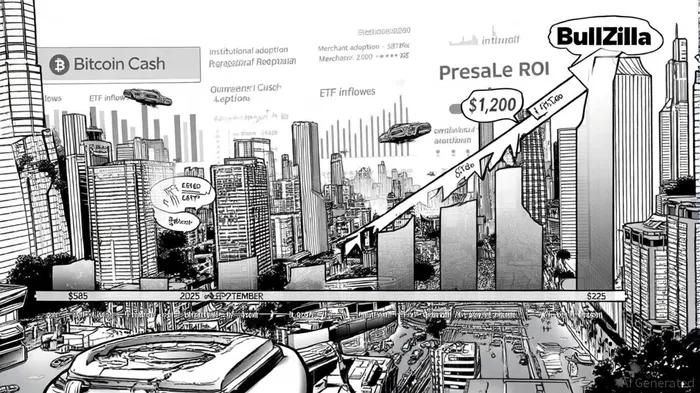
The Case for BitcoinBTC-- Cash: From $585 to $1,200 in 2025
Bitcoin Cash (BCH) has long positioned itself as a scalable, low-cost digital cash solution. As of September 2025, its price hovers around $585, with some analysts forecasting a conservative $400 target by year-end[1]. However, a deeper dive into on-chain metrics, institutional adoption, and macroeconomic tailwinds suggests a far more bullish narrative.
1. Institutional Adoption and ETF Momentum
The approval of spot Bitcoin ETFs in early 2024 catalyzed a shift in institutional sentiment, with over $143 billion in assets under management by mid-2025[2]. While Bitcoin dominates this narrative, BCHBCH-- has quietly gained traction as a complementary asset. MicroStrategy's $12 billion Bitcoin allocation[3] and the U.S. Treasury's strategic Bitcoin reserve[4] signal a broader acceptance of digital assets as institutional-grade stores of value. BCH's lower volatility (35% 30-day volatility, comparable to gold[5]) and faster transaction speeds (25,000 TPS vs. Bitcoin's 7 TPS[6]) make it an attractive alternative for institutions seeking liquidity without sacrificing utility.
2. Post-Halving Dynamics and Network Upgrades
The July 2025 BCH halving reduced block rewards to 3.125 BCH, creating scarcity-driven pressure[7]. Coupled with the May 2025 network upgrades (CHIP-2024-07), which enhanced smart contract capabilities and numeric operations[8], the ecosystem is primed for developer activity and dApp growth. On-chain data reveals a 122% surge in whale transactions[9], indicating large investors are accumulating BCH for long-term gains.
3. Merchant Adoption and Real-World Utility
BCH's practicality as a payment network is gaining traction. Platforms like Paytaca and BitPay have expanded merchant adoption, with BCH now accepted by over 100,000 businesses globally[10]. In hyperinflationary economies like Venezuela, BCH's low fees (under $0.001 per transaction[11]) and instant settlement times are reshaping financial inclusion. This real-world utility, combined with a declining exchange supply (indicating increased cold storage[12]), creates a supply-demand imbalance that could push BCH toward $1,200.
BullZilla's 2025 Presale: A MemeMEME-- Coin with Institutional-Grade Mechanics
While Bitcoin CashBCH-- represents a pragmatic, institutional-grade play, BullZilla ($BZIL) embodies the disruptive potential of 2025's presale landscape. Built on EthereumETH--, BullZilla combines meme-driven virality with structured tokenomics, positioning itself as a top 100x presale opportunity.
1. Structured Scarcity and ROI Potential
BullZilla's presale employs a Mutation Mechanism, where the token price increases every $100,000 raised or 48 hours, whichever comes first[13]. This creates urgency for early participation and rewards investors with exponential ROI. As of September 2025, the presale has raised $500,000 with 1,700+ holders[14], and a $1,000 investment at the current price of $0.00004575 could yield a 100x return if the token reaches $0.00527 at listing[15].
2. Tokenomics and Staking Incentives
The project's tokenomics are engineered for long-term growth:
- 50% allocated to the presale.
- 20% to the HODL Furnace staking mechanism (70% APY[16]).
- 20% to the treasury and ecosystem.
- 5% to the Roar Burn pool (permanent supply reduction[17]).
This structure not only incentivizes long-term holding but also reduces sell pressure post-presale. The Roar Burn Mechanism, which burns tokens at each milestone, further enhances scarcity[18].
3. Institutional-Grade Infrastructure
Despite being a meme coin, BullZilla leverages Ethereum's robust infrastructure, ensuring security and liquidity. Its 24-chapter “Lore Bible” narrative, combined with live burn events and a referral system (10% bonuses for both parties[19]), fosters community-driven growth. As institutional interest in meme coins grows (e.g., DogecoinDOGE-- ETF proposals[20]), BullZilla's structured approach could attract institutional capital seeking high-ROI opportunities in a nascent market.
Strategic Entry Points: Undervalued Assets in a Shifting Market
Both Bitcoin Cash and BullZilla represent strategic entry points for investors seeking exposure to undervalued assets with strong use cases and growing institutional adoption.
1. Bitcoin Cash: A $1,200 Pathway
- Technical Catalysts: A golden cross on hourly charts and a bullish RSI suggest continued upward momentum[21]. Historical backtests of similar MACD Golden Cross signals show strong absolute returns, though with sizable drawdowns[25]. Breaking through $700 (current target[22]) could trigger a retest of $1,200 as institutional demand and merchant adoption accelerate.
- Macro Tailwinds: Federal Reserve rate cuts and rising M2 money supply[23] are likely to drive risk-on sentiment, benefiting crypto assets with real-world utility like BCH.
2. BullZilla: High-ROI with Institutional Potential
- Early-Stage Liquidity: With only 50% of tokens allocated to the presale, BullZilla's liquidity is constrained, reducing volatility and increasing appeal to institutional investors.
- Regulatory Alignment: As New York's DFS mandates blockchain analytics for institutions[24], projects with transparent tokenomics (like BullZilla's Roar Burn) are better positioned to attract compliance-focused capital.
Conclusion
Bitcoin Cash's journey to $1,200 hinges on its ability to capitalize on institutional adoption, post-halving scarcity, and real-world utility. Meanwhile, BullZilla's presale model redefines meme coins by blending virality with structured scarcity and staking incentives. For investors, both assets represent strategic entry points in a crypto landscape increasingly defined by institutional-grade infrastructure and macroeconomic tailwinds.






Comentarios
Aún no hay comentarios