
Bitcoin's Bullish Undercurrents Amid ETF Outflows: Why Whale Accumulation Signals Institutional Confidence
The Paradox of ETF Outflows and Whale Accumulation
Bitcoin ETFs have long served as a proxy for institutional demand, but Q3 and Q4 2025 have revealed a nuanced picture. While IBITIBIT--, the largest U.S. Bitcoin ETF, saw $290.8 million in outflows on a single Thursday, on-chain analytics firm CryptoQuant reported a dramatic reversal in Bitcoin's net buying demand. From November 6 to 8, the "Apparent Demand (30-day sum)" metric shifted from -79.085k BTC to +108.5819k BTC, according to Yahoo Finance, a steepest movement of the year. This "demand pivot" is historically linked to institutional entry, as large investors capitalize on discounted prices during market dips.
Meanwhile, JPMorgan's 64% increase in IBIT holdings-valued at $343 million as of Q3 2025, according to Bitcoinist-highlights a broader trend. Despite corporate treasuries reporting unrealized losses on crypto assets, institutions like MicroStrategy continue to accumulate Bitcoin, according to Bitcoinist, signaling long-term conviction.
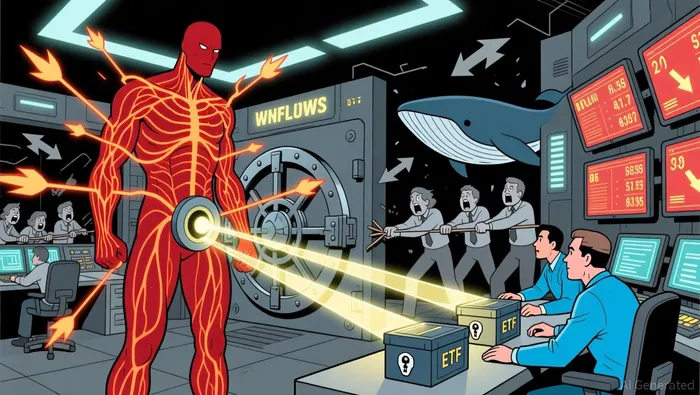
Institutional Capital Flows and Whale Behavior: A Symbiotic Relationship
The correlation between whale accumulation and institutional buying is becoming increasingly evident. Over 30,000 BTC-valued at nearly $3 billion-was added by whales in a single week, according to Blockhead, while spot ETFs recorded $240 million in net inflows, ending a six-day outflow streak, according to Blockhead. This suggests that institutional capital is not only stabilizing the market but also reinforcing Bitcoin's narrative as a store of value.
On-chain data from Adler Crypto Insights further underscores this trend. Large investors are re-entering the market as prices dip, with Bitcoin's 15% of total supply now controlled by institutional players, according to Yellow. For context, MicroStrategy's holdings alone total 629,376 BTC, according to Yellow, a strategic allocation that reflects corporate treasuries' growing appetite for Bitcoin as a hedge against macroeconomic uncertainty.
The Halving Narrative and Supply Dynamics
The next Bitcoin halving in 2028 is a looming catalyst, and current accumulation patterns hint at its influence. With whales and institutions absorbing over 2 million BTC-nearly 10% of the circulating supply, according to EthNews-the market is priming itself for a potential supply squeeze. This dynamic is amplified by the fact that institutional investors now control 12.5% of Bitcoin's supply, according to Bitget, a figure that has grown by 40% in Q3 2025 alone.
The reactivation of dormant whale wallets since the October 2025 market crash, according to Yahoo Finance, further illustrates this trend. Nearly 892,643 BTC from older cohorts has been moved, indicating that long-term holders are either consolidating positions or preparing for a price rebound. This behavior aligns with historical patterns where whale activity precedes major bull cycles.
Conclusion: A Market in Transition
Bitcoin's current phase is defined by a redistribution of power from retail to institutional and whale-driven capital. While ETF outflows reflect short-term volatility, the underlying data reveals a market maturing through strategic accumulation. As BlackRockBLK-- prepares to launch its Bitcoin ETF in Australia, according to Coinotag and JPMorgan's stake in IBIT grows, according to Bitcoinist, the institutional infrastructure for Bitcoin is solidifying.
For investors, the key takeaway is clear: the bearish narrative of ETF outflows is being counterbalanced by a bullish undercurrent of whale and institutional demand. This duality suggests that Bitcoin's next move-whether upward or sideways-will be driven by structural forces rather than retail sentiment.







Comentarios
Aún no hay comentarios