
Bitcoin's Bullish Trajectory Amid Global Liquidity Expansion: Navigating Structural Bottlenecks and Macroeconomic Alignment
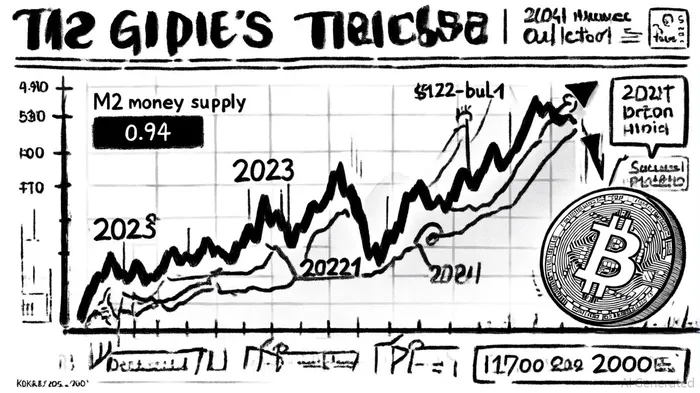
Bitcoin's performance in 2025 has been inextricably linked to the trajectory of global monetary expansion, with the asset exhibiting a near-perfect 0.94 correlation to global M2 money supply growth over long-term cycles [1]. As central banks injected liquidity into economies—driven by post-pandemic recovery efforts, inflationary pressures, and accommodative monetary policies—Bitcoin's price mirrored these trends with a lag of 60–107 days [4]. By mid-2025, global M2 had surged to $123.3 trillion, a 4.8% annualized increase, creating a fertile environment for Bitcoin's resurgence [5]. This liquidity-driven cycle, coupled with institutional adoption and regulatory clarity, has positioned BitcoinBTC-- as a high-beta asset, outperforming traditional inflation hedges like gold [1].
Monetary Expansion and Bitcoin's Macroeconomic Alignment
The interplay between monetary policy and Bitcoin's price dynamics has been a defining feature of the 2020s. During the 2020–2021 liquidity boom, Bitcoin surged from $10,000 to $64,800, aligning with a 25% annualized M2 growth rate [1]. By 2023–2024, as M2 growth stabilized, Bitcoin entered a consolidation phase, trading in a tight range between $25,000 and $35,000 [4]. However, the mid-2025 liquidity expansion—driven by the U.S. Federal Reserve's dovish pivot and the European Central Bank's accommodative stance—has reignited Bitcoin's momentum. Analysts project a price target of $170,000 by late 2025, citing the asset's historical response to liquidity infusions and its current MVRV Z-score, which indicates it is not yet overvalued [6].
This alignment is not without structural bottlenecks. Short-term disruptions, such as the Terra/Luna collapse in 2022 and overvaluation metrics like the MVRV Z-score, have temporarily weakened Bitcoin's correlation with M2 [1]. However, these factors have not derailed the long-term trend. Instead, they highlight Bitcoin's role as a speculative asset within a broader macroeconomic framework.
Institutional Adoption and Regulatory Clarity
Institutional adoption has been a critical catalyst for Bitcoin's integration into traditional finance. By Q2 2025, 59% of institutional investors allocated at least 10% of their portfolios to Bitcoin, with spot ETFs like BlackRock's iShares Bitcoin Trust (IBIT) amassing $18 billion in assets under management [2]. Regulatory clarity, particularly the U.S. GENIUS Act and CLARITY Act, has normalized Bitcoin as a legitimate asset class, reducing volatility by 75% compared to historical peaks [3]. These developments have also spurred corporate treasuries to adopt Bitcoin as a strategic reserve asset, with 267 publicly listed firms now holding the cryptocurrency [1].
The U.S. and EU regulatory frameworks have further solidified Bitcoin's macroeconomic alignment. The GENIUS Act's stablecoin regulations and the EU's Markets in Crypto-Assets (MiCA) framework have created a legal certainty that institutional investors demand [5]. This clarity has not only attracted sovereign wealth funds and pension funds but also reinforced Bitcoin's role as a hedge against fiat devaluation. For instance, Bitcoin's negative correlation with the U.S. Dollar Index (DXY)—which fell 10.8% in H1 2025—signals a shift in capital from dollar-denominated assets to decentralized alternatives [4].
Structural Bottlenecks and Macroeconomic Misalignment
Despite Bitcoin's macroeconomic alignment, structural bottlenecks persist. Regulatory uncertainty in jurisdictions like China and the EU's preference for CBDCs over private crypto solutions create friction [5]. Additionally, Bitcoin's scalability limitations—processing only seven transactions per second—remain a barrier to its adoption as a medium of exchange [4]. While Layer 2 solutions like the Lightning Network and rollups have mitigated these issues, they require further innovation to compete with traditional payment systems like Visa.
Environmental concerns also pose a challenge. Bitcoin's energy-intensive Proof-of-Work (PoW) mechanism has drawn criticism, though 40% of mining operations now use renewable energy [4]. The lack of standardized sustainability practices across the decentralized network complicates efforts to align Bitcoin with ESG (Environmental, Social, and Governance) frameworks.
Blockchain Utility and On-Chain Metrics
Blockchain utility metrics underscore Bitcoin's evolving role. On-chain analysis reveals that exchange reserves have dropped below 2.5 million BTC, signaling reduced sell pressure and long-term accumulation [2]. DeFi platforms, while dominated by EthereumETH--, have seen a 22% annual growth in adoption, with Bitcoin-based solutions like Alkanes and Impervious expanding programmability [5]. NFTs, though less central to Bitcoin's core narrative, have driven 15% of smart contract deployments, reflecting growing demand for digital ownership [2].
The MVRV Z-score—a metric measuring the ratio of realized value to market value—indicates Bitcoin is not yet overvalued, offering room for further appreciation [6]. This metric, combined with rising institutional demand and ETF inflows, suggests Bitcoin's price trajectory remains intact despite macroeconomic headwinds.
Conclusion: A New Bull Cycle Amid Structural Challenges
Bitcoin's performance in 2025 reflects a unique confluence of monetary expansion, institutional adoption, and regulatory clarity. While structural bottlenecks like scalability and environmental concerns persist, the asset's macroeconomic alignment—driven by a 0.94 correlation to global M2—positions it as a leading hedge against inflation and currency depreciation. As central banks continue to expand liquidity and institutional investors normalize Bitcoin as a strategic reserve asset, the stage is set for a new bull cycle. However, sustained innovation in scalability, sustainability, and regulatory frameworks will be critical to ensuring Bitcoin's long-term viability in a rapidly evolving financial landscape.






Comentarios
Aún no hay comentarios