
Is Bitcoin's Bull Market Still Investable Amid Macro Volatility?
The Bull Case: Structural Resilience Amid Macro Volatility
Bitcoin's current price action reflects a market in transition. After hitting an all-time high of $125,000 in early 2025, the asset faced a sharp correction to $104,700, driven by a 100% tariff on Chinese tech exports and subsequent panic selling, according to Analytics Insight. However, BitcoinBTC-- has since rebounded to hold above $110,000, buoyed by $6 billion in new capital flowing into global crypto ETFs during the week of October 4, the Analytics Insight report noted. This resilience underscores the growing institutional demand and the maturation of Bitcoin as a financial asset.
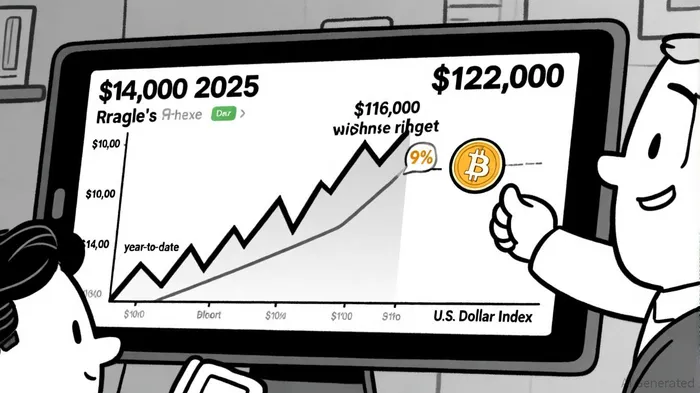
Macroeconomic indicators further support the bull case. The U.S. Dollar Index has declined by nearly 9% in 2025, reinforcing Bitcoin's inverse relationship with the dollar and its role as an inflation hedge, according to The Crypto Basic. Meanwhile, the ISM Manufacturing Index-a barometer of U.S. business activity-has historically aligned with Bitcoin's price cycles, suggesting the bull market could extend into Q2 2026, the same coverage observed. Analysts like Raoul Pal argue that Bitcoin's current phase is a "bear trap," where short-term volatility precedes a FOMO-driven euphoria, a point also highlighted by The Crypto Basic.
Institutional Positioning: From Speculation to Functionality
The institutional landscape has evolved dramatically in 2025. JPMorgan's announcement to allow Bitcoin and EthereumETH-- as collateral for loans by year-end 2025 marks a pivotal shift. This move transforms digital assets from speculative tools into functional components of traditional credit markets, enhancing liquidity without requiring liquidation - a development reported by Analytics Insight. Such developments reduce the risk of forced sales during downturns and inject stability into the ecosystem.
However, not all institutions are embracing Bitcoin. Major Asian exchanges, including Hong Kong's HKEx and India's Bombay Stock Exchange, have rejected corporate Bitcoin treasury strategies due to volatility and liquidity concerns, according to Kenson Investments. These institutions emphasize the need for robust governance frameworks, highlighting the duality of Bitcoin's potential: it can either diversify corporate treasuries or amplify financial risks if mismanaged.
Strategic Allocation and Risk Management
For investors, the key lies in balancing exposure to Bitcoin's upside with hedging against macroeconomic volatility. Bitcoin's low correlation to the S&P 500 (0.15 over 10 years) makes it a valuable diversifier, as BlackRock notes, but its role as a hedge is asymmetric. During high economic policy uncertainty (EPU), Bitcoin enhances risk-adjusted returns; during low EPU, it may underperform or drag on portfolio performance, according to a ScienceDirect paper.
To mitigate this, investors can adopt a multi-layered approach:
1. Hedging with Bitcoin: Allocate a portion of the portfolio to Bitcoin during high EPU periods, as its inverse relationship with the dollar and traditional assets can offset downside risks - a conclusion reached in the ScienceDirect paper.
2. Diversification with Alternatives: Pair Bitcoin with equity market-neutral funds and tactical opportunities funds, which have shown low correlations to traditional assets and delivered strong returns amid volatility, as BlackRockBLK-- recommends.
3. Institutional Tools: Utilize Bitcoin ETFs and staking mechanisms to generate yield while maintaining exposure, leveraging DeFi's utility to optimize returns, a trend Analytics Insight has documented.
The Path Forward: Bull Market or Bear Trap?
Bitcoin's bull market is far from a sure thing. While AI models predict a potential $200,000 price target by year-end 2025, according to Finbold, the path is fraught with risks. Regulatory pressures, geopolitical shocks, and weakened sentiment could trigger a reversion to mean. However, the structural factors-ETF inflows, institutional adoption, and macroeconomic tailwinds-suggest the bull phase is not over.
Investors must adopt a disciplined, strategic approach. Positioning in Bitcoin should be gradual, with stop-loss mechanisms and hedging strategies to navigate volatility. As the market evolves, those who balance optimism with caution will be best positioned to capitalize on the next leg of the bull run.





Comentarios
Aún no hay comentarios