
Bitcoin (BTC) Price Prediction for September 20, 2025: Navigating Volatility in a Macro Shift
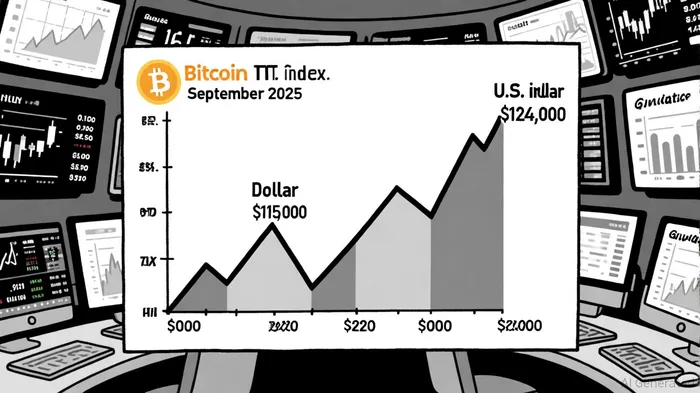
Bitcoin's price action in late September 2025 is a high-stakes chess match between macroeconomic tailwinds and derivatives-driven volatility. With the U.S. Federal Reserve's first rate cut of the year—lowering the federal funds rate to 4.0–4.25%—investors are recalibrating their strategies amid a fragile labor market and inflationary pressures[5]. This shift, combined with Bitcoin's precarious perch near the $115,000 support level, creates a volatile cocktail for traders. Let's dissect the forces at play and identify strategic entry points for those willing to navigate this turbulence.
Macroeconomic Tailwinds: Fed Policy and Dollar Dynamics
The Fed's rate cut, while modest, signals a pivot toward easing monetary policy to cushion a slowing labor market. Job growth has averaged just 29,000 per month in recent quarters, and immigration restrictions are exacerbating labor shortages[5]. A weaker U.S. dollar, a likely consequence of further rate cuts, historically benefits BitcoinBTC--, which inversely correlates with the greenback[2]. Analysts project an additional 50-basis-point reduction by year-end, potentially pushing the target range to 3.5–3.75%[5]. This creates a “risk-on” environment where non-yielding assets like Bitcoin gain appeal, especially as bond yields retreat.
However, inflation remains a wild card. While it has dipped slightly, it still hovers above the Fed's 2% target[2]. This duality—easing rates amid sticky inflation—could lead to choppy Bitcoin price action as markets parse the Fed's next moves.
Derivatives Market: A Double-Edged Sword
Bitcoin's derivatives market is a ticking time bomb. Open interest has surged past $220 billion, with leveraged positions concentrated in the $113,300–$114,500 range[2]. If the price dips below $104,500, long liquidations could exceed $10 billion, while a breakout above $124,000 might trigger $5.5 billion in short liquidations[2]. This creates a self-fulfilling prophecy: a minor price move could cascade into a full-blown selloff or rally.
Perpetual futures trading volume, now 8–10x spot volume[2], underscores the market's reliance on leverage. Retail and institutional traders alike are overexposed, amplifying volatility. For investors, this means short-term price swings will be dictated less by fundamentals and more by margin calls and algorithmic trading bots.
Strategic Entry Points: Buy the Dip or Hedge the Risk?
The $115,000 support level is a critical inflection point. If Bitcoin holds here, it could attract institutional buyers seeking discounted entry points, particularly as ETF inflows remain robust[4]. A rebound to $120,000 or higher is plausible if the Fed's dovish stance spurs risk appetite[2]. Conversely, a breakdown below $115,000 could test $108,000 or even $100,000, as bearish analysts warn[2].
For tactical traders, the key is to use liquidation heatmaps to identify stop-loss levels. For example, avoiding positions near $113,300–$114,500 could prevent being caught in a cascade of forced selling[3]. A long-term investor might consider dollar-cost averaging into dips below $115,000, while hedging with short-term options to mitigate liquidation risks.
Institutional Confidence: A Stabilizing Force?
Despite the short-term chaos, institutional demand remains a stabilizing force. Corporate Bitcoin accumulation and ETF inflows suggest that price stability is underpinned by long-term demand[4]. This creates a floor for Bitcoin even as derivatives-driven volatility persists. However, this confidence could evaporate if macroeconomic data surprises to the downside, such as a sharper-than-expected inflation rebound.
Conclusion: Prepare for a Bumpy Ride
Bitcoin's September 20, 2025, price action will hinge on three variables: the Fed's next rate decision, the dollar's strength, and the derivatives market's ability to withstand liquidation shocks. While the $115,000 support level offers a tactical entry point for bullish investors, the risks of a $104,500 breakdown are real. Those with a macroeconomic edge—particularly those betting on further Fed easing—should prioritize liquidity and risk management. In this environment, patience and discipline will separate winners from casualties.







Comentarios
Aún no hay comentarios