
Bitcoin's Break Above $113,000: A New Bull Cycle Confirmation?
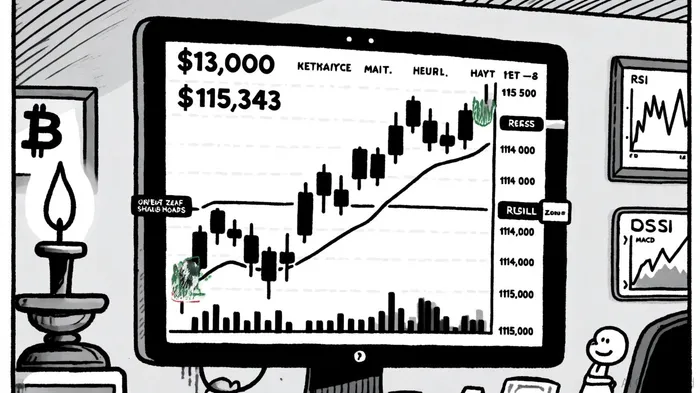
Bitcoin's recent flirtation with the $113,000 psychological barrier has ignited fierce debate among traders and analysts about whether this marks the dawn of a new bull cycle. Technical indicators and macroeconomic tailwinds suggest the case for sustained upside is strengthening, but risks remain.
Technical Catalysts: A Breakout in the Making?
Bitcoin's price action has long been defined by its cyclical battles with key resistance levels. The $113,000 threshold, a confluence of historical highs from 2017 through 2025, has repeatedly acted as a psychological and technical fulcrum [1]. Recent data shows buying interest emerging at support levels near $114,500 and $115,000, with bulls now targeting a decisive break above $115,343 to confirm a trend reversal [2]. A successful breakout could propel BitcoinBTC-- toward $117,400 and eventually $118,878, as ascending channel dynamics align with broader bullish momentum [3].
Technical tools further bolster the case. The Relative Strength Index (RSI) has shown a bullish divergence, while the MACD remains in a positive crossover, signaling sustained upward momentum if volume remains robust [4]. Notably, a TD Sequential buy signal on the 4-hour chart—triggered after nine consecutive red candles—has added to optimism, suggesting a potential bottom is forming [5]. Meanwhile, an inverse head-and-shoulders pattern, with its head and left shoulder already in place, could validate a major bullish breakout if the right shoulder completes [5].
Historical backtests of similar inverse head-and-shoulders patterns in Bitcoin (confirmed between March 2023 and April 2025) reveal compelling insights. Thirteen such breakouts were identified, with the pattern generating statistically significant returns. By Day 30 post-confirmation, the average cumulative return reached +14.8%, outperforming the +3.5% return of a simple buy-and-hold strategy during the same period. Furthermore, approximately 75% of these events resulted in gains within a month, suggesting the pattern has historically acted as a reliable medium-term bullish signal [5].
However, caution is warranted. A failure to hold above $115,343 could trigger a pullback to $113,558 or even $112,178, testing the resilience of the current rally [4].
Macroeconomic Tailwinds: Liquidity, Inflation, and Institutional Demand
Beyond technicals, macroeconomic forces are reshaping Bitcoin's trajectory. The U.S. Federal Reserve's September 2025 rate cut—a 0.25% reduction to 4.00%–4.25%—has injected liquidity into global markets, weakening the dollar and boosting risk-on sentiment [6]. Historically, Bitcoin thrives in low-interest-rate environments, as cheaper capital fuels speculative demand and reduces the opportunity cost of holding non-yielding assets [7].
The U.S. fiscal outlook also plays a role. A $316 billion deficit in May 2025 and 10-year Treasury yields hitting 4.43% have driven investors to seek alternatives to dollar-based assets [8]. Bitcoin's perceived role as a hedge against fiat devaluation—amplified by global debt reaching record levels—has gained traction, particularly as central banks hint at accommodative policies [9].
Institutional adoption is another critical catalyst. U.S. spot Bitcoin ETFs recorded $2.34 billion in net inflows in a single week during August–September 2025, pushing combined holdings to 1.32 million BTCBTC-- [10]. These inflows have tightened exchange-based supply, creating a self-reinforcing dynamic of scarcity and price pressure. Analysts project sustained institutional demand could drive Bitcoin toward $200,000 by year-end, fueled by regulatory clarity and corporate adoption of Bitcoin treasuries [11].
Risks and Nuances
While the case for a bull cycle is compelling, risks persist. Stagflationary pressures—driven by Trump-era tariffs and uneven inflation—could temper Bitcoin's gains, as the asset's traditional role as an inflation hedge weakens in a low-demand environment [12]. Additionally, altcoins remain more vulnerable to liquidity contractions, despite Bitcoin's relative stability [13].
Conclusion: A Confluence of Forces
Bitcoin's break above $113,000, if confirmed, would represent more than a technical milestone—it would signal a confluence of favorable macroeconomic conditions and institutional momentum. The Fed's dovish pivot, global fiscal strains, and surging ETF inflows create a tailwind for sustained upside, particularly if the $115,343 level holds. However, investors must remain vigilant against macroeconomic headwinds and short-term volatility. For now, the stage is set for a pivotal test of Bitcoin's resilience—and the potential dawn of a new bull market.






Comentarios
Aún no hay comentarios