
Bitcoin's Bollinger Bands Contraction and Impending Breakout: A Volatility-Driven Playbook for 2025
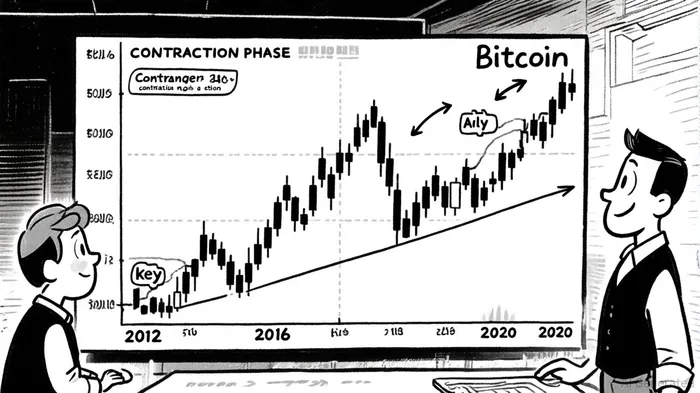
Bitcoin's Bollinger Bands have contracted to their most extreme levels since the cryptocurrency's inception in 2009, signaling a high-probability inflection point in the market[1]. This technical phenomenon, historically a precursor to explosive price action, has occurred three times before—2012, 2016, and 2020—each followed by sharp rallies that propelled BitcoinBTC-- to new all-time highs[4]. The current squeeze, tighter than any observed in Bitcoin's 16-year history, suggests a potential breakout of unprecedented magnitude. However, the path forward is not without risks, as bearish catalysts like macroeconomic headwinds and “max pain” events at $107,000 loom[6].
Volatility Compression: A Historical Prelude to Explosive Moves
Bollinger Bands contractions represent periods of compressed volatility, where the upper and lower bands converge tightly around the price. This phase often precedes a breakout, as traders anticipate a resolution to the consolidation. In 2012, the contraction occurred ahead of a 19.8% September rally[1]; in 2016, it set the stage for a 120% surge in Q4; and in 2020, it coincided with the halving event and a 300% year-end surge[4]. The 2025 contraction is even tighter, with volatility metrics hitting multi-decade lows[1].
Data from CoinGlass underscores this anomaly: Bitcoin's volatility has dropped to levels unseen since 2015, despite a 30% drawdown from all-time highs in 2025—far smaller than the 80% corrections of prior bull cycles[1]. This “compressed volatility paradox” suggests a market in equilibrium, where institutional demand and ETF inflows are counterbalancing macroeconomic pressures[5].
September 2025: Breaking the “Red September” Curse
September has historically been a bearish month for Bitcoin, with an average loss of 8% over the past 13 years[1]. Yet 2025 defies this trend, with Bitcoin surging 8% in September—the second-best performance on record[2]. This divergence is attributed to a confluence of factors:
1. Macro Tailwinds: Anticipated U.S. interest rate cuts and favorable CPI data have reduced the dollar's dominance, easing pressure on crypto markets[5].
2. Options Expiry Dynamics: The $107,000 “max pain” level for options traders has become a focal point, with analysts predicting a forced liquidation event if Bitcoin fails to break above $111,000[6].
3. Institutional Resilience: ETF inflows and long-term holder accumulation remain robust, with on-chain metrics showing a 15% increase in whale activity since July 2025[1].
However, the recent $160 billion retreat in crypto market cap—driven by geopolitical tensions and regulatory uncertainty—has created a bearish counterweight[6]. This tug-of-war between bullish fundamentals and bearish triggers amplifies the significance of the Bollinger Bands contraction as a timing mechanism.
Strategic Entry Timing: Squeeze Breakout Frameworks
Traders leveraging Bollinger Bands contractions typically employ “squeeze breakout” strategies, waiting for a decisive close beyond the bands accompanied by rising volume[3]. Historical case studies reinforce this approach:
- 2020 Halving Event: A hybrid strategy combining Bollinger Bands with fuzzy logic achieved a 92.47% success rate in simulated trading[2].
- 2017 Bull Run: A contraction in September 2017 preceded a 200% rally into December, with the RSI and MACD confirming the breakout[3].
For 2025, key entry levels include:
- Bullish Confirmation: A close above $111,000 with volume exceeding 2.5 million BTCBTC-- per day would validate the $300,000 target[4].
- Bearish Rejection: A breakdown below $107,000 would trigger a “max pain” event, potentially accelerating a short-term selloff[6].
Risk management is critical. Traders should place stop-loss orders just below the lower band ($105,000) and use the 20-day moving average as a dynamic support reference[3]. Combining Bollinger Bands with RSI divergence and on-chain metrics like NVT (Network Value to Transactions) can refine entry timing[5].
The Road Ahead: A High-Stakes Volatility Play
Bitcoin's current setup mirrors the 2017 September base, where a consolidation phase led to a parabolic rally[5]. However, the 2025 contraction is tighter, suggesting a more abrupt breakout. If macroeconomic conditions stabilize—particularly with U.S. rate cuts—Bitcoin could test $300,000 by Q1 2026. Conversely, a failure to hold $107,000 would expose deeper support at $95,000, reigniting the “Red September” narrative[6].
For investors, the key takeaway is clear: volatility compression is not a signal to panic but a call to prepare. The Bollinger Bands contraction is a masterclass in market psychology—a moment where patience and precision can unlock outsized returns.






Comentarios
Aún no hay comentarios