
Bitcoin's Bipartisan Appeal and Its Implications for Crypto Policy Adoption in 2025
The Cross-Partisan Case for Bitcoin
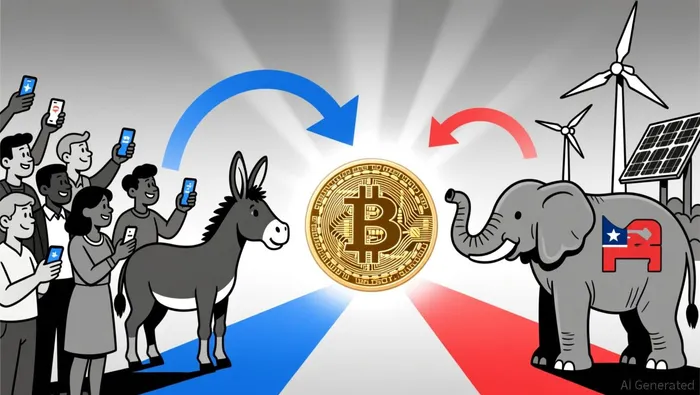
Bitcoin's bipartisan appeal is rooted in its ability to resonate with distinct political priorities. For Democrats, the cryptocurrency represents a tool for financial inclusion, offering accessible, low-cost financial services to underserved communities. A June 2025 Cygnal survey, analyzed by the BTC Policy Institute, found that Democrats overwhelmingly associate Bitcoin with bridging gaps in traditional banking systems. Conversely, Republicans and Independents view Bitcoin mining as a catalyst for energy innovation, leveraging excess renewable power from solar and wind farms to stabilize energy grids according to the same survey. Over 70% of Republicans in the survey also emphasized Bitcoin's resistance to government interference, framing it as a digital safeguard for transactional freedom.
This dual alignment creates a unique political narrative: Bitcoin is not just a financial asset but a policy enabler. For Democrats, it's a vehicle for economic empowerment; for Republicans, a driver of energy resilience. Such cross-partisan resonance reduces the likelihood of regulatory overreach, as policymakers from both sides find common ground in Bitcoin's utility.
Strategic Asset Allocation in a Polarized Era
Institutional investors are capitalizing on Bitcoin's political resilience. According to Sygnum's Future Finance 2025 report, 57% of institutional investors prioritize Bitcoin for portfolio diversification over short-term profit, with over 60% planning to increase crypto allocations in 2025. This shift reflects a broader recognition of Bitcoin's role as a strategic reserve asset. More than 80% of institutional investors now view cash holdings as an opportunity cost, driving demand for tokenized money market funds, stablecoins, and staking-enabled ETFs.
The maturation of the crypto asset class is further accelerated by partnerships like PolkadotDOT-- Capital Group and Blockdaemon, which provide compliant staking solutions and educational frameworks to institutional clients. These developments underscore a transition from speculative trading to long-term, asset-allocation-driven strategies-a trend amplified by Bitcoin's bipartisan appeal, which insulates it from the volatility of politically charged regulatory shifts.
Policy Developments: From Experimentation to Institutionalization
Bitcoin's bipartisan narrative is already influencing policy. The Czech National Bank's $1 million investment in a crypto reserve-including Bitcoin, stablecoins, and tokenized deposits-signals a global trend of central banks exploring digital assets to remain competitive. While the CNB clarifies this is not a commitment to long-term adoption, the move highlights Bitcoin's growing legitimacy as a reserve asset.
In the U.S., the end of a 43-day government shutdown in late 2025 temporarily boosted Bitcoin to $102,000, as regulatory clarity improved for ETF approvals and crypto rulemaking. Analysts argue that bipartisan support for Bitcoin's energy and financial inclusion benefits could lead to more favorable policies, such as national Bitcoin reserves or tax incentives for green mining operations.
The Resilience Factor: Why Bitcoin Thrives in Polarization
Bitcoin's political resilience stems from its ability to align with opposing values simultaneously. For Democrats, it's a tool for democratizing finance; for Republicans, a means to decentralize energy systems. This duality creates a buffer against regulatory hostility, as policymakers are incentivized to avoid actions that could undermine either narrative.
Moreover, institutional adoption reinforces this resilience. As 80% of institutional investors treat Bitcoin as a core reserve asset, its demand becomes less susceptible to political cycles. Even in a polarized environment, the asset's utility as a hedge against inflation, a diversifier of traditional portfolios, and a catalyst for energy innovation ensures its continued relevance.
Conclusion
Bitcoin's bipartisan appeal is not a coincidence but a strategic outcome of its alignment with cross-partisan values. As institutional investors reframe it as a strategic reserve asset and policymakers explore its energy and financial inclusion potential, Bitcoin is poised to become a cornerstone of 2025's crypto policy landscape. In a world where political polarization often stifles innovation, Bitcoin's unique position as a unifying force may prove to be its greatest strength.






Comentarios
Aún no hay comentarios