
Bitcoin's Bearish Technical Setup and Cautious ETF Sentiment: Is a Correction Inevitable?
The cryptocurrency market is no stranger to volatility, but the current technical and sentiment landscape for BitcoinBTC-- (BTC) suggests a high probability of further downside in the near term. As we approach the end of 2025, a confluence of bearish technical indicators and a sharp selloff in Bitcoin ETFs has created a precarious setup. For investors, this environment demands a disciplined approach to risk management and tactical positioning. Let's dissect the data and explore how to navigate this potential correction.
The Bearish Technical Case: A Perfect Storm of Indicators
Bitcoin's technical picture in November 2025 has deteriorated sharply. The monthly close for November came as a massive red candle, confirming a bearish MACD crossover on the monthly chart-a critical signal for long-term trend reversal. This development, coupled with a breakdown from a long-term parallel channel since January 2025, has cemented a bearish bias. The price has since fallen below key resistance levels, including the $91,400 threshold and the 0.146 Fibonacci retracement at $87,000, now testing critical support at $82,045.
Momentum indicators reinforce the bearish narrative. The Relative Strength Index (RSI) has dipped below 30, signaling oversold conditions and strong negative momentum. Meanwhile, the MACD oscillator remains in negative territory, suggesting further downward pressure is likely as the MACD confirms bearish momentum. On-chain metrics add to the concern: a breakdown below $82,045 could trigger a deeper retracement toward $30K–$35K, a level last seen during the 2022 bear market.
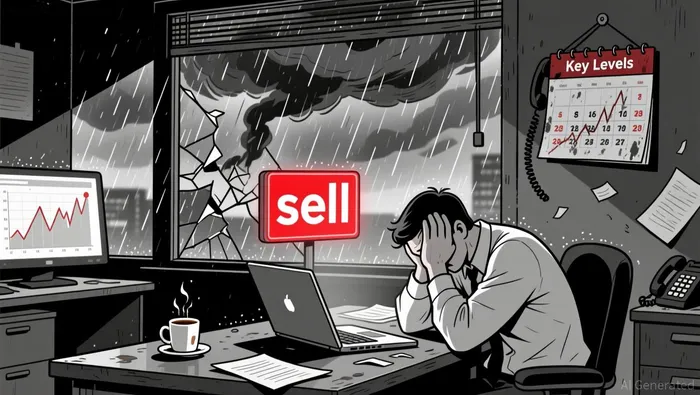
Historical parallels are also striking. The breakdown from the January 2025 channel mirrors the start of the 2021 bear market, with analysts projecting a potential retest of the $50,000 level by 2026. For context, Bitcoin's failure to reclaim the broken channel-a structure that had held for over a year-signals a loss of institutional confidence and a shift in market psychology.
ETF Sentiment: A Flight to Safety Amid Macro Uncertainty
The bearish technical case is amplified by deteriorating sentiment in Bitcoin ETFs. U.S. spot Bitcoin ETFs hemorrhaged over $3.4 billion in November 2025, with BlackRock's iShares Bitcoin Trust ETFIBIT-- (IBIT) leading the exodus with $2.2 billion in outflows. This selloff accelerated as Bitcoin's price collapsed from over $120,000 to the low $80,000s, reflecting a broader risk-off environment ahead of key Federal Reserve rate decisions and inflation data.
Retail and institutional investors alike have adopted a defensive stance. Retail investors, who flocked to ETFs during the October rally, are now exiting positions amid heightened volatility and eroding confidence in Bitcoin's "safe haven" narrative. Institutional outflows, meanwhile, suggest a recalibration of risk exposure as macroeconomic uncertainty looms. Despite these outflows, experts note that the $60 billion in inflows earlier in 2025 indicates underlying demand remains intact-provided macroeconomic conditions stabilize according to market analysts.
Prediction markets further underscore the bearish sentiment, with probabilities of Bitcoin hitting $115,000 and EthereumETH-- revisiting $5,000 being slashed according to market data. This shift in expectations highlights a growing consensus that the current correction is far from over.
Contrarian Risk Management: Navigating the Correction
For investors, the key question is not whether a correction is inevitable but how to position for it. A contrarian approach requires balancing caution with opportunistic positioning. Here's how to navigate the current environment:
Hedge Exposure with Derivatives: Options strategies, such as long puts or iron condors, can provide downside protection while limiting capital at risk. Given Bitcoin's volatility, these tools are essential for managing portfolio risk.
Tactical Allocation to Key Support Levels: If the $82,045 support holds, it could serve as a buying opportunity for long-term investors. However, any rebound should be treated as a short-term trade until Bitcoin reclaims the broken channel and retests $91,400.
Diversify Across Cycles: While Bitcoin's Four-year cycle suggests a potential top, it's unwise to bet heavily on timing. Diversifying into shorter-term cycles or altcoins with strong fundamentals (e.g., Ethereum post-merge) can mitigate risk.
Monitor Macro Catalysts: The Federal Reserve's rate decisions and inflation data will remain critical. A dovish pivot could reignite risk-on sentiment, while a hawkish stance may prolong the bearish trend.
Conclusion: Patience and Discipline in a Bearish Setup
Bitcoin's technical and sentiment indicators paint a clear picture: a correction is not just likely but already underway. The breakdown from key levels, bearish momentum, and ETF outflows all point to a high probability of further downside. However, history shows that bear markets often create asymmetric opportunities for those who can stomach the volatility.
For now, the priority is risk management. Investors should avoid overexposure, hedge against further declines, and remain patient. While the short-term outlook is bearish, the long-term potential of Bitcoin remains intact-provided we avoid the emotional pitfalls of panic selling. As always, the market rewards those who stay disciplined and adapt to changing conditions.





Comentarios
Aún no hay comentarios