
Bitcoin's Bearish Signals and Funding Rates: A Preemptive Strategy for Navigating the Next Market Move
The cryptocurrency market, particularly BitcoinBTC--, has long been a theater of volatility, where sentiment and technical indicators often serve as early warning systems for impending price shifts. As we approach the end of 2025, the interplay between bearish signals, funding rates in derivatives markets, and investor sentiment metrics like the Fear & Greed Index and Bitcoin Volatility Index (BVOL) is becoming increasingly critical for positioning in both spot and derivatives markets. By synthesizing empirical studies and real-world trading strategies, this analysis outlines a framework for leveraging these dynamics to anticipate and profit from the next major market move.
Bearish Signals: Sentiment as a Leading Indicator
Bitcoin's price action is deeply intertwined with investor sentiment, a relationship underscored by the Fear & Greed Index. When this index plunges into extreme pessimism-such as the record low below 5 points observed in late 2025-it historically signals a tactical or interim bottom, often preceding a short-term rebound according to analysis. Conversely, levels above 90% indicate overbought conditions, suggesting caution according to data. Academic research further validates this, showing that natural language processing (NLP) models analyzing social media, news, and analyst reports can predict Bitcoin's price movements with notable accuracy according to studies. These tools are particularly valuable in high-frequency trading environments, where sentiment shifts can rapidly translate into price action.
The Bitcoin Volatility Index (BVOL), another key metric, reflects market expectations of future price swings. Elevated BVOL levels often coincide with heightened fear, creating opportunities for volatility-based strategies such as options straddles or hedges in futures markets according to market analysis. For instance, during November 2025's price volatility, traders who combined BVOL analysis with on-chain data and sentiment shifts were able to execute disciplined entries and exits, optimizing risk-adjusted returns according to case studies.
Funding Rates: A Derivatives Market Barometer
Funding rates in perpetual futures markets provide another layer of insight. These rates, which reflect the cost of holding leveraged positions, often spike during periods of extreme bearishness or bullishness. When funding rates turn negative-a sign of bearish pressure-this can indicate a potential short-term price correction according to research. Empirical studies demonstrate that integrating funding rates with sentiment indicators enhances predictive accuracy. For example, models combining FinBERT-derived Twitter sentiment with funding rate data outperformed traditional price-only baselines in detecting extreme Bitcoin price movements according to studies.
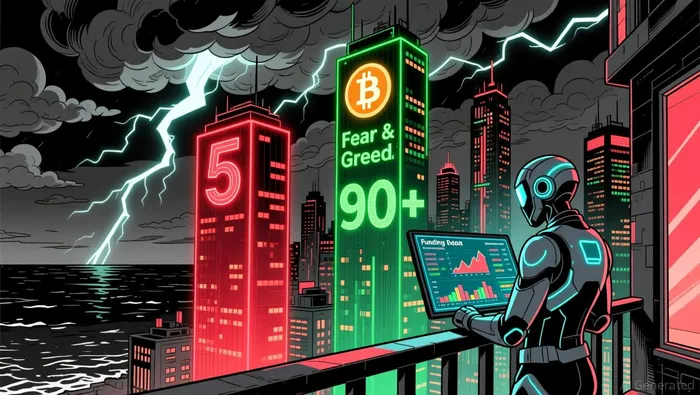
Moreover, large ETF outflows and institutional rebalancing in 2025 have amplified the impact of funding rates on Bitcoin's price trajectory. Traders who monitored these dynamics alongside sentiment metrics were better positioned to navigate liquidity shifts and avoid overexposure during volatile periods according to case studies.
A Preemptive Strategy: Synthesizing Sentiment and Funding Rates
The most robust strategies in 2025 have combined sentiment, funding rates, and volatility metrics into a cohesive framework. For example:
1. Options Overlays: During periods of extreme fear (Fear & Greed Index < 5), buying put options or protective calls can hedge against short-term rebounds while maintaining exposure to long-term trends according to analysis.
2. Futures Hedges: Negative funding rates paired with elevated BVOL suggest a tactical shorting opportunity, particularly when supported by on-chain metrics like declining active addresses according to case studies.
3. AI-Powered Positioning: Multimodal deep-learning models, such as FinAgent, have demonstrated profitability by integrating sentiment, technical indicators, and funding rates. One such model achieved a 92.27% return in a simulated 2025 scenario by dynamically adjusting leverage and position sizes according to research.
These strategies emphasize discipline in position sizing and dynamic hedging, especially during periods of institutional activity or macroeconomic shocks. For instance, in November 2025, traders who used AI bots to monitor sentiment and volatility in real time were able to capitalize on intraday swings while minimizing drawdowns according to market analysis.
Conclusion: Navigating the Next Move
Bitcoin's market remains a complex interplay of sentiment, funding dynamics, and macroeconomic forces. While bearish signals like extreme Fear & Greed readings and negative funding rates can indicate short-term corrections, they also present opportunities for strategic positioning. By adopting a framework that synthesizes sentiment analysis, funding rate monitoring, and volatility-based tools, investors can preemptively navigate the next major market move-whether it be a rebound from a tactical bottom or a deeper correction in a broader downtrend.
As the lines between traditional finance and crypto markets blurBLUR--, the ability to interpret these signals will become a defining factor in achieving alpha in 2025 and beyond.






Comentarios
Aún no hay comentarios