
Bitcoin's Bearish Momentum and Options Market Signals: A Derivative Positioning Analysis
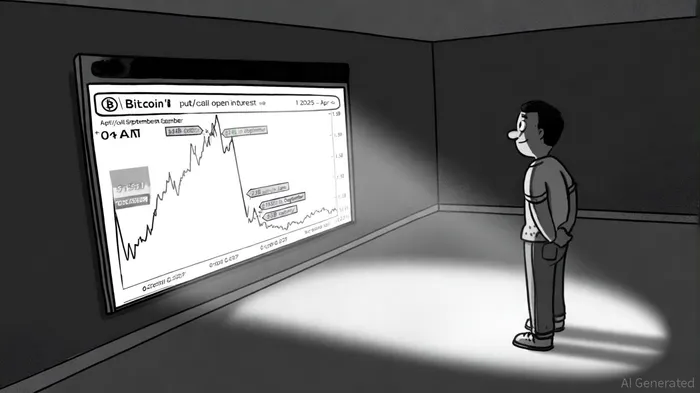
Bitcoin's derivatives market in late 2025 has become a battleground of conflicting signals, with bullish positioning clashing against growing bearish momentum. While call open interest surged to $19.3 billion in April 2025, reflecting optimism about a potential rally[1], the subsequent rise in put/call ratios and max pain levels suggests a market increasingly hedging against downside risks. By August, the put/call ratio had spiked to 1.31, a stark reversal from earlier bullish bias[4], and max pain levels—where the most open options expire—were calculated at $116,000, creating a gravitational pull for price action[4]. This duality underscores a market in transition, where speculative bets and risk management strategies coexist.
Derivative Positioning: From Bullish Optimism to Bearish Caution
The shift in options positioning is most evident in the put/call ratio, a key barometer of market sentiment. In April, the ratio stood at 0.59, indicating strong demand for calls[1]. However, by June, the ratio had risen to 0.72, driven largely by cash-secured put strategies rather than outright bearishness[2]. This trend accelerated through August, with the ratio hitting 1.31, signaling a pronounced bearish bias[4]. Such movements reflect a mix of hedging activity and yield-generation tactics, as traders lock in profits or generate income through put options.
The max pain theory further amplifies bearish signals. In August, Bitcoin's max pain level was calculated at $116,000, meaning that if the price approached this level at expiry, the largest number of option holders would face losses[4]. By September, this level had shifted to $114,000[3], suggesting a gradual downward gravitational pull. These levels act as psychological anchors, potentially triggering stop-loss orders or forced liquidations as expiry dates near.
Bearish Indicators: Skew, GMMA, and Macro Risks
Beyond open interest and max pain, technical indicators reinforce a bearish regime. The 180-day call-put skew on Deribit turned negative 0.42 in August 2025—the most bearish reading in over two years[1]. This skew, which measures the difference in implied volatility between put and call options, reflects heightened demand for downside protection. Similarly, the Guppy Multiple Moving Average (GMMA) has turned bearish, with Bitcoin's price crossing below the moving average bands[1]. This crossover, a classic bearish signal, suggests weakening bullish momentum and potential capitulation.
Macro factors also weigh on sentiment. The anticipation of Federal Reserve rate cuts in late 2025 has led to a “sell the news” dynamic, where traders short BitcoinBTC-- ahead of expected monetary easing[1]. Compounding this, the $23 billion options expiry in late September 2025—part of a broader $8.94 trillion crypto derivatives market—threatens to amplify volatility[5]. Historical trends, such as Bitcoin's historically weak September performance, further exacerbate bearish expectations[4].
The Path Forward: Balancing Risk and Opportunity
While the bearish signals are compelling, the market remains nuanced. Whale accumulation and potential Fed rate cuts could provide a floor for Bitcoin, creating opportunities for a rebound[4]. However, the concentration of put options near the $110,000 strike and the looming $23 billion expiry suggest that volatility will remain a defining feature of late 2025[5]. Traders must navigate this environment with caution, balancing hedging strategies against speculative bets.
In conclusion, Bitcoin's options market in late 2025 reflects a tug-of-war between bullish optimism and bearish caution. While derivative positioning and technical indicators point to a bearish regime, macroeconomic catalysts and historical patterns add layers of complexity. Investors would be wise to monitor max pain levels, expiry dynamics, and Fed policy closely, as these factors will likely dictate Bitcoin's trajectory in the coming months.






Comentarios
Aún no hay comentarios