
Is Bitcoin's Bear Market Inevitable Amid Dwindling Institutional Demand and Fragile Retail Sentiment?
The question of Bitcoin's long-term trajectory has never been more contentious. While institutional adoption and regulatory clarity have propelled BitcoinBTC-- into the mainstream, recent data suggests a growing disconnect between bullish fundamentals and bearish market dynamics. This article examines the structural weaknesses in Bitcoin's demand drivers-particularly institutional and retail sentiment-and deteriorating technical indicators to assess whether a bear market is not just possible, but inevitable.
Structural Weaknesses in Institutional Demand
Bitcoin's institutional demand, once a cornerstone of its bull case, is showing signs of fatigue. Despite 86% of institutional investors holding or planning to allocate to digital assets by 2025, key segments of this demand are contracting. Public companies and ETF-like vehicles, which held 12% of Bitcoin's total supply, have ceased expanding their holdings, removing a critical source of marginal demand according to analysis. Spot Bitcoin ETFs, once a symbol of institutional validation, have shifted from accumulation to distribution, reducing net holdings by approximately 24,000 BTC. This reversal signals a loss of confidence in Bitcoin's ability to outperform traditional assets in a tightening macroeconomic environment.
The structural underpinnings of institutional demand are further fraying. 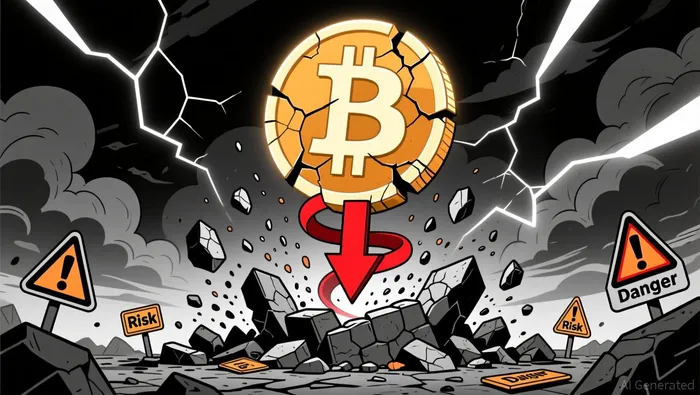 . Bitcoin's price has fallen 28% from its January 2025 peak of $109,350 to $78,000, eroding the asset's appeal as a hedge against inflation and fiat devaluation. Corporate treasury demand, a once-vibrant segment, has weakened due to falling prices and balance-sheet pressures according to research. Meanwhile, the U.S. Federal Reserve's delayed monetary easing has constrained risk appetite, leaving institutional investors with fewer incentives to allocate capital to a high-beta asset like Bitcoin according to analysis.
Retail Investor Fragility and Macroeconomic Shifts
Retail investor behavior, historically a double-edged sword for Bitcoin, has grown increasingly fragile. Q4 2025 data reveals a stark divergence between historical patterns and current performance: Bitcoin, which historically gains 77% on average in December, has declined over 20% for the quarter. This underperformance is compounded by a shift in capital from crypto to AI and machine learning, sectors that have absorbed venture funding while crypto startups face declining investment according to analysis.
Retail sentiment surveys reflect this fragility. While 57% of Charles Schwab traders remain optimistic about Bitcoin's performance in Q4 2025, two-thirds believe the market is overvalued, particularly in AI and tech sectors according to survey results. Political uncertainties in Washington, D.C., further amplify caution, with 21% of traders fearing market corrections or volatility according to survey data. This hesitancy is mirrored in on-chain metrics: Bitcoin's price has broken below the short-term holder (STH) cost basis, signaling a structural breakdown in retail accumulation according to on-chain analysis.
Deteriorating Technical Indicators
Technical analysis paints a grim picture for Bitcoin's near-term prospects. The SuperTrend indicator has turned red on the weekly BTC chart, confirming a bearish phase. The Death Cross-where the 50-day moving average crosses below the 200-day moving average-has emerged as a classic bear market signal. Bitcoin's price has also fallen below the 365-day moving average, a historically significant threshold separating bull and bear markets.
On-chain metrics reinforce this bearish narrative. The Bull Score index, which tracks ten critical metrics, shows eight turning bearish, including miner activity and exchange positioning according to analysis. The RSI reading of 20, reflecting extreme pessimism, and the Crypto Fear and Greed Index at an extreme fear level of 11 according to data, further underscore the market's fragility. Fibonacci retracement levels suggest Bitcoin could fall as low as $67,000 if the bearish trend continues according to market analysis.
The Inevitability of a Bear Market
The convergence of structural demand weaknesses and deteriorating technical indicators points to an inevitable bear market. Institutional demand, once a tailwind, is now a headwind as ETFs and corporate treasuries reduce exposure. Retail investors, meanwhile, are caught in a macroeconomic crossfire between AI-driven capital reallocation and political uncertainty. Technically, Bitcoin is trapped in a downward spiral, with key indicators aligning to confirm a bearish phase.
While long-term fundamentals-such as Bitcoin's fixed supply and regulatory progress-remain intact, the immediate outlook is bleak. The market must first digest the $77 billion in new supply expected by 2030 against a backdrop of $3 trillion in projected institutional demand. Until this imbalance resolves, Bitcoin's bear market will persist, testing the patience of even the most bullish investors.






Comentarios
Aún no hay comentarios