
Bitcoin Bear Market Dynamics: Key Price Levels and Strategic Entry Opportunities
Technical Liquidity Structures: Key Support Levels and Market Behavior
Bitcoin's current bearish trajectory has brought it to pivotal support zones that could determine the depth of the correction. The $90,000–$95,000 range has emerged as a critical area of focus, with on-chain data revealing that long-term holders (LTHs) have contributed to over $722 million in realized losses as of early 2025 according to Coinotag. This selling pressure, driven by LTHs accounting for 60% of total losses, mirrors historical patterns preceding 15–20% corrections as data shows.
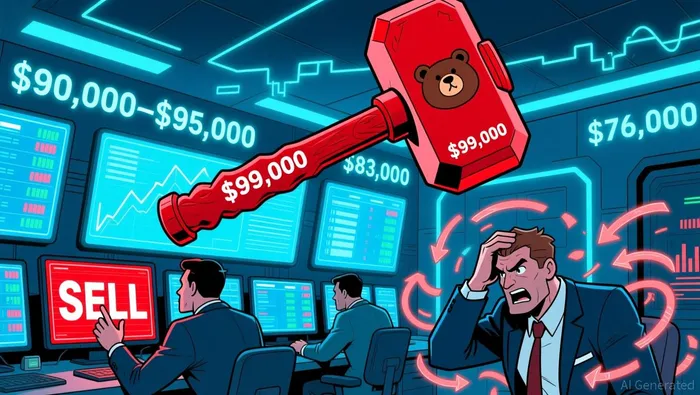
If this support zone fails, the next liquidity cluster lies around $83,000, identified by CoinGlass as a "bright" area of concentrated leveraged positions according to CoinGlass analysis. A breakdown here could trigger cascading liquidations, potentially resetting technical indicators and creating short-term buying opportunities. However, a failure to hold above $83,000 would likely extend the correction to $76,000–$78,000, where deeper stop-loss orders and reduced leverage may stabilize the market according to market analysis.
The interplay between these levels and broader market psychology is evident in the recent hammer candlestick formation at $99,000, suggesting a potential near-term bottom according to Investing.com analysis. Traders are advised to monitor volume and Fibonacci retracement levels (e.g., 61.8% at ~$83,000) for confirmation of reversals according to CAIA research.
Macro Sentiment Shifts: Trade Wars, Fed Policies, and Investor Sentiment
Bitcoin's macroeconomic environment remains fraught with uncertainty. The U.S.-China trade war, exacerbated by a 100% tariff hike on Chinese imports in October 2024, triggered an 18% price drop within days, highlighting the asset's sensitivity to global risk aversion according to Markets.com analysis. While a temporary truce at the APEC summit eased tensions, BitcoinBTC-- struggled to reclaim its 200-day moving average, underscoring structural fragility as reported.
Monetary policy remains a double-edged sword. The Federal Reserve's delayed rate cuts and hawkish rhetoric have dampened bullish momentum, even as long-term holders continue offloading positions according to Markets.com analysis. Conversely, U.S. consumer sentiment reveals a contrasting narrative: 60% of crypto-aware Americans anticipate price gains under a potential Trump administration, with 46% expecting regulatory tailwinds to boost adoption according to Security.org data. This optimism, however, is tempered by security concerns, with 20% of crypto owners reporting access issues to custodial platforms as found in the annual report.
Strategic Entry Opportunities: Balancing Technical and Macro Signals
For investors seeking entry points, the convergence of technical and macroeconomic factors offers a framework for risk management. A breakdown below $83,000 could create a "buy the dip" scenario if liquidity loosens-potentially catalyzed by the Fed ending quantitative tightening (QT) in December or a resolution to the U.S. government shutdown according to Investing.com analysis. Such events could reverse the Treasury General Account (TGA)'s liquidity drain, which currently sits at $1 trillion according to Investing.com analysis.
Strategically, traders might consider:
1. Range-bound strategies between $76,000–$83,000, using Fibonacci retracements and volume spikes to time entries according to CAIA research.
2. Hedging against macro risks by allocating a portion of capital to gold or U.S. Treasuries during periods of heightened geopolitical uncertainty according to Markets.com analysis.
3. Monitoring LTH behavior, as continued selling could prolong bearish momentum despite favorable technical setups according to Coinotag data.
Conclusion
Bitcoin's bear market dynamics in 2024–2025 reflect a tug-of-war between technical liquidity clusters and macroeconomic headwinds. While key support levels like $83,000 and $76,000 offer potential inflection points, macro factors-including trade tensions and Fed policy-remain critical variables. Investors must remain agile, leveraging both on-chain data and macroeconomic signals to navigate this volatile phase. As the market tests its resilience, disciplined risk management and a nuanced understanding of these dual forces will be paramount.







Comentarios
Aún no hay comentarios