
Bitcoin-Backed Lending as a High-Growth, Institutional-Grade Liquidity Play in 2025: Strategic Positioning in a Fast-Consolidating CeFi Market
Institutional Adoption and Market Expansion
Bitcoin-backed lending has evolved from a niche DeFi experiment to a mainstream financial tool, with institutions now treating BitcoinBTC-- as a legitimate collateral asset. JPMorgan's announcement to allow institutional clients to use Bitcoin and EthereumETH-- as collateral for loans by late 2025 marks a watershed moment. This move notNOT-- only legitimizes crypto as a collateral class but also addresses liquidity constraints for institutions holding large crypto portfolios. Analysts estimate such initiatives could inject an additional 10–15% liquidity into the market within a year, reducing selling pressure on Bitcoin and Ethereum while expanding institutional access to capital.
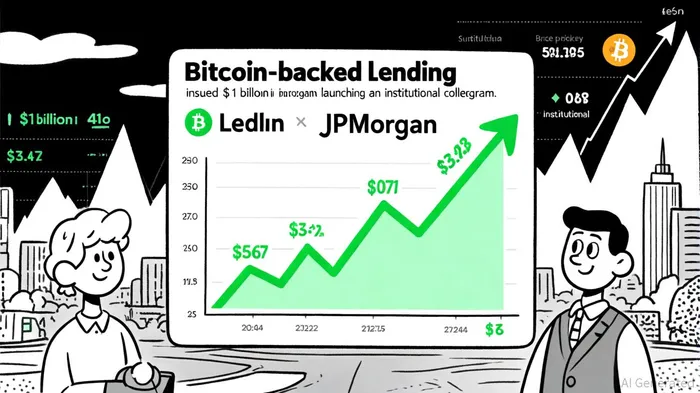
The market's growth is further underscored by platforms like Ledn. A Ledn report shows $392 million in Bitcoin-backed loans for Q3 2025, with year-to-date figures surpassing $1 billion and cumulative totals reaching $2.8 billion since inception. These numbers reflect a sector in hypergrowth, fueled by Bitcoin's bull market and the demand for non-dilutive liquidity solutions. Maple Finance's CEO, Sid Powell, has even predicted a 10x expansion in Bitcoin-backed lending over three years, projecting a $200 billion market by 2028, according to a Maple CEO interview. Such forecasts highlight Bitcoin's role as a "wealth engine," akin to real estate, and its potential to redefine credit markets.
Consolidation and Strategic Positioning in CeFi
As the market matures, consolidation is accelerating among CeFi players, with strategic partnerships and infrastructure innovations defining competitive advantage. Gate Ventures' acquisition of ADEN, a decentralized perpetual exchange (Perp DEX), exemplifies this trend. By integrating ADEN into its ecosystem, GatePORTAL-- is bridging CeFi and DeFi through its LayerLAYER-- 2 network, Gate Layer Chain, which leverages the OP Stack and EVM compatibility. This move enhances scalability, reduces fees, and enables seamless cross-chain interoperability via LayerZeroZRO--, catering to institutional-grade participants seeking deep liquidity and security.
The consolidation narrative is further amplified by the dominance of top lenders like TetherUSDT-- and Galaxy, which collectively control nearly 89% of the CeFi market. Cantor Fitzgerald's entry into the space-through a $2 billion-backed partnership with Maple FinanceSYRUP-- and FalconX-underscores the sector's institutional appeal. These partnerships are not merely about capital but about building infrastructure that supports institutional participation, from custodial solutions to regulatory compliance frameworks.
Investment Implications and Future Outlook
The Bitcoin-backed lending market is poised to grow from its current $2.8 billion cumulative loan base to an estimated $45 billion by 2030, driven by both institutional and retail adoption. For investors, strategic positioning hinges on identifying players that combine robust infrastructure, regulatory alignment, and cross-chain interoperability. JPMorgan's entry, for instance, signals a shift toward traditional finance (TradFi) integration, while Gate's ADEN acquisition highlights the importance of DeFi-compatible CeFi platforms.
However, risks remain, including regulatory uncertainty and volatility in Bitcoin's price. Yet, the sector's rapid adoption and institutional validation suggest these challenges are being mitigated through custodial innovations (e.g., multi-signature wallets and third-party custodians) and diversified collateral models.
Conclusion
Bitcoin-backed lending is no longer a speculative niche but a high-growth, institutional-grade liquidity play. As CeFi consolidates and bridges with DeFi, the winners will be those that prioritize infrastructure innovation, strategic partnerships, and institutional-grade security. For investors, the key is to align with platforms that are not only capturing market share but also redefining the future of digital asset finance.







Comentarios
Aún no hay comentarios